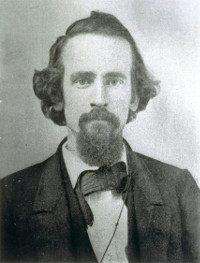
Henry George (2 September 1839 – 29 October 1897) was an American political economist and journalist. His writing was immensely popular in the 19th century, and sparked several reform movements of the Progressive Era. His writings also inspired the economic philosophy known as Georgism, based on the belief that people should own the value they produce themselves, but that the economic value derived from land (including natural resources) should belong equally to all members of society.
Reference
Henry George (1839-1897), by Charles L. Hooper, The Concise Encyclopedia of Economics
Includes picture and list of selected works with links to those hosted by the Library of Economics and Liberty
Henry George is best remembered as a proponent of the 'single tax' on land. The government should finance all of its projects, he argued, with proceeds from only one tax. This single tax would be on the unimproved value of land—the value that the land would have if it were in its natural state with no buildings, no landscaping, and so on. George's idea was not new; it was largely borrowed from David Ricardo, James Mill, and John Stuart Mill.
A prolific author who was a strong defender of free trade and an advocate of the idea of a single tax on land. George believed that a single tax on land would be sufficient to fund government activities. It would be based upon the unimproved value of the land.
Nock embraced ideas of crusading economic reformer Henry George. "As a social philosopher, George interested me profoundly," Nock recalled, "... George's philosophy was the philosophy of human freedom ... he believed that all mankind are indefinitely improvable, and that the freer they are, the more they will improve. He saw also that they can never become politically or socially free until they have become economically free." ... Nock did a book-length essay on Henry George (1939), drawing substantially on the two-volume biography by Henry George Jr.
America as Utopia, by Robert Nisbet, Reason, Mar 1987
Historical survey of the "American Religion" (America as "the city upon a hill") from the Pilgrims to the present and questions whether it will progress further in the near future
It is sometimes forgotten that Henry George's classic Progress and Poverty, justly famous for its brilliantly conceived single tax, on land, had its origins, by the author's own acknowledgement, not in musings upon poverty but upon progress. Everything, with but one exception, he believed, bespoke the fulfilled progress of mankind in his day. This one exception was the persistence of poverty. To repair poverty—and the single tax would effect this—was to add the final step to a then-complete stairway to perfection, to utopia.
Tucker severely criticized Henry George, the founder of the single-tax movement, and he devoted considerable space in Liberty to refuting George, only once quoting him with favor in regard to patents. The two single-tax papers significantly mentioned in Liberty were the Philadelphia Justice and Henry George's The Standard ... [Tucker's] pamphlet Henry George, Traitor was written to prove "that the leader of the Single Taxers was a hypocrite and coward in his sanctioning of the hanging of the Chicago Communists."
Blockading with Trade Restrictions, by Jim Powell, 27 Oct 2010
Explores the writings of Henry George in his book Protection or Free Trade (1879) offering advice to current waves of protectionism
Milton Friedman believed that the rhetorically most effective critique of trade restrictions was Henry George's book Protection or Free Trade (1879) ... [George] realized that if tariffs were really good, then civilization would have begun where people were cut off from the outside world by mountains, oceans, deserts and other natural barriers. But, he explained, "it is where trade could best be carried on that we find wealth first accumulating and civilization beginning. It is on accessible harbors, navigable rivers and highways that we find cities arising and the arts and sciences developing."
[Fetter] read the books and periodicals ... which included Henry George's Progress and Poverty, the book that influenced his decision to choose economics as a career ... "Henry George's semi-communistic doctrine of land confiscation, based on the labor theory, or rent feature of it," argued Fetter, "impelled [economists of the latter sixties] to re-examine the theory of value..." ... The subjective-value rejoinder to the Marxist and Georgist attack was to be found, said Fetter, in the capital value concept of J.B. Clark and ... Wieser's Natural Value and in Böhm-Bawerk's ...
Frank Chodorov: A Libertarian's Libertarian, by Joseph R. Stromberg, The Old Cause, 30 Nov 1999
Biographical essay on Frank Chodorov with emphasis on his foreign policy views, and his debates about the Cold War with William F. Buckley Jr. and William S. Schlamm in the pages of The Freeman
An important influence on Chodorov was the writings of Henry George, apostle of free trade, free markets, and–unfortunately, some would say–the "Single Tax" on land, which was supposed to alleviate the evils of rent and private land-ownership. Sometime in the 'teens he read George's Progress and Poverty, which had a profound impact on his world-outlook. In 1941 he wrote of George: "His is the philosophy of free enterprise, free trade, free men."
Henry George and the Tariff Question, by Karen De Coster, Mises Daily, 19 Apr 2006
After some introductory remarks and a biographical section on Henry George, examines the protective tariff arguments posed by George in Protection or Free Trade
American economist Henry George is best known for his 1879 treatise Progress and Poverty, for which Albert Einstein designated George a "beautiful combination of intellectual keenness, artistic forum, and fervent love of justice" ... George (1839-1897) ... was born in Philadelphia, but settled in California in his teens. After failed attempts at gold mining, he ended up in the newspaper industry, where he developed his exceptional talents for writing and analyzing political economy. He had no formal training in economics, in spite of his many superb books on the topic.
Murray Rothbard's Philosophy of Freedom, by David Gordon, The Freeman, Nov 2007
Examines the arguments made by Rothbard that, given the premise that slavery is wrong, self-ownership, private property rights and a free market without government interventions follow
Parcels of land do not come into the world with persons' names attached; and Rothbard firmly rejects the Georgist contention that everyone owns all land collectively. "Some critics," he writes in ... Man, Economy, and State, "especially the Henry Georgists, assert that, while a man or his assigns may be entitled to the produce of his own labor or anything exchanged for it, he is not entitled to an original, nature-given factor, a 'gift of nature.' For one man to be able to appropriate this gift is alleged to be an invasion of a common heritage that all men deserve to use equally ..."
The Physiocrats, by Wendy McElroy, Freedom Daily, Dec 2010
Discusses the 18th century French economists and their influences on Adam Smith, on American agriarianism and on Henry George
[Henry] George believed land to be the common property of mankind and, so, argued for financing government through a single tax on those who used this "common" property. The tax would be on the unimproved value ...; that is, on the land in its natural state without crops, homes, or other contributions of labor. Although several economists ... had espoused a similar idea, George drew directly on the Physiocrats' advocacy of an "impôt unique." This was a tax on unimproved land that landowners would pay to the king as a means to finance all expenses and so eliminate the need for other taxation.
Part of Nock's view is colored by his position on land ownership. Nock was a follower of Henry George, who held that no individual has the right to the value of land per se because that value is created not by the putative owner, but by the community. Thus that value should be taxed for the benefit of the community the famous single tax. (The individual user of land, however, did have the right to the fruits of his labor.) For George and Nock, a host of evils grow out of a Lockean notion of property ownership, including land speculation and scarcity.
George radically championed the individual and her rights while calling for the abolition of private property in land, crafting a governmental system through which he claimed "to unite the truth perceived by the school of Smith and Ricardo to the truth perceived by the school of Proudhon and Lasalle." Through his masterwork Progress and Poverty, George undertook "to show that laissez faire (in its full true meaning) opens the way to a realization of the noble dreams of socialism." We may therefore regard George as a unique kind of limited government socialist ...
Some reflections on Georgism, by Tibor R. Machan, Rational Review, 29 Jul 2004
Argues against the Henry George idea that since land was not made by any individual, nobody can claim ownership rights over it
In his famous book, Progress and Poverty, Henry George argues that there is at least one value that should not be privately owned. No one can claim the right to any land since no one has produced it ... [A] person is himself or herself a combination of factors he has and has not created—one's physique versus one's character. There is, however, the Georgist response to this that land is the only scarce value among all these, so while in other cases acquisition also involves appropriation in no other case than land ownership does such appropriation serve to deplete the value in question.
A Tax Even Libertarians Could Love?, by Matt Zwolinski, LearnLiberty.org, 4 Mar 2016
Discusses Henry George's proposal for a Single Tax and his moral and economic arguments in favor of imposing the tax
In 1879, an American social theorist named Henry George wrote a book entitled Progress and Poverty in which he proposed an intriguing answer to this question: government financing should be derived from one "Single Tax." And that tax should be not on income, or on consumption, but on land. By "land," George meant ... all natural resources ... Anything that exists independently of human activity but which can nevertheless be appropriated and used for human purposes is a natural resource, and the unimproved value of such resources is a legitimate object of George's Single Tax.
Mutualism: An interview with Kevin Carson, by Kevin Carson, The Isocracy Network (interviewer), 3 Nov 2009
Topic discussed include: mutualism in theory and practice, worker cooperatives and credit unions, small-scale manufacturing, Henry George, worker-managed firms, Lockean land ownership concepts, labor theory of value and political coalitions
A follower of Henry George would argue in the realm of natural resources it would be impossible for success and that land-rents should be socialised. How would you respond ...? I'm quite friendly to George, and think the lines between individualism and Georgism are a lot less harsh than (say) Tucker would have believed. But I believe a great deal of rent could be eliminated simply by removing subsidies to economic centralization and positive externalties I think a majority of George's aims could be achieved by Tucker's means, or even by a throughgoing application of Rothbard's means.
Progress and Poverty: An Inquiry in the Cause of Industrial Depressions and of Increase of Want with Increase of Wealth...The Remedy, 1879
Partial contents: Wages and Capital - Population and Subsistence - The Laws of Distribution - Effect of Material Progress Upon the Distribution of Wealth - The Problem Solved - The Remedy - Justice of the Remedy - Application of the Remedy
ISBN 091131279X: Hardcover, Robert Schalkenbach Foundation, Reprint edition, 1992
The Henry George Historical Archives, by Henry George School of Social Science, 29 Jul 2015
About four minutes of Henry George biographical introduction followed by a program of lectures and interviews at the reopening of the Henry George birthplace and the opening of the Henry George Archive Center