
Thirty-sixth president of the United States
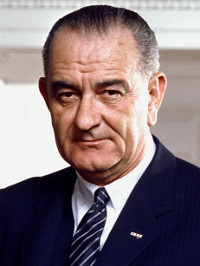
Lyndon Baines Johnson (27 August 1908 – 22 January 1973), often referred to by his initials LBJ, was an American politician who served as the 36th President of the United States from 1963 to 1969, assuming the office after having served as the 37th Vice President of the United States from 1961 to 1963. A Democrat from Texas, he also served as a United States Representative and as the Majority Leader in the United States Senate. Johnson is one of only four people who have served in all four federal elected positions.
Born
Articles
The American Heritage of "Isolationism", by Gregory Bresiger, Freedom Daily, May 2006
Criticizes the use of the word "isolationist" by the media, "internationalists" and other foreign intervention promoters, looking at the heritage of noninterventionism as exemplified by Washington's Farewell Address
Criticizes the use of the word "isolationist" by the media, "internationalists" and other foreign intervention promoters, looking at the heritage of noninterventionism as exemplified by Washington's Farewell Address
[Americans] have often voted for presidential candidates they thought would keep the nation at peace but instead led the nation into wars and more wars. For example, in the 1964 presidential election Americans overwhelmingly voted for Lyndon Baines Johnson. He campaigned as a moderate peace candidate and portrayed Goldwater as an extremist war candidate. Johnson ended up greatly expanding the American commitment to Vietnam, with some 500,000 troops sent to Southeast Asia. He left office in 1969 as one of the most hated men in America. He wouldn't even attempt to run for reelection.
Bill Kauffman: American Anarchist, by Laurence M. Vance, 4 Dec 2006
Review of Kauffman's Look Homeward, America: In Search of Reactionary Radicals and Front-Porch Anarchists (2006)
Review of Kauffman's Look Homeward, America: In Search of Reactionary Radicals and Front-Porch Anarchists (2006)
Lyndon Johnson in particular incurs Kauffman's wrathful prose. LBJ was "the homicidal Texan in the White House." On Johnson's radio ads imploring Americans to support the troops in Vietnam: "That Americans might best 'support our troops' by reuniting them with their families seems never to occur to those who would choke the country with their yellow ribbons." And on the connection between Johnson's war on poverty and Vietnam: "Johnson declared war on poverty, which he apparently intended to win by killing as many poor boys as possible in Vietnam."
Related Topics: George W. Bush, Abraham Lincoln, The State, Vietnam War, War, George Washington, World War II
Do Elections Guarantee Freedom?, by James Bovard, Freedom Daily, Nov 2007
Discusses whether democratic elections achieve the purported objective of "will of the people" controlling the government
Discusses whether democratic elections achieve the purported objective of "will of the people" controlling the government
President Lyndon Johnson declared in 1965 that the vote is the most powerful instrument ever devised by man for breaking down injustice and destroying the terrible walls which imprison men because they are different from other men ... During the election campaign the prior year, Johnson had promised, "We are not about to send American boys 9,000 or 10,000 miles away to do what Asian boys ought to be doing to protect themselves." The fact that parents could vote for or against Johnson did nothing to stop him from betraying his promise and sending their sons to die.
Related Topics: George W. Bush, Bill Clinton, United States Constitution, Government, Ronald Reagan, Voting
Ellsberg's Lessons for Our Time, by James Bovard, Freedom Daily, May 2008
Reviews Daniel Ellsberg's Secrets: A Memoir of Vietnam and the Pentagon Papers (2003) and points out how its commentary applies to the then current conflict in Iraq
Reviews Daniel Ellsberg's Secrets: A Memoir of Vietnam and the Pentagon Papers (2003) and points out how its commentary applies to the then current conflict in Iraq
[O]n the day the Gulf of Tonkin crisis ignited ... the [USS Maddox]'s commander had wired Washington that the reports of an attack on his ship may have been wildly exaggerated ... But it didn't matter, because this was just the pretext that Lyndon Johnson was looking for. Johnson and Defense Secretary Robert McNamara raced to proclaim that the attack was unprovoked ... [T]he United States had orchestrated an attack by South Vietnamese commandos on North Vietnamese territory before the alleged conflict began. But Johnson lied and commenced bombing, and Congress rushed to cheer him on.
The Ethics of Voting: Part Three [PDF], by George H. Smith, The Voluntaryist, Apr 1983
Examines, among other things, whether a libertarian can be employed by or hold office in a State entity
Examines, among other things, whether a libertarian can be employed by or hold office in a State entity
In a war crimes trial, President Johnson would not be as liable for a particular murder as the person who physically committed the act. But Johnson shares some liability for a vast number of similar acts. His degree of liability for a particular murder may be less, but his range of liability is far greater ... when we say that President Johnson was "more resonsible" for murders than individual bomber pilots, we mean: (1) [he], utilizing the power of his office, made fundamental decisions that set the State apparatus in motion. (2) [he] was responsible, to whatever degree, for a broader range of casualties ...
Related Topics: Government, Politicians
The Urge to 'Surge', by Justin Raimondo, 15 Dec 2006
Discusses reactions to the Iraq Study Group suggestion supporting "a short-term redeployment or surge of American combat forces to stabilize Baghdad"
Discusses reactions to the Iraq Study Group suggestion supporting "a short-term redeployment or surge of American combat forces to stabilize Baghdad"
If that happens, then George W. Bush will complete his metamorphosis into another Texan in the White House who had to deal with an unpopular war: Lyndon Baines Johnson. We'll have "jobs programs" – and, no doubt, "poverty pimps" (remember them?) ... The "angry young men" of 1960s urban America were neither appeased nor bought off ... President Johnson, you'll remember, launched his War on Poverty in tandem with escalating the Vietnam War, and the political rhetoric and objectives of these losing campaigns were remarkably similar. Both were pacification programs, and they failed in Vietnam, as well as in South Central Los Angeles.
Related Topics: George W. Bush, Imperialism
The introductory paragraph uses material from the Wikipedia article "Lyndon B. Johnson" as of 26 May 2018, which is released under the Creative Commons Attribution-Share-Alike License 3.0.