Reference
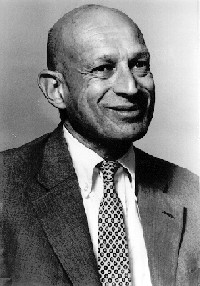
Simon, Julian (1932-1998), by
Donald J. Boudreaux,
The Encyclopedia of Libertarianism, 15 Aug 2008
Biographical essay
Julian Simon was one of the most underappreciated economists of the 20th century. ... Although Simon wrote on an unusually wide range of topics—including statistical methods and mental depression—Simon's greatest contribution to economics is his refinement of the idea that humans are 'the ultimate resource.' Simon argued there are no resources without human creativity to figure out how to use them and human effort to actually do so. ... Population researcher Paul Ehrlich found Simon's optimism about population growth to be so absurd that he famously accepted a bet offered by Simon in 1980.
Born
12 Feb
1932, Julian Lincoln Simon, in Newark,
New Jersey
Biography
Laissez Faire Books
Julian Simon (1932-1998) used scientific methods to demonstrate that free people can achieve unlimited material progress. ... As early as 1965, he had done some research showing that population growth had positive effects ... Simon's most important book, The Ultimate Resource, was published in 1981. He cited plenty of historical experience to show that the human mind is the most important resource, because resourceful people keep finding ways to extract natural resources more efficiently, to economize in their use of resources, to find substitutes when things run out, and so on.
Associations
Independent Institute, In Memoriam Research Fellow
Articles
35 Heroes of Freedom, by
Reason,
Reason, Dec 2003
"Eclectic, irreverent" list of individuals "who have made the world a freer, better, and more libertarian place by example, invention, or action", as chosen by
Reason editors (includes the unknown martyr of Tiananmen Square and "The Yuppie")
Julian Simon. In books such as The Ultimate Resource and The State of Humanity, the late "Doomslayer" patiently and exhaustively collected the data proving that neo-Malthusians such as Paul Ehrlich and Lester Brown were blowing smoke about environmental degradation and overpopulation. More impressive still: This oracle of optimism suffered from depression much of his adult life.
Barack Obama: The Anti Economic Growth President, by
Jim Powell, 29 Feb 2012
Lists and criticizes several of Obama's policies and proposals and discusses why economic growth and progress is beneficial
Human progress began eons before there were modern welfare states, and it has continued up to the present wherever governments weren't disrupting markets with taxation, regulation, expropriation or war. Economist Julian Simon noted that 'In the nineteenth century, the planet Earth could sustain only one billion people. Ten thousand years ago, only 4 million could keep themselves alive. Now, more than 5 billion people are living longer and more healthily than ever before, on average.'
The Doomslayer, by
Ed Regis,
Wired, Feb 1997
Lengthy essay about Simon, his research and writings, as well as critical views on his positions
This is the litany: Our resources are running out. The air is bad, the water worse. ... There's just one problem with The Litany ... each and every last claim, is false. ... Thus saith The Doomslayer, one Julian L. Simon, a neither shy nor retiring nor particularly mild-mannered professor of business administration at a middling eastern-seaboard state university. ... These, he says, are the actual and empirical facts ... Simon first got a taste of those facts while studying the data amassed by the economic demographer Simon Kuznets (winner of the 1971 Nobel Prize in economics) and by economist Richard Easterlin, in the mid-1960s.
Julian L. Simon - Hero of the Day, by John C. LeGere,
The Daily Objectivist, 2000
Biographical profile published by
The Daily Objectivist
When Paul Ehrlich, author of The Population Bomb, argued that humanity was a menace to the ecosystem, ... a demoralized country listened. ... The counter-offensive came from an obscure professor of business economics named Julian Simon ... With cheerful insouciance and a mountain of facts, Simon demonstrated that the ultimate resource is not oil or copper, it is 'people—skilled, spirited, and hopeful people who will exert their wills and imaginations for their own benefit, and so, inevitably, for the benefit of us all,' and that 'the world's problem is not too many people, but lack of political and economic freedom.'
Julian Simon, combatant in a 200-year war, by
Thomas Sowell, 12 Feb 1998
Memorial essay, pointing out that Simon's death occurred near the 200th anniversary of Thomas Malthus'
Essay on the Principle of Population, and describing his famous bet with Paul Ehrlich
A professor of economics at the University of Maryland, Julian Simon wrote fact-filled books about population—all of them exposing the fallacies of those who were promoting "overpopulation" hysteria ... With a full understanding of the opposition and smears he would encounter, Julian Simon nevertheless wrote The Economics of Population Growth, Population Matters, and—his best-known book—The Ultimate Resource. To him, the ultimate resource was human intelligence. We should also add, in honor of Julian Simon, the courage to use that intelligence.
Julian Simon, Lifesaver, by
Donald J. Boudreaux,
The Freeman, Apr 1998
Reflections on the passing of Julian Simon; opening quote: "The real issue is not whether one cares about nature, but whether one cares about people",
The Ultimate Resource 2 (1996)
While pessimism-pushers ... received the mainstream media's reverence, during his life Julian received mostly scorn for showing that the world is not on the brink of an environmental and population calamity. His only consolation was that truth was his constant ally. Julian's foremost contribution to humankind was his demonstration that prosperity and a healthy environment are best assured when governments respect private property and free market—because only within free markets can human creativity flourish. In his magnum opus, The Ultimate Resource 2 ... Julian showed that ours is not a world of fixed resources.
Julian Simon Remembered: It's a Wonderful Life, by
Stephen Moore,
Cato Policy Report, Mar 1998
In memoriam by one of Simon's students, research assistant and co-author of the posthumous
It's Getting Better All the Time
I first met "doom-slayer" Julian L. Simon at the University of Illinois in the spring of 1980—at just the time when the environmental doomsday industry had reached the height of its influence and everyone knew the earth was headed to hell in a hand basket ... [He] was the person who brought me to Washington in 1982 ... So for more than 15 years I was privileged to occupy a front-row seat from which I watched as Simon thoroughly and often single-handedly capsized the prevailing Malthusian orthodoxy. He routed nearly every prominent environmental scaremonger of our time: from the Club of Rome, to Paul Ehrlich, ... to Al Gore.
Writings
Natural Resources Aren't Finite,
Cato Institute Commentary, 4 Mar 1997
Discusses losses incurred by commodities traders and investment managers who believed that prices of commodities must rise because there is a "finite" stock of natural resources on Earth
Why did the trading arm of the Japanese firm Sumitomo recently lose more than a billion dollars in its commodities trading operations? Because its copper trader believed that copper prices had to go up eventually. Why did a recent article in The Wall Street Journal report that, 'Despite Risks, Colleges Dabble in Commodities'? Because the investment managers for Harvard and other universities do not understand that the prices of commodities fall over the long term. ... I continue to stand on the ground of non-finiteness, because I have found that leaving this ground causes more bad arguments than standing on it does.
On Keynes as a Practical Economist,
The Freeman, Aug 1996
Brief discussion of the predictions made by Keynes, in his 1919 book
The Economic Consequences of the Peace, about probable shortages of certain natural resources in the United States and Europe after World War I
John Maynard Keynes's contemporaries thought that he was the cleverest mortal of the century (putting aside such immortals of physical science as Einstein). Bertrand Russell said of Keynes's intellect that it was 'the sharpest and clearest that I have ever known. When I argued with him, I felt that I took my life in my hands, and I seldom emerged without feeling something of a fool.' ... Millions of plain American farmers had a far better grasp of the agricultural reality in the 1920s than did Keynes. So much for Keynes's wisdom as an economist and a seer into the future.
The State of Humanity: Good and Getting Better, by
Sheldon Richman, Julian Simon, 11 Nov 1996
Contrasts the pessimistic 1980 prediction, made in the
Global 2000 Report to the President, about the probable state of the world in the year 2000 with the actual state in the mid-1990's.
In 1980 the Global 2000 Report to the President began by stating that "if present trends continue, the world in 2000 will be more crowded, more polluted, less stable ecologically, and more vulnerable to disruption than the world we live in now." The introduction to The Resourceful Earth (edited by Julian Simon and the late Herman Kahn) revised that passage ... Our message certainly is not one of complacency. The ultimate resource is people — especially skilled, spirited and hopeful young people endowed with liberty — who will exert their wills and imaginations for their own benefit and inevitably benefit the rest of us as well.
What About Immigration?,
The Freeman, Jan 1986
Examines the economic impact of immigration to the United States, including actual levels of legal and illegal immigration, effect on unemployment, wages, services used, taxes paid and productivity
Immigration is one of the most important topics of our times. The issue seems to pit (though it really does not) two fundamental values against each other—lending a helping hand to strangers and ensuring the economic self-interest of family and community. Also involved are values that may not appeal to all ...
We do not even need to raise the ethical issue of drawing a boundary around our nation and saying that those lucky enough to be born within are entitled to opportunities that we deny to others. immigration is good for ourselves at the same time that it is good for the immigrants.
Interviews
Interview with David Kelley, by
David Kelley,
Raymie Stata (interviewer),
Full Context, Jun 1993
Topics discussed include: the Institute for Objectivist Studies, ties between IOS and classical liberal institutions, the Objectivism movement, the split with the Ayn Rand Institute, the marketplace of ideas, open questions in philosophy, and psychology
Kelley: ... Julian Simon once told me something interesting as he was getting involved in a cable narrow-casting venture. He said something like the following: "I figure that our ideas are so much better than theirs that if we get 1/10 the exposure we'll win. It used to be that we got zero exposure because all the media were centralized. Now we may only be reaching a 1/10 of the audience that the bad guys are, but if we can reach that 1/10 with our ideas we'll win." I think there's something to that; I would encourage people to explore every opportunity open to them.
Books Authored
Hoodwinking the Nation, 1999
Partial contents: The Concepts That Lead to Scares about Resources and Population Growth - Why Does the Public Not Hear Sound Environmental Thinkers - Damn Lies, Statistics, and Doomsday - Personal Knowledge versus Medis-Shaped Opinions
It's Getting Better All the Time: 100 Greatest Trends of the Last 100 Years
by
Stephen Moore, Julian Simon,
Cato Institute, 2000
Partial contents: Health - Diets and Nutrition - Wealth - The State of Poor Americans - The State of Children and Teens - The American Worker - Leisure, Recreation, and Entertainment - Housing - Transportation, Innovation, and Scientific Progress
A Life Against the Grain: The Autobiography of an Unconventional Economist, 2002
Partial contents: My Mind as a Young Person - In the Fleet - Working in the Advertising Business - Research on Population Economics - The Joy of Studying Immigration - The Airline Oversales Auction System - How did My Economics Get to be What It Is?
The State of Humanity
by Julian Simon (editor), 1995
58 essays by various authors; contents: Life, Death, and Health - Standard of Living, Productivity, and Poverty - Natural Resources - Agriculture, Food, Land, and Water - Pollution and the Environment - Thinking about the Issues - Conclusion
The Ultimate Resource 2, 1996
Revised edition of 1981 title, 39 essays, contents: Introduction - Toward Our Beautiful Resource Future - Population Growth's Effect Upon Our Resources and Living Standard - Beyond the Data - Conclusion
- ISBN 0691042691: Hardcover, Princeton University Press, Revised edition, 1996
- ISBN 0691003815: Paperback, Princeton University Press, Revised edition, 1998