Sixteenth president of the United States
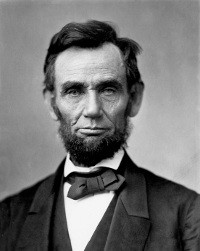
Abraham Lincoln (12 February 1809 – 15 April 1865) was an American statesman and lawyer who served as the 16th President of the United States from March 1861 until his assassination in April 1865. Lincoln led the United States through its War Between the States—its bloodiest war and perhaps its greatest moral, constitutional and political crisis. In doing so, he preserved the Union, abolished slavery, strengthened the federal government and modernized the economy.
Born
Died
15 Apr 1865, in Washington, D.C.
Articles
Bill Kauffman: American Anarchist, by Laurence M. Vance, 4 Dec 2006
Review of Kauffman's Look Homeward, America: In Search of Reactionary Radicals and Front-Porch Anarchists (2006)
Review of Kauffman's Look Homeward, America: In Search of Reactionary Radicals and Front-Porch Anarchists (2006)
And then there is Lincoln. Kauffman ... agrees "with the Peace Democrats that the war was a tragic mistake. No cause is worth 600,000 deaths ..." Kauffman introduces us to Ohio congressman Clement L. Vallandigham, who "publicly denounced the 'wicked and cruel' war by which 'King Lincoln' was 'crushing out liberty and erecting a despotism,'" and to Lieutenant Governor Sanford Church, who "vilified the Lincoln administration for seeking to 'absorb, centralize and consolidate the rights and powers of the loyal States in the general government.'"
Related Topics: George W. Bush, Lyndon B. Johnson, The State, Vietnam War, War, George Washington, World War II
Democracy Versus Liberty, by James Bovard, The Freeman, Aug 2006
Discusses the dangers of equating liberty with "self-government" as majority rule, with representative actions or quotes by several U.S. presidents from Lincoln to George W. Bush
Discusses the dangers of equating liberty with "self-government" as majority rule, with representative actions or quotes by several U.S. presidents from Lincoln to George W. Bush
Abraham Lincoln was by far the most avid champion of democracy among nineteenth-century presidents—and the president with the greatest visible contempt for the Constitution and the Bill of Rights. He swayed people to view national unity as the ultimate test of the essence of freedom. That Lincoln suspended habeas corpus, jailed 20,000 people without charges, forcibly closed hundreds of newspapers that criticized him, and sent in federal troops to shut down state legislatures was irrelevant because he proclaimed "that this nation shall have a new birth of freedom ..."
Emergencies: The Breeding Ground of Tyranny, by William L. Anderson, Freedom Daily, Nov 2006
Examines the long history of "emergency powers" claimed by U.S. Presidents, including recent examples such as sanctions stemming from the International Economic Powers Act and the so-called War on Terror
Examines the long history of "emergency powers" claimed by U.S. Presidents, including recent examples such as sanctions stemming from the International Economic Powers Act and the so-called War on Terror
Although other presidents have engaged in conduct that arguably could be termed an abuse of power, no one truly claimed "emergency" powers until Abraham Lincoln, who in 1861 suspended habeas corpus, ordered the arrest of thousands of people, and held others without trial ... [H]e established a number of precedents that demonstrated that if a president wishes to cross the line of legality, there is little to stop him ... From the blockade against Southern ports to the war effort itself, Lincoln assumed powers of the presidency that his critics said were not appropriated by the Constitution.
Related Topics: American War Between the States, Jimmy Carter, Government, Law, Franklin D. Roosevelt, Terrorism, George Washington, Woodrow Wilson
The Federal War on Gold, Part 2, by Jacob G. Hornberger, Freedom Daily, Sep 2006
Continues with the brief monetary history of the United States, discussing Abraham Lincoln's war loans and legal tender law, and the Supreme Court cases of Hepburn v. Griswold (1870) and Knox v. Lee (1871)
Continues with the brief monetary history of the United States, discussing Abraham Lincoln's war loans and legal tender law, and the Supreme Court cases of Hepburn v. Griswold (1870) and Knox v. Lee (1871)
In 1862, Congress granted Lincoln's request to issue $150 million in Treasury notes to finance the war effort during the War Between the States ... Congress provided that the notes would constitute "legal tender." What did "legal tender" mean? It meant ... that for the first time since the founding of the nation, Americans would be required to accept the federal government's paper money as a medium of exchange. Why was that important to Abraham Lincoln? Like so many other government officials in history, Lincoln was resorting to the printing press—inflation—to finance his war expenditures.
Related Topics: American War Between the States, United States Constitution, Founding Fathers, Money, Enumerated Powers
Honoring Jefferson, by Joseph Sobran, 1 Jul 2004
Argues the 2004 cover of Time magazine, featuring Jefferson, as well as numerous articles in it, merely pay "lip service (to his genius) while missing the essence of it"
Argues the 2004 cover of Time magazine, featuring Jefferson, as well as numerous articles in it, merely pay "lip service (to his genius) while missing the essence of it"
One of Jefferson's recent biographers remarks that this argument was 'dangerously close' to an argument for the states' right to secede from the Union. ... The new president, Abraham Lincoln, who claimed to be a disciple of Jefferson, had to ignore much of Jefferson's thought in order to justify suppressing secession as 'rebellion.' He incessantly cited the truth that all men are created equal, but he evaded the part about the consent of the governed and established military dictatorships in the conquered South, while effectively criminalizing Jefferson's views on secession in the North.
Related Topics: Thomas Jefferson, John Locke
How Lincoln Gave Us Kwanzaa, by Joseph Sobran, The Reactionary Utopian, 7 Dec 2006
While planning for his holidays with The Snoop Dogg Christmas Album, Sobran discusses a couple of recent books about the Gettysburg Address: The Gettysburg Gospel and Lincoln at Gettysburg
While planning for his holidays with The Snoop Dogg Christmas Album, Sobran discusses a couple of recent books about the Gettysburg Address: The Gettysburg Gospel and Lincoln at Gettysburg
According to Lincoln, the Declaration "brought forth a new nation." That is plainly not true. The Declaration says nothing about a "nation"; it speaks only of 13 "Free and Independent States." ... But Lincoln's worshippers, bewitched by his eloquence, ... overlook not only his lapses in logic but his gross violations of the Constitution: usurpations of power, suspension of habeas corpus, arbitrary arrests of dissenters ..., crackdown on the free press, the Emancipation Proclamation (Lincoln himself doubted his authority to issue it but finally yielded to Republican pressure), and so on.
Related Topics: American War Between the States, Iraq War
The Latest Defamation of Jefferson, by Thomas DiLorenzo, LewRockwell.com, 31 Mar 2006
Criticizes a conference titled "Mr. Jefferson Goes to the Middle East", thus implying that George W. Bush is somehow Jeffersonian, by contrasting Jefferson and Lincoln's (and by extension Bush's) policies and actions
Criticizes a conference titled "Mr. Jefferson Goes to the Middle East", thus implying that George W. Bush is somehow Jeffersonian, by contrasting Jefferson and Lincoln's (and by extension Bush's) policies and actions
Lincoln was the anti-Jefferson ... [He] waged the bloodiest war in American history to destroy the Jeffersonian states' rights doctrine ... Lincoln's overriding purpose in his war was to destroy the secessionist and states' rights principles of the Declaration (while using slick rhetoric designed to pretend that he revered the document) ... Lincoln eviscerated constitutional liberty by illegally suspending habeas corpus, shutting down the opposition press, imprisoning thousands of political opponents, confiscating firearms, and many other atrocities.
Related Topics: Standing Army, George W. Bush, Foreign entanglements, Grove City College, Thomas Jefferson
Lincoln's Presidential Warrant to Arrest Chief Justice Roger B. Taney: 'A Great Crime' or a Fabrication?, by Charles Adams, LewRockwell.com, 5 Jan 2004
Examines evidence that President Abraham Lincoln signed a warrant to arrest Supreme Court Chief Justice Roger Taney in early 1861
Examines evidence that President Abraham Lincoln signed a warrant to arrest Supreme Court Chief Justice Roger Taney in early 1861
It does seem too preposterous to be true, probably because of all the grave errors and wrongs allegedly committed by Lincoln's administration, this would rank at the top of the list ... Lincoln ... accepted the Machiavellian doctrine that the end justified the means, when the end was to preserve the Union, and was to be achieved regardless of the Constitution and rulings of the Supreme Court. Lincoln expressed that policy to a Chicago clergyman:
"As commander in chief of the army and navy, in time of war, I suppose I have a right to take any measure which may best subdue the enemy."
Related Topics: American War Between the States, Writ of Habeas Corpus
Lincoln-Worship Overlays the Corporatist Agenda, by Kevin Carson, Future of Freedom, Mar 2014
Review of Rich Lowry's Lincoln Unbound: How an Ambitious Young Railsplitter Saved the American Dream—and How We Can Do It Again (2013)
Review of Rich Lowry's Lincoln Unbound: How an Ambitious Young Railsplitter Saved the American Dream—and How We Can Do It Again (2013)
Lincoln's vision of the society he wanted to build implied an aversion to the society it would replace. In many ways his father, Thomas Lincoln, symbolized everything he wanted to eradicate from American society ... Lincoln was a direct descendant of the modernizing Puritans of the 17th century, who banned the large number of saints' days on which peasants previously rested and celebrated, and imposed the Calvinist Sabbath on what had been a day of games and enjoyment ... [T]he economy that Lincoln built compelled the average person to work harder than necessary to achieve a given level of consumption.
No More "Great Presidents", by Robert Higgs, The Free Market, Mar 1997
Discusses the results of a 1996 poll of 30 historians and two politicians asking them to rank U.S. presidents, focusing on those ranked Great, Near Great and Failure, and offers his own ranking
Discusses the results of a 1996 poll of 30 historians and two politicians asking them to rank U.S. presidents, focusing on those ranked Great, Near Great and Failure, and offers his own ranking
It does not matter how ill-conceived [a] war may be. Lincoln achieved his presidential immortality by quite unnecessarily plunging America into its greatest bloodbath—ostensibly to maintain the boundaries of an existing federal union, as if those boundaries possessed some sacred status ... What weight does Grant's Credit Mobilier scandal have in comparison to Lincoln's 620,000 dead in the Civil War? ... Were I to rank the presidents ... Lincoln, Wilson, FDR, Truman, and [LBJ] belong at the bottom, for their statist economic policies as well as their supremely catastrophic war policies.
Patriotism along the Southern Border, Part 2, by Jacob G. Hornberger, Freedom Daily, Jan 1999
Continues discussing patriotism and treason in the historical context of Mexico and the territories annexed by the U.S. after the Mexican-American War, up to the early 20th century; includes parallels in more modern contexts
Continues discussing patriotism and treason in the historical context of Mexico and the territories annexed by the U.S. after the Mexican-American War, up to the early 20th century; includes parallels in more modern contexts
In April 1846, Mexican troops attacked a small contingent of American soldiers across the river from Matamoros, Mexico ... Polk advised Congress that American troops had been attacked by Mexico. Congress declared war ... Support for the war, however, was not unanimous. Rep. Abraham Lincoln challenged Polk to prove that the land where the troops had been attacked was truly American territory. Other opponents of the war included Henry David Thoreau, Ralph Waldo Emerson, Henry Clay, and Daniel Webster. Were these people patriots or traitors for standing against their own government?
Taking the gloss off of the Great Emancipator, by Jeffrey Rogers Hummel, Chicago Tribune, 12 Feb 2009
Examines Lincoln's attitude toward the abolition of slavery as well as the effects of his war on the growth of government
Examines Lincoln's attitude toward the abolition of slavery as well as the effects of his war on the growth of government
Abraham Lincoln is justly celebrated as the Great Emancipator ... [U]nfortunately, [he] did almost as much to repudiate as to reaffirm the radical principles of the Declaration of Independence. To begin with, the 16th president's determination to hold the Union together with military force was an explicit rejection of the revolutionary right of self-determination ... Moreover, Lincoln elevated the suppression of Southern independence above any concern for blacks ... Fortunate for the slaves that Lincoln ultimately concluded that freeing them offered the most military and political advantages.
Related Topics: American War Between the States, Slavery
 Warring as Lying Throughout American History, by James Bovard, Freedom Daily, Feb 2008
Recounts how U.S. Presidents and their administrations since James Polk have been deceitful about wars and military engagements
In 1846, James K. Polk took Americans to war after falsely proclaiming that the Mexican army had crossed the U.S. border and attacked a U.S. army outpost—"shedding the blood of our citizens on our own soil." Though Polk refused to provide any details of where the attack occurred, the accusation swayed enough members of Congress to declare war against Mexico. Congressman Abraham Lincoln vigorously attacked Polk for his deceits. But Lincoln may have studied Polk's methods, since they helped him whip up war fever 15 years later.
Related Topics: Bill Clinton, Gulf War, Nicaragua, Ronald Reagan, Franklin D. Roosevelt, Terrorism, Vietnam War, War, Woodrow Wilson, World War II
Reviews
Wartime Attacks on Civil Liberties, by George C. Leef, Freedom Daily, Dec 2005Review of Perilous Times: Free Speech in Wartime: From the Sedition Act of 1798 to the War on Terrorism (2004) by University of Chicago Law School professor Geoffrey R. Stone
Lincoln suspended the writ of habeas corpus. In the case of Ex parte Merryman, Chief Justice Roger Taney ruled that only Congress had the power to suspend the writ of habeas corpus, but Lincoln refused to obey the Supreme Court's ruling ... Although Lincoln (in Stone's view, rather feebly) defended the arrest [of Rep. Vallandigham], he did order that the Chicago Times be permitted to reopen ... Stone argues that the Lincoln administration for the most part was willing to leave dissenting voices undisturbed and usually countermanded the arrests and seizures of zealous military commanders.
Books
The Real Lincoln: A New Look at Abraham Lincoln, His Agenda, and an Unnecessary War, by Thomas J. DiLorenzo, Walter E. Williams (foreword), 2002
Partial contents: Lincoln's Opposition to Racial Equality - Why Not Peaceful Emancipation? - Lincoln's Real Agenda - The Myth of Secession as "Treason" - Was Lincoln a Dictator? - Waging War on Civilians - Reconstructing America - The Great Centralizer
Partial contents: Lincoln's Opposition to Racial Equality - Why Not Peaceful Emancipation? - Lincoln's Real Agenda - The Myth of Secession as "Treason" - Was Lincoln a Dictator? - Waging War on Civilians - Reconstructing America - The Great Centralizer
Related Topic: American War Between the States
- ISBN 0761536418: Hardcover, Prima Lifestyles, 2002
- ISBN 0761526463: Paperback, Three Rivers Press, Reprint edition, 2003
Podcasts
Lincoln's War, by John V. Denson, Lew Rockwell (interviewer), The Lew Rockwell Show, 7 Aug 2008
John Denson discusses how Lincoln managed to get the Southern states to "fire the first shot" and thus allow the War between the States to be called a "just war"
John Denson discusses how Lincoln managed to get the Southern states to "fire the first shot" and thus allow the War between the States to be called a "just war"
Related Topic: American War Between the States
The introductory paragraph uses material from the Wikipedia article "Abraham Lincoln" as of 27 May 2018, which is released under the Creative Commons Attribution-Share-Alike License 3.0.