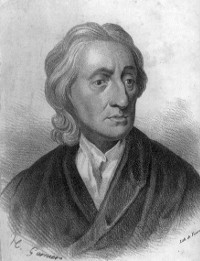
Reference
John Locke, by William Uzgalis,
Stanford Encyclopedia of Philosophy, 7 Jul 2022
Major sections: Historical Background and Locke's Life - The Limits of Human Understanding - Locke's Major Works on Education - The
Two Treatises Of Government - Locke and Religious Toleration - Bibliography - Other Internet Resources
John Locke (b. 1632, d. 1704) was a British philosopher, Oxford academic and medical researcher. Locke's monumental An Essay Concerning Human Understanding (1689) is one of the first great defenses of empiricism and concerns itself with determining the limits of human understanding ... Locke's association with Anthony Ashley Cooper (later the First Earl of Shaftesbury) led him to become successively a government official ..., economic writer, opposition political activist, and finally a revolutionary whose cause ultimately triumphed in the Glorious Revolution of 1688.
John Locke (1632-1704),
The Concise Encyclopedia of Economics
Includes list of selected works
Born in England, John Locke was a persistent champion of natural rights—the idea that each person owns himself and should have certain liberties that cannot be expropriated by the state or anyone else. When someone labors for a productive end, the results become that person's property, reasoned Locke. ... Locke also sketched out a quantity theory of money, which held that the value of money is inversely related to the quantity of money in circulation.
John Locke (1632-1704), by Patrick J. Connolly,
Internet Encyclopedia of Philosophy
Major sections: Life - Method - Human Nature - Religion - Moral Philosophy - Political Philosophy - Assessment - References and Further Reading
For much of his life Locke held administrative positions in government and paid very careful attention to contemporary debates in political theory. So it is perhaps unsurprising that he wrote a number of works on political issues. In this field, Locke is best known for his arguments in favor of religious toleration and limited government. Today these ideas are commonplace and widely accepted. But in Locke's time they were highly innovative, even radical.
Locke, John (1632-1704), by
Eric Mack,
The Encyclopedia of Libertarianism, 15 Aug 2008
Biographical and bibliographical essay
John Locke was perhaps the most influential and paradigmatic of classical liberal thinkers ... His early works in political philosophy include the Essays on the Law of Nature (1663–1664), and the pro-tolerance An Essay on Toleration (1667). His major and mature works in political philosophy were Two Treatises of Government (written 1680–1683, published in 1689) and the Letter Concerning Toleration (written in 1685 ...). Locke established his reputation as a major figure in philosophy with the publication of his treatise in epistemology, An Essay Concerning Human Understanding (1689).
Biography
John Locke
Oregon State University, Philosophy Department: includes short biography, detailed timeline, links to his principal works (three at the same site) and list of selected texts about Locke
Locke's Two Treatises of Civil Government were published after the Glorious Revolution of 1688 brought William of Orange and Mary to the throne, but they were written in the throes of the Whig revolutionary plots against Charles II in the early 1680s. In this work Locke gives us a theory of natural law and natural rights which he uses to distinguish between legitimate and illegitimate civil governments, and to argue for the legitimacy of revolt against tyrannical governments.
Web Pages
John Locke | Libertarianism.org
Short profile and links to essays, columns and other resources about Locke
Nicknamed the 'Father of Liberalism,' Locke's theories have formed the foundation of many important works, including the U.S. Declaration of Independence and Constitution. His theories of social contract, the mind, and property are perhaps the most widely known.
John Locke - Online Library of Liberty
Includes portrait, short biography, links to several related articles, to various versions of Locke's works and to selected quotations
John Locke (1632-1704) was an English philosopher who is considered to be one of the first philosophers of the Enlightenment and the father of classical liberalism. In his major work Two Treatises of Government Locke rejects the idea of the divine right of kings, supports the idea of natural rights (especially of property), and argues for a limited constitutional government which would protect individual rights.
Module 2: John Locke's Two Treatises of Government
Second module of the Cato Home Study Course, includes link to listen or download audio program (2:41:50), questions and suggested readings
John Locke (1623-1704) was undoubtedly one of the most influential individuals who ever lived. Locke considered the great questions of slavery, religious toleration, constitutional government, individual rights, property, the market economy, and the foundations of justice. He was a physician, a philosopher, an economist, and an activist for liberty and limited government. He is also important as an "intellectual bridge" between the broader European civilization and the American revolutionaries whom his work inspired.
Articles
Algernon Sidney: A Father of the Declaration of Independence, by
David B. Kopel,
The Washington Post, 3 Jul 2016
After a short biography, discusses the main themes made by Sidney in
Discourses Concerning Government, written in response to Robert Filmer's
Patriarcha, which defended the divine right of kings
Like Locke's "First Treatise," Sidney's "Discourses Concerning Government" was a refutation of Robert Filmer's "Patriarcha," which had argued ... any resistance to a king, no matter how tyrannical he might be, is sinful ... Sidney and Locke showed that the right of resistance is inseparable from the right of religious freedom ... It would take a while for Locke's and Sidney's ideas to be fully accepted in England. Their true fruition ... would come in the United States, where they are embodied in the Declaration of Independence, the First and Second Amendments, and the American way of life.
Algernon Sidney: Forgotten Founding Father, by Chris Baker,
The Freeman, Oct 1997
Biographical essay discussing also Sidney's political theories and his influence in the American colonies
While his better-known contemporary John Locke harshly criticized self-interest, Sidney seemed to favor it ... Sidney's political philosophy had one fatal flaw, which Locke also accepted. He believed that "if he enter into the society, he is obliged by the laws of it." (Locke called it tacit consent.) Yet Sidney was the most radical man of his time. While Locke earned fame and prestige, Sidney became famous mostly for his "treason." Had he lived out his life, he might have had as much influence as Locke, whose major works were all published after the bloodless revolution of 1688.
"And the Pursuit of Happiness": Nathaniel Branden, RIP, by
Sheldon Richman,
The Goal Is Freedom, 12 Dec 2014
Memorial essay, including some personal recollections, with emphasis on Branden's work on self-esteem and self-responsibility, and a preamble on the quoted phrase in the United States Declaration of Independence
Carol V. Hamilton claims that Jefferson found the phrase
the pursuit of happiness in John Locke's
An Essay Concerning Human Understanding (1689) ... It is true, however, that Locke, sounding very Greek, wrote,
As therefore the highest perfection of intellectual nature lies in a careful and constant pursuit of true and solid happiness, so the care of ourselves ... is the necessary foundation of our liberty ... [W]e are, by the necessity of preferring and pursuing true happiness as our greatest good, obliged to suspend the satisfaction of our desires in particular cases.
Boxer's Confusion about Ownership, by
Tibor Machan, 4 May 2007
Explains the absurdity of California Senator Barbara Boxer's statement that public lands are "owned ... by the American people" by recalling a story about Ludwig Wittgenstein
The American idea, laid out in the political theory of John Locke, is the right to private property. It is this right that makes possible, if property defended in the legal system, the freedom of diverse uses of lands and other property, uses that will serve the purposes of a highly diverse population.
The Growth of Libertarian Thought, by
Murray N. Rothbard,
Conceived in Liberty
Volume II, Part II "Intercolonial Developments", Chapter 33: Starts by considering the influence of English writers Sidney and Locke and then considers Trenchard and Gordon's
Cato's Letters
There were two strains in Locke's Essay: the individualist and libertarian, and the conservative and majoritarian ... But the individualist view is the core of the philosophic argument, while the majoritarian and statist strain appears more in the later, applied portions of the theory.
Honoring Jefferson, by
Joseph Sobran, 1 Jul 2004
Argues the 2004 cover of
Time magazine, featuring Jefferson, as well as numerous articles in it, merely pay "lip service (to his genius) while missing the essence of it"
The 'self-evident truths' of his Declaration of Independence — that all men are created equal, that their Creator has endowed them with unalienable rights, that government derives its just powers from the consent of the governed — were meant to be challenges, not platitudes. ... A master of several languages and many sciences, Jefferson sought to reduce political philosophy to simple terms every American could understand. The Declaration distills the political philosophy of John Locke, which Jefferson regarded as the consensus of reasonable men of his own generation.
How Nationalism and Socialism Arose from the French Revolution, by
Dan Sanchez, 12 Apr 2017
Examines how three crucial ideas (liberalism, nationalism and socialism) emerged around the same time (18th and 19th century) and how they depended on the rise of the modern people's state
According to Locke, the state is not the royal family's private property. Whether democratic or not, proper government is a public institution ... In Locke's view, the state is a servant of the people with a specific job. If that servant is not performing its function, or worse still, if it is deliberately trampling on the very rights it was tasked to protect, then it has broken the "social contract" ... In such cases, the people may exercise their right of revolution: the right to fire (abolish or secede from) their government and hire (establish) a new one.
John Locke - Hero of the Day,
The Daily Objectivist, 2000
Biographical profile published by
The Daily Objectivist; includes details on how the
Essay Concerning Human Understanding came about
Locke's Second Treatise offers a theoretical justification of private property—which could be acquired by 'mixing one's labor' with the land—and of political rebellion. He doubtless had recent rebellious doings in England in mind as he drafted it. The work exerted a profound influence on the thought (and action) of the American Founding Fathers.
John Locke: His American and Carolinian Legacy, by George M. Stephens
John Locke Foundation: explores Locke's principle of property rights and government's role in protecting them
The political philosophy of Locke's mature years stemmed from the commonly-accepted Natural Law, under which man had Natural Rights, not given to him by any ruler. ... Locke was rather vague about the organization of government. He said that the legislative and executive power 'come often to be separated.' While Locke thought that the legislature should be supreme among the branches, the establishment of legislative, executive and judicial powers and their separation in our governmental tradition came from Montesquieu.
John Locke—Natural Rights to Life, Liberty, and Property, by
Jim Powell,
The Freeman, Aug 1996
Extensive biographical essay, including summaries of his major works
Thomas Jefferson ranked Locke, along with Locke's compatriot Algernon Sidney, as the most important thinkers on liberty. Locke helped inspire Thomas Paine's radical ideas about revolution. Locke fired up George Mason. From Locke, James Madison drew his most fundamental principles of liberty and government. Locke's writings were part of Benjamin Franklin's self-education, and John Adams believed that both girls and boys should learn about Locke. The French philosopher Voltaire called Locke "the man of the greatest wisdom. What he has not seen clearly, I despair of ever seeing."
John Locke's Top 5 Radical Political Ideas, by
Brandon Turner,
LearnLiberty.org, 29 Aug 2016
Brief discussions of "five features of Locke's political thought that remain particularly important": natural equality, property, consent, resistance and toleration
John Locke turns 384 years old today, making this an unusually appropriate occasion for reflecting upon his legacy ... Locke was not the first to articulate the idea of natural equality, of course, but his formulation ... placed equality at the very foundation of liberal political thought ... The function of consent in Locke's political thought remains vital to our conceptions of liberal morality. Locke's discussion of the "dissolution" of government does not appear until the final chapter ..., but there's a real sense in which the question of the right of revolution permeates the entire work.
Keynote Address to the LP Convention, by
M. Rothbard,
The Libertarian Forum, Aug 1977
Speech at the National Convention in July 1977; based on the "Turning Point, 1777/1977" Libertarian Party convention theme, compares the American Revolution against the British with the contemporary libertarian situation versus the state
It used to be thought that all Americans had read John Locke and were simply engaged in applying his concept of natural rights, of rights to liberty and property, and right of revolution against tyranny ... What most Americans did read were intellectuals and libertarians, like Tom Paine, who took Locke's abstract philosophy and radicalized it to apply to the conditions of their time. By far the most influential such writings ... were "Cato's Letters", written by two ... English journalists, John Trenchard and Thomas Gordon. [They] ... put Locke's ideas into stirring and hard-hitting phrases ...
Libertarian Anarchism: Responses to Ten Objections, by
Roderick T. Long,
Mises.org, 6 Aug 2004
Transcript of informal talk given at the 2004 Mises University; first makes the case for anarchism and then responds to objections others have raised against it
Locke argues that anarchy involves three things he calls "inconveniences." ... One problem, he said, was that there wouldn't be a general body of law that was generally known, and agreed on, and understood. People could grasp certain basic principles of the law of nature. But their applications and precise detail were always going to be controversial ... Second, there is a power-of-enforcement problem. He thought that without a government you don't have sufficiently unified power to enforce ... Third, Locke said the problem is that people can't be trusted to be judges in their own case.
Locke Mess, by Loren E. Lomasky,
Reason, Jan 1996
Review of the book
Passions and Constraint: On the Theory of Liberal Democracy by Stephen Holmes
The legitimate inheritor of John Locke is, he contends, not Hayek or Milton Friedman or any of their ilk but rather John Rawls. ... Has he succeeded after all in paving an impeccably Lockean road to the welfare state? ... With breathtaking nonchalance Holmes utterly neglects the qualifications that Locke carefully attaches to claims for relief from indigence. ... alms are explicitly said by Locke to be a last resort; they are forthcoming only to he who 'has no means to subsist otherwise.'
Murray Rothbard's Philosophy of Freedom, by
David Gordon,
The Freeman, Nov 2007
Examines the arguments made by Rothbard that, given the premise that slavery is wrong, self-ownership, private property rights and a free market without government interventions follow
In Rothbard's view, then, one acquires property through "mixing one's labor" with unowned land, or by acquiring such property in gift or exchange from someone else. This doctrine of course comes from John Locke, though Rothbard embraces this principle of initial acquisition without Locke's numerous qualifications. Rothbard displays great dialectical ingenuity in anticipating objections to his theory. One of the most important of these is that if one may acquire property through Lockean labor mixture, does this not unfairly bias matters in favor of the first possessor?
The Natural Right of Property, by
Sheldon Richman,
The Goal Is Freedom, 17 Aug 2007
Examines Thomas Hodgskin's philosophy, in particular his writings on property rights in
The Natural and Artificial Right of Property Contrasted (1832)
Locke's commonwealth, says Hodgskin, has not lived up to its theory.
... The important ... fact ... is, that law and governments are intended, and always have been intended, to establish and protect a right of property, different from that which, in common with Mr. Locke, I say is ordained by nature. The right of property created and protected by the law, is the artificial or legal right of property, as contra-distinguished from the natural right of property. It may be the theory that government ought to protect the natural right; in practice, government seems to exist only to violate it.
Nozick, Robert (1938-2002), by Ellen Frankel Paul,
The Encyclopedia of Libertarianism, 15 Aug 2008
Biographical and bibliographical essay
The imprint of John Locke's Second Treatise (1690) is present throughout Nozick's book. Nozick begins by assuming Locke's state of nature and then by reprising his account of its moral foundation in natural law and natural right ... Locke's state of nature is a state of perfect freedom, yet it suffers from certain defects for which natural law, imprinted in each man's heart, is an insufficient remedy ... To remedy these and other defects, Locke envisioned a voluntary agreement—a social contract—between people desirous of leaving the state of nature and forming into a civil society.
One Moral Standard for All, by
Sheldon Richman,
The Goal Is Freedom, 15 Nov 2013
Postulates that most nonlibertarians agree that initiation of force is wrong, but they have to be shown that the same moral standard should hold for government personnel as for private individuals
You can find [equality of authority] in John Locke ...:
Being all equal and independent, no one ought to harm another in his life, health, liberty or possessions ... And, being furnished with like faculties, sharing all in one community of nature, there cannot be supposed any such subordination among us that may authorise us to destroy one another, as if we were made for one another's uses.
"Unless it be to do justice on an offender," Locke continued, no one may "take away, or impair the life, or what tends to the preservation of the life, the liberty, health, limb, or goods of another."
Popular Sovereignty: A Biography of Algernon Sidney, by
Jim Powell,
Libertarianism.org, 4 Jul 2000
Biographical essay; alternative version of chapter "Popular Sovereignty" in section 9, "Protecting Liberty", of
The Triumph of Liberty (2000)
[Quaker merchant Benjamin] Furley provided lodging for John Locke when he became an exile in Holland ... Some of the greatest minds of the era began refuting Filmer. John Locke, secretary and medical advisor to radical Anthony Ashley Cooper, the Earl of Shaftesbury, began defending natural rights in two treatises but, being a cautious man, he kept them out of circulation until 1689, after the Stuarts had been overthrown—and even then the books were published anonymously. Locke's long-time friend and assistant James Tyrrell was more daring: he wrote Patriarcha non Monarchia, published in 1681.
Real Liberalism and the Law of Nature, by
Sheldon Richman,
The Goal Is Freedom, 10 Aug 2007
Examines Thomas Hodgskin's introductory letter to Henry Brougham, a Member of Parliament (later Lord Chancellor), written in 1829, published in
The Natural and Artificial Right of Property Contrasted (1832)
Hodgskin cuts to the chase ...
... [T]hough the Westminster philosophers ... agree with Mr. Locke, in attributing to the right of property the utmost importance, ... they differ from him ... as to the origin of this right. Mr. Locke lays it down, that the preservation of property is the object for which men unite into a commonwealth. For this purpose, they put themselves under government. Property therefore, according to Mr. Locke, existed antecedently to government, and government was established for the protection of an antecedently existing right of property. [Emphasis added.]
The Rights of the Colonists, by
Samuel Adams,
Old South Leaflets, 20 Nov 1772
Leaflet No. 173, in Vol. VII; first of three reports of the Massachusetts Comittee of Correspondence, authored by Adams, presented to the Boston Town Meeting by James Otis
In regard to religion, mutual toleration in the different professions thereof is what all good and candid minds in all ages have ever practised, and ... inculcated on mankind ... Insomuch that Mr. Locke has asserted and proved, beyond the possibility of contradiction on any solid ground, that such toleration ought to be extended to all whose doctrines are not subversive of society. The only sects which he thinks ought to be, and which by all wise laws are excluded from such toleration, are those who teach doctrines subversive of the civil government under which they live.
What you should know about the Non-Aggression Principle, by Jason Kuznicki, 24 Feb 2017
Discusses the non-aggression principle, stating that it "depends on a valid theory of property ownership" and concludes that such a theory is in conflict with what most people view as the proper role of government
John Locke's theory of property, which has frequently been invoked by classical liberals, holds that property began as a grant of the entire world, from God, to all of humanity in common. Property became private, Locke held, because property existed from the beginning to satisfy human needs, and because private property was apt to satisfy those needs more effectively. Individuals improve private property, a step which they tend not to take with a commons, and thus private property is more apt to the purpose for which property exists in any form.
Would-Be Rulers without Clothes, by
Sheldon Richman,
Freedom Daily, May 2008
Examines Hillary Clinton's assertion, in a debate with Barack Obama, about "wanting" a universal health care plan and dismissing the option of voluntary medical insurance
Jefferson borrowed the Declaration philosophy from John Locke, who was quite clear on what he meant by equality. In his
Second Treatise of Government, Locke writes that equality is a state
wherein all the Power and Jurisdiction is reciprocal, no one having more than another: there being nothing more evident, than that Creatures of the same species and rank promiscuously born to all the same advantages of Nature, and the use of the same faculties, should also be equal one amongst another, without Subordination or Subjection. ... [Emphasis added.]
Reviews
Economic Thought Before Adam Smith—An Austrian Perspective on the History of Economic Thought, Volume 1, by Gregory P. Pavlik,
The Freeman, Oct 1995
Review of Murray Rothbard's
Economic Thought Before Adam Smith (1995) (note: despite the title, Adam Smith is included in this volume and the review)
[T]he Catholic professor ... Huguccio, in his Summa of 1188, established the doctrine that "private property was to be considered a sacrosanct right derived from the natural law." ... This analysis leads to an interesting reinterpretation of more well known proto-libertarian natural rights theorists like John Locke ... Rothbard regards [Locke's] theory as "neo-Scholastic Protestantism," a resurrection of previously held Christian doctrine regarding the natural law. Of course, there were radical innovations within the Lockean system, most importantly with regard to social contract theory.
Interviews
Mutualism: An interview with Kevin Carson, by
Kevin Carson,
The Isocracy Network (interviewer), 3 Nov 2009
Topic discussed include: mutualism in theory and practice, worker cooperatives and credit unions, small-scale manufacturing, Henry George, worker-managed firms, Lockean land ownership concepts, labor theory of value and political coalitions
Reisman and Long both argue that you do not support John Locke's ownership of landed property that has been mixed with labour ... How do you respond ...?
... I think Long acknowledged Locke's Proviso and explicitly characterized his own position as "non-Proviso Lockeanism." ... In any case ..., when answering Lockean critics I tend to tacitly work from the premise that "Lockean" means "non-Proviso Lockean." And for the most part, I think a radical and consistent application of non-Proviso Lockean rules would go most of the way toward achieving the aims of the Tucker-Ingalls land theory.
Books Authored
An Essay Concerning Human Understanding, 1689
Contents: Book I: Neither Principles nor Ideas Are Innate - Book II: Of Ideas - Book III: Of Words - Book IV: Of Knowledge and Probability
A Letter Concerning Toleration, 1689
Original title:
Epistolia de Tolerantia
Originally in Latin and addressed to Philip van Limborch, translated to Dutch and French, and then to English
Since you are pleased to inquire what are my Thoughts about the mutual Toleration of Christians in their different Professions of Religion, I must needs answer you freely, That I esteem that Toleration to be the chief Characteristical Mark of the True Church ...
I beseech Him, that ... Civil Magistrates, growing more careful to conform their own Consciences to the Law of God and less sollicitous about the binding of other mens Consciences by Humane Laws, may ... direct all their Counsels and Endeavours to promote universally the Civil Welfare of all their Children ...
The Second Treatise of Civil Government, 1690
Partial contents: Of the State of Nature - Of the State of War - Of Slavery - Of Property - Of Paternal Power - Of Political or Civil Society - Of the Beginning of Political Societies - Of Conquest - Of Tyranny - Of the Dissolution of Government