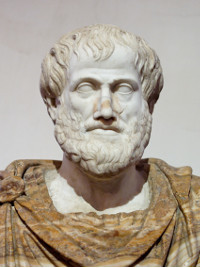
Aristotle (Ἀριστοτέλης; 384–322 BCE) was an ancient Greekphilosopher and polymath. His writings cover a broad range of subjects spanning the natural sciences, philosophy, linguistics, economics, politics, psychology and the arts. As the founder of the Peripatetic school of philosophy in the Lyceum in Athens, he began the wider Aristotelian tradition that followed, which set the groundwork for the development of modern science.
Reference
Aristotle, by Christopher Shields, Stanford Encyclopedia of Philosophy, 29 Jul 2015
Partial list of sections: Aristotle's Life - The Aristotelian Corpus - Logic, Science, and Dialectic - Essentialism and Homonymy - Category Theory - Aristotelian Teleology - Happiness and Political Association - Rhetoric and the Arts - Aristotle's Legacy
Aristotle was sent to Athens at about the age of seventeen to study in Plato's Academy, then a pre-eminent place of learning in the Greek world. Once in Athens, Aristotle remained associated with the Academy until Plato's death in 347, at which time he left for Assos, in Asia Minor, on the northwest coast of present-day Turkey. There he continued the philosophical activity he had begun in the Academy, but in all likelihood also began to expand his researches into marine biology.
Aristotle of Stagira was a Greek philosopher, logician, and scientist and one of the most influential ancient thinkers. As a young man, Aristotle entered Plato's Academy in Athens, where he studied for 20 years. Subsequently, he was invited by Philip of Macedon to tutor his son, the future Alexander the Great. Aristotle later returned to Athens to found his own school, the Lyceum, and write some of his most important treatises. After Alexander's sudden death, Aristotle had to flee Athens because of his Macedonian affiliation, and he died soon after.
Aristotle (384-322 B.C.E.), Internet Encyclopedia of Philosophy
Includes biography, general and detailed reviews of Aristotle's writings on various topics; major sections: Life - Writings - Logic - Metaphysics - Philosophy of Nature - The Soul and Psychology - Ethics - Politics - Art and Poetics
Aristotle is a towering figure in ancient Greek philosophy, making contributions to logic, metaphysics, mathematics, physics, biology, botany, ethics, politics, agriculture, medicine, dance and theatre. He was a student of Plato who in turn studied under Socrates. He was more empirically-minded than Plato or Socrates and is famous for rejecting Plato's theory of forms.
Aristotle - Online Library of Liberty
Includes picture, short biography and links to quotes and works by the author, in particular Constitution of Athens, The Nichomachean Ethics, The Politics and Posterior Analytics
Aristotle was an ancient Greek philosopher who set up a rival academy, The Lyceum, to challenge Plato's Academy. Aristotle wrote influential works in a range of disciplines - politics, physics, ethics, economics - and had a profound impact on Western thought.
Ethics Study Guide: Aristotle, by Roderick T. Long, Praxeology.net
Part of study guide to professor Long's introductory ethics course; includes biographical details, comments on Aristotle's writings, short introductions to Rethoric and Nichomachean Ethics and study questions
Aristotle believes that most of his fellow Greeks are mistaken about the nature of the human good, identifying it with wealth or power rather than with virtuous activity ... Aristotle's theories have been seen as a mere transcription of existing mores only because modern scholars have mistakenly read Aristotle's outlook back into the mores that he is in fact criticizing ... But a careful reading of his works shows that Aristotle was keenly aware of, and bitterly opposed to, the centralizing political trends of his day.
Aristotle Called the 2016 Election, by Martin Cothran, 17 Nov 2016
Argues that, as per Aristotle in Rhetoric, in an election contest between a candidate with an inspiring personality (pathos) vs. another with good character (ethos) or intellect (logos), the former is more likely to win
Almost 2,500 years ago, Aristotle wrote his book, Rhetoric. It remains today one of the best books on persuasion ever written. Such a book comes in handy during an event like an election, since an election is what Aristotle might have called a "rhetorical situation." It is an event in which two or more people are each trying to persuade the public that he or she is the best person for the job. In his book, Aristotle says that there are three ways in which people are persuaded: ethos, logos, and pathos. ... Pathos has to do with the emotional state of the audience: does the speaker reach the hearts of his hearers?
Aristotle Understood the Importance of Property, by Richard M. Ebeling, 27 Sep 2016
Discusses Aristotle's views on private property and property rights (contrasting them with those of Plato), the "ends" of human life, economics ("household management"), wealth acquisition, prices, money and related topics
When we turn to another famous ancient Greek philosopher, Aristotle (384 B.C.–322 B.C.), we find little of the political regimentation that characterizes his teacher, Plato. For Aristotle, the appropriate behavior is the "golden mean" ... While he hopes that wise policies may help to improve the conditions and actions of men, Aristotle recognizes that man possesses a human nature that cannot be molded or bent or transformed to conform to some ideal of a perfect State populated by transformed people in the way that Plato believed was in principle desirable and possible.
Ayn Rand on Aristotle, by George H. Smith, Libertarianism.org, 4 Mar 2016
Examines Rand's appreciative view of Aristotle based on his epistemological theories yet she seems to have disregarded his comments on slavery, racism and coercive government laws
According to Aristotle, "there are certain people who are free and certain who are slaves by nature, and it is both to their advantage, and just, for them to be slaves." ... [I]f Aristotle's rational epistemology did not prevent him from defending racism, slavery, and statism, this could only be because Aristotle himself did not understand the logical implications of his own epistemology. And if later defenders ... were profoundly influenced by Aristotle's theories, this was only because they, too, did not appreciate that such theories were inconsistent with Aristotle's theory of knowledge.
Bourgeois Virtues?, by Deirdre McCloskey, Cato Policy Report, May 2006
Offers an apologia (formal defense) of capitalism "in its American form", in particular of the phrase "bourgeois virtues" as being neither a contradiction in terms nor a lie
The virtues came to be gathered by the Greeks, the Romans, ... Adam Smith, and recent "virtue ethicists" into a coherent ethical framework. Until the framework somewhat mysteriously fell out of favor among theorists in the late 18th century, most Westerners did not think in Platonic terms of the One Good ... They thought in Aristotelian terms of Many Virtues, plural. "We shall better understand the nature of the ethical character," said Aristotle, "if we examine its qualities one by one." ... Since about 1958 ... a so‐called virtue ethics ... has revived Aristotle's one‐by‐one program.
Dialectics and Liberty [PDF], by Chris Matthew Sciabarra, The Freeman, Sep 2005
Written ten years after publication of the first two of Sciabarra's "Dialectic and Liberty" trilogy, discusses Hayek's and Rand's dialectical analysis approaches and suggests that such context-keeping analysis is important in radical libertarian theory
In fact, the father of dialectics, the man whom Hegel himself called the "fountainhead" of dialectical inquiry, was Aristotle. In works such as the Topics—the very first theoretical treatise on dialectics—Aristotle presented numerous techniques by which one might gain a more complete picture of an issue by varying one's "point of view." The Topics serves as a grand discussion of how shifts in one's perspective can reveal different things about the objects of our inquiry, and about the perspectives from which those objects are viewed.
First Freedom, by Tom G. Palmer, Reason, Jun 1993
Review of Liberty and Nature: An Aristotelian Defense of Liberal Order by Douglas B. Rasmussen and Douglas J. Den Uyl
In Liberty and Nature: An Aristotelian Defense of Liberal Order, the authors attempt to ground a defense of (classical) liberal values in the tradition of inquiry initiated by Aristotle. That seems to be quite a challenge, given that Aristotle himself, apart from a few lines critical of Plato's proposals for communism and the abolition of property, was in general either hostile to or unaware of (understandable, given the times) most of the principal elements of classical-liberal political thought ...
Herbert Spencer - Hero of the Day, by Chris Matthew Sciabarra, The Daily Objectivist, 2000
Biographical profile published by The Daily Objectivist; argues that Spencer was a pioneer of "dialectical" (context-keeping) libertarianism; based on article in Aug 1999 Liberty
Spencer is a genuine contextualist, sensitive to the reciprocal relations among parts within a whole. It was Aristotle who first explored the mutual implications of "correlatives," such as "master" and "slave." Hegel stressed the same notion in his analysis of the relationship between "lord" and "bondsman." Like Aristotle and Hegel, Spencer explains "that correlatives imply one another," as surely as a father implies a child, a child the father ... Spencer absorbs the organic metaphor from Aristotle in much the same way as Hegel did.
The Ignorant Can't Be Free, by C. T. Rossi, LewRockwell.com, 28 Mar 2007
Considers the U.S. Constitution in terms of Aristotle's "four questions" (causes), particularly the purpose (final cause), then cites Edward Freeman's study of federalism and the U.S. transition from confederacy to a "supreme federal government"
Our present day "study" of constitutionalism is incomplete at best. Our appreciation of the subject could stand to be jumpstarted by the four traditional questions set out by that ancient Macedonian who lived at the time of the forging of the world's first federal government. That small percentage of Americans who do bother to think about our form of government usually limit their inquiry to two of the four traditional questions: "what is the Constitution's form?" and "who made it?" ... But what about those other two questions: "what is it made from?" and "what is its purpose?"
Libertarianism: The Moral and the Practical, by Sheldon Richman, Future of Freedom, May 2014
Explores whether libertarian policies should distinguish between moral and practical concerns; revised version of "The Goal Is Freedom" column of 27 Dec 2013
The concern of ethics, according to Aristotle, is to learn how [a reasoning, language-using social] being must think and act in order to flourish individually and as a member of society; the object of consideration is "the practical life of man as possessing reason." That's why prudence (or practical wisdom) finds a place on his list of virtues. In Rational Man: A Modern Interpretation of Aristotelian Ethics, Henry B. Veatch elaborates why ethics may be regarded as the art of living, although, to be sure, it is an art unlike all other arts.
As we see, the division of human life into the moral and the practical is of recent vintage. Smith's reference to "ancient philosophy" is a reference to Socrates, Plato, and Aristotle, for whom this chasm would be unfathomable. Moral inquiry for them was essentially an investigation into the art of living as a reasoning, language-using social being. The concern of ethics, according to Aristotle, is to learn how such a being must think and act in order to flourish individually and as a member of society; the object of consideration is "the practical life of man as possessing reason."
The Philosophical Origins of Austrian Economics, by David Gordon, Mises Daily, 17 Jun 2006
Surveys the views of the schools of philosophy and economics that influenced or competed with Austrian economics, including Hegel, the Historical School, Franz Brentano, Occam, Karl Marx, Aristotle, Kant, the logical positivists and Karl Popper
Aristotle argues that a complete science must start with a self-evident axiom and, by the use of deduction, exfoliate the entire discipline. ... Aristotle also discusses the necessity of self-evident principles in the Nicomachean Ethics. He notes that to justify a proposition, one would normally proceed by citing another proposition. But if matters are left at this, the task is not finished. What in turn justifies the proposition advanced in support of one's original claim?
The Revolution Was, by Garet Garrett, 1938
Monograph describing the nine problems faced by New Dealers and how they were handled according to "revolutionary technic"
There are those who have never ceased to say very earnestly, 'Something is going to happen to the American form of government if we don't watch out.' These were the innocent disarmers. Their trust was in words. They had forgotten their Aristotle. More than 2,000 years ago he wrote of what can happen within the form, when 'one thing takes the place of another, so that the ancient laws will remain, while the power will be in the hands of those who have brought about revolution in the state.'
What Social Animals Owe to Each Other, by Sheldon Richman, The Goal Is Freedom, 18 Apr 2014
Delves into the meaning and justification for the non-aggression principle, with insights from Roderick Long's "Reason and Value: Aristotle versus Rand"
What are the grounds for accepting the constitutive model of virtue, including justice? Turning to Aristotle, Long writes,
For Aristotle, a human being is essentially a logikon animal and a politikon animal ... To be a rational animal is to be a language-using animal, a conversing animal, a discursive animal ... Being politikon is for Aristotle an expression of being logikon; just as logikon animals naturally conduct their private affairs through reason rather than through unreflective passion, so they naturally conduct their common affairs through public discourse and rational persuasion, rather than through violence ...
Aristotle: A Contemporary Appreciation
by Henry Babcock Veatch, 1974
Partial contents: Aristotle Redivivus - Physics: The Nature of Things Physical - Physics: The Nature of Things Animate and Things Human - Varieties of Human Achievement: Ethics, Politics, Poetics and the Arts - After the Physics, Methaphysics
Aristotle's First Principles
by Terence Irwin, 1988
Partial contents: The Problem of First Principles - Inquiry and Dialectic - Constructive Dialectic - Puzzles about Substance - The Formal Cause - Conditions for Science - Puzzles about Science - The Universal Science - The science of Being
ISBN 0198242905: Paperback, Oxford University Press, Reprint edition, 1990
Total Freedom: Toward a Dialectical Libertarianism
by Chris Matthew Sciabarra, 2000
Partial Contents: Aristotle: The Fountainhead - From Aristotle to Hegel - After Hegel - Defining Dialectics - Foundations - The Market versus the State - Class Dynamics and Structural Crisis - On the Precipice of Utopia - The Dialectical Libertarian Turn
ISBN 0271020482: Hardcover, Pennsylvania State Univ Press, 2000
ISBN 0271020490: Paperback, Pennsylvania State Univ Press, 2000
Books Authored
A New Aristotle Reader
by J. L. Ackrill (editor), Aristotle, 1988
Contents: Translations - Aristotle's Works - Introduction - Glossary - TEXTS: Logic - Natural Philosophy - Metaphysics - Practical Philosophy - Topics - List of Books
ISBN 0691020434: Paperback, Princeton University Press, 1988
Audio
2. Aristotle, by David Gordon, The History of Political Philosophy: From Plato to Rothbard, 5 Jun 2007
Lecture 2 of 10 of the History of Political Philosophy series, 90 minutes
Aristotle, 384-322 BC, joined Plato's Academy in Athens at eighteen and remained there until the age of thirty-seven. He was not a citizen of Athens. His writings constitute the first comprehensive system of Western philosophy. He tutored Alexander the Great. That experience provided him with an abundance of supplies to work with. He established a library in the Lyceum.
Videos
Liberty & Virtue, by James Otteson, 29 Jun 2011
Explains why virtuous behaviour presupposes freely taken or uncoerced decisions
Not all freely made choices, after all, are good. Some of them are bad. So what's the distinction? The distinction, I think—and I'm going to draw on Aristotle—is when we employ the concept of good judgment, the person of good judgment is the one who makes wise, virtuous choices. So take another step back. How do you get to be a person of good judgment? Well, there are two things that are necessary. First of all, as Aristotle said, you have to practice it. You can't have good judgment if you don't practice. Judgment is a skill. It's like other skills.
PHILOSOPHY - The Good Life: Aristotle, by Chris Surprenant, 9 Sep 2015
Summarises the views of Aristotle, as discussed in his Nicomachean Ethics and Politics, on what constitutes a "good life", why some humans act in a vicious or virtuous manner and what can influence such behaviour