
18th century American printer, inventor and statesman
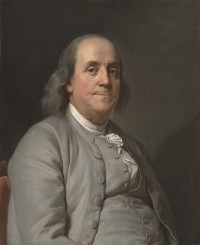
Benjamin Franklin FRS FRSE (17 January 1706 [6 January 1705 O.S.] – 17 April 1790) was an American polymath and one of the Founding Fathers of the United States. Franklin was a leading author, printer, political theorist, politician, freemason, postmaster, scientist, inventor, humorist, civic activist, statesman and diplomat. As a scientist, he was a major figure in the American Enlightenment and the history of physics for his discoveries and theories regarding electricity. As an inventor, he is known for the lightning rod, bifocals and the Franklin stove, among other inventions. He founded many civic organizations, including Philadelphia's fire department and the University of Pennsylvania.
Born
17 Jan 1706, in Boston, Massachusetts
Died
17 Apr 1790, in Philadelphia
Biography
Benjamin Franklin: A Documentary History, by Leo Lemay
Detailed chronology of events, from the birth of Franklin's father to Franklin's burial, divided into seven periods, the first three became the basis for three volumes of The Life of Benjamin Franklin
Detailed chronology of events, from the birth of Franklin's father to Franklin's burial, divided into seven periods, the first three became the basis for three volumes of The Life of Benjamin Franklin
28 March, Saturday, BF [Benjamin Franklin] to Peter Collinson: 'Your kind present of an electric tube, with directions for using it, has put several of us on making electrical experiments. ...For my own part, I never was before engaged in any study that so totally engrossed my attention and my time as this has lately done.' P [The Papers of Benjamin Franklin] 3:118-9. Cf. April, 1745 (and sources cited there); 6 March (b) and 13 July 1747; and 8 Feb 1770. P 3:115-18 has an excellent headnote on the manuscripts and printed editions of BF's Experiments and Observations on Electricity.
Websites
The Benjamin Franklin Tercentenary
Website, now maintained by Franklin & Marshall College, dedicated to celebrating the 300th anniversary of Franklin's birth; includes interactive timeline of his life and a virtual display of the exhibition "Benjamin Franklin: In Search of a Better World"
Website, now maintained by Franklin & Marshall College, dedicated to celebrating the 300th anniversary of Franklin's birth; includes interactive timeline of his life and a virtual display of the exhibition "Benjamin Franklin: In Search of a Better World"
Web Pages
Benjamin Franklin | Libertarianism.org
Links to essays, columns and other resources about Franklin
Links to essays, columns and other resources about Franklin
Benjamin Franklin - Online Library of Liberty
Includes portrait, short biography and links to various versions of Franklin's works and to selected quotations
Includes portrait, short biography and links to various versions of Franklin's works and to selected quotations
Benjamin Franklin (1706-1790) was a Founding Father of the American republic, an author, inventor, and diplomat whose life and ideas came to be identified with the new American nation. He wrote the best selling Poor Richard's Almanac (1733), a posthumously published Autobiography, and many articles advocating American independence from Great Britain. From 1776-1785 he was the American ambassador to France, and from 1785-1788 he was governor of Pennsylvania.
Articles
Autobiography, by Thomas Jefferson, 29 Jul 1821
Covering the period from 1743 (his childhood, with background on his parents) to 1790 (shortly after his return from Paris and before assuming his office as U.S. Secretary of State); written during 6 Jan-29 July 1821
Covering the period from 1743 (his childhood, with background on his parents) to 1790 (shortly after his return from Paris and before assuming his office as U.S. Secretary of State); written during 6 Jan-29 July 1821
I left Monticello on the 1st of March 1790. for New York. At Philadelphia I called on the venerable and beloved Franklin. He was then on the bed of sickness from which he never rose. My recent return from a country in which he had left so many friends, and the perilous convulsions to which they had been exposed, revived all his anxieties ... He went over all in succession, with a rapidity and animation almost too much for his strength. When all his inquiries were satisfied ... I told him I had learnt with much pleasure that ... he had been occupied in preparing for the world the history of his own life.
Barack Obama: The Anti Economic Growth President, by Jim Powell, 29 Feb 2012
Lists and criticizes several of Obama's policies and proposals and discusses why economic growth and progress is beneficial
Lists and criticizes several of Obama's policies and proposals and discusses why economic growth and progress is beneficial
Our Founders risked their lives, their fortunes and their sacred honor for liberty and all its blessings — not least, unlimited human progress. For instance, Benjamin Franklin, in a 1788 letter, wrote: 'I have been long impressed with the improvements in philosophy, morals and even the conveniences of common living, by the invention and acquisition of new and useful utensils and instruments. Invention and improvement are prolific and beget more of their kind.'
Related Topics: Bernard Mandeville, Barack Obama, Property Rights, Julian Simon, Adam Smith, Herbert Spencer, Anne Robert Jacques Turgot
Ben Franklin on Liberty, by Gary Galles, Mises Daily, 3 Feb 2003
List of select quotes by Franklin on the subject of liberty, with introductory and closing remarks
List of select quotes by Franklin on the subject of liberty, with introductory and closing remarks
As a member of the Second Continental Congress, Franklin helped draft the Declaration of Independence. As a member of the Constitutional Convention, he helped draft the Constitution ... Franklin's role in our founding has, however, been eclipsed in modern memory by his many other accomplishments ... Unfortunately, the result has been that attention which deserves to be paid to what Franklin said about America and the liberty it was designed to protect has often been crowded out by that paid to his other accomplishments. It is worth remembering some of those inspirational words.
Related Topic: Liberty
Benjamin Franklin - Hero of the Day, The Daily Objectivist, 2000
Biographical profile published by The Daily Objectivist consisting of two excerpts from The Autobiography of Benjamin Franklin
Biographical profile published by The Daily Objectivist consisting of two excerpts from The Autobiography of Benjamin Franklin
[I] grew very artful and expert in drawing people, even of superior knowledge, into concessions, the consequences of which they did not foresee, ... and so obtaining victories that neither myself nor my cause always deserved. I continu'd this method some few years, but gradually left it, retaining only the habit of expressing myself in terms of modest diffidence; never using, when I advanced any thing that may possibly be disputed, the words certainly, undoubtedly ... This habit, I believe, has been of great advantage to me when I have had occasion to inculcate my opinions, and persuade men into measures that I have been from time to time engag'd in promoting ...
Benjamin Franklin: The Man Who Invented the American Dream, by Jim Powell, The Freeman, Apr 1997
Lengthy biographical essay, including a section on the posthumous publication and reaction to Franklin's Autobiography
Lengthy biographical essay, including a section on the posthumous publication and reaction to Franklin's Autobiography
Benjamin Franklin pioneered the spirit of self-help in America. With less than three years of formal schooling, he taught himself almost everything he knew. He took the initiative of learning French, German, Italian, Latin, and Spanish ... He made himself an influential author and editor. He started a successful printing business, newspaper, and magazine. He developed a network of printing partnerships throughout the ... colonies ... He affirmed that by improving yourself and helping your neighbors you can make a free society succeed. His most glorious invention was—and is—the American dream.
Childhood Ends at Puberty, by Charley Reese, LewRockwell.com, 15 Apr 2006
Recounts the early life of Benjamin Franklin and argues for ending formal basic education by 13
Recounts the early life of Benjamin Franklin and argues for ending formal basic education by 13
Franklin, at the age of 8, studied at Boston Grammar School. He was withdrawn because of poor family finances and finished his formal schooling at George Brownell's English School—at age 11. From 11 to 12, he worked in his father's shop making candles and soap, then tried the cutlery business ... From age 13 to 15, he worked for his brother and wrote broadside ballads. He borrowed books to read, among them John Bunyan, Xenophon, John Locke, various histories and religious polemics ... At age 16, Franklin started his own newspaper, and his career was under way.
Empire or Liberty: The Antifederalists and Foreign Policy, 1787-1788 [PDF], by Jonathan Marshall, The Journal of Libertarian Studies, 1980
Describes the arguments regarding foreign policy made during the period of ratification of the United States Constitution by the Federalists and the counterarguments, "largely ignored" by historians, from the Antifederalists
Describes the arguments regarding foreign policy made during the period of ratification of the United States Constitution by the Federalists and the counterarguments, "largely ignored" by historians, from the Antifederalists
Few Federalists harbored any doubts as to America's future greatness under a centralized, energetic regime. As early as 1775 John Adams was calling for a second Continental Congress ... Benjamin Franklin, too, had abandoned the ideal of the small Spartan republic, as he began to sense the awesome implications of "our growing Strength, both in Numbers and Wealth."
Franklin's Golden Rules, by Mark Skousen, The Daily Reckoning, 18 May 2006
Guest essay describing how Franklin managed his finances, written upon releasing The Compleated Autobigraphy by Benjamin Franklin (2006), compiled and edited by Skousen
Guest essay describing how Franklin managed his finances, written upon releasing The Compleated Autobigraphy by Benjamin Franklin (2006), compiled and edited by Skousen
Benjamin Franklin made great contributions as an inventor, scientist, writer, and founding father, but he is also offered valuable advice on money matters ...In his "Advice to a Young Tradesman" in his famous pamphlet, "The Way to Wealth," published in Poor Richard's Almanac in 1758, Franklin wrote, "In short, the way to wealth, if you desire it, is as plain as the way to market. It depends chiefly on two words, industry and frugality; that is, waste neither time nor money, but make the best use of both. Without industry and frugality, nothing will do, and with them everything."
Related Topic: United States
Frederic Bastiat, Ingenious Champion for Liberty and Peace, by Jim Powell, The Freeman, Jun 1997
Biographical essay of Frédéric Bastiat, covering those who influenced him as well as those influenced by him, his writings (including correspondence with his friend Coudroy), his roles in the French Constituent and Legistative Assemblies and his legacy
Biographical essay of Frédéric Bastiat, covering those who influenced him as well as those influenced by him, his writings (including correspondence with his friend Coudroy), his roles in the French Constituent and Legistative Assemblies and his legacy
Bastiat came across a copy of Poor Richard's Almanack in 1827. He wrote a friend: "I have discovered a real treasure—a small volume of the moral and political philosophy of Franklin. I am so enthusiastic about his style that I intend to adopt it as my own."
In Pursuit of Liberty, by Jarret Wollstein, ISIL.org, May 1997
Primer on liberty concepts, including voluntary vs. coercive associations, individual rights, government and possible future improvements in the status quo
Primer on liberty concepts, including voluntary vs. coercive associations, individual rights, government and possible future improvements in the status quo
Liberty is such a compelling and important value that even brutal dictatorships claim to support it. Tyrants say they are promoting "higher" freedoms–such as "national security", "economic equality", or "the common good." ... Even the United States imprisoned over 115,000 Americans of Japanese descent during World War II in the name of "national security." As Benjamin Franklin observed in 1759, those who give up their liberty in exchange for government promises of security, end up with neither liberty nor security.
Liberty, safety, and Benjamin Franklin, by Eugene Volokh, The Volokh Conspiracy, 11 Nov 2014
Parses the famous Franklin quote about "essential Liberty" and "little temporary Safety" in the two contexts in which he made it
Parses the famous Franklin quote about "essential Liberty" and "little temporary Safety" in the two contexts in which he made it
As Ben Wittes has noted ...
The words appear originally in a 1755 letter that Franklin is presumed to have written on behalf of the Pennsylvania Assembly to the colonial governor ... Franklin was writing ... in his capacity as a legislator being asked to renounce his power to tax lands notionally under his jurisdiction ...Then Franklin famously repeated the words right before the Revolution, as a defense of the colonies' right not to have their charters and laws altered by Parliament—again, we're talking here about "liberty" in the sense of communal self-government, not individual liberty.
Related Topic: Unreasonable Searches and seizures
No U-Turns, by Jack Dennon, 29 May 2006
Critiques the U.S. Constitution and the government it allowed to be set up, with quotes from Albert Jay Nock and Lysander Spooner
Critiques the U.S. Constitution and the government it allowed to be set up, with quotes from Albert Jay Nock and Lysander Spooner
Government encroachments on civil society, now associated with the Bush administration, actually ride on coat-tails of mistakes made long ago. Recall that on his way home from Independence Hall, where he had been delegate to the Constitutional Convention of 1789, Benjamin Franklin is said to have been asked what kind of government he and the others had created. "A republic," answered Franklin, "if you can keep it." If the Franklin fable be true, then evidently like many today, Ben had not read the fine print.
The Physiocrats, by Wendy McElroy, Freedom Daily, Dec 2010
Discusses the 18th century French economists and their influences on Adam Smith, on American agriarianism and on Henry George
Discusses the 18th century French economists and their influences on Adam Smith, on American agriarianism and on Henry George
Several Founding Fathers, including Benjamin Franklin, traveled to France where they personally met the Physiocrats. Franklin first visited Paris in 1767 and, at that point, formed close bonds of friendship with the French economists with whom he shared many beliefs, including free trade, agrarianism, and natural law. Upon his return to America, he maintained active contact with them through correspondence ... Declaring himself "perfectly charmed" by the work, Franklin claimed to have received "a great deal of instruction from it."
Related Topics: France, Henry George, Thomas Jefferson, François Quesnay, Adam Smith, Taxation, Anne Robert Jacques Turgot
The Rocky Road of American Taxation, by Charles Adams, Mises.org, 15 Apr 2006
Adapted from the author's For Good and Evil: The Impact of Taxes on the Course of Civilization; examines tax resistance in colonial America up to the Jefferson presidency
Adapted from the author's For Good and Evil: The Impact of Taxes on the Course of Civilization; examines tax resistance in colonial America up to the Jefferson presidency
Benjamin Franklin was one of those sent to argue for repeal. He was the agent for New Jersey, Georgia, and above all, Massachusetts—the seedbed of the rebels. He was invited to speak to the House of Commons ... The best record we have of the tyranny of British tax agents is in a small article written by Benjamin Franklin in 1773, which has no resemblance to his remarks to Parliament in 1766. His later article was called, "Rules by which a Great Empire may be Reduced to a Small One." He did not name Great Britain specifically, but he listed 20 grievances the colonies had against the British.
The Spirit of Humility [PDF], by Stanley Kober, Cato Journal, 1997
Discusses the recognition of the limits on human knowledge, which the author claims leads to the title spirit as evidenced in "the American experiment" and its possible lessons for European unification
Discusses the recognition of the limits on human knowledge, which the author claims leads to the title spirit as evidenced in "the American experiment" and its possible lessons for European unification
[W]hat historian Daniel Boorstin has called "the courage to doubt," ... was exemplified by Benjamin Franklin. Near death, Franklin was asked his opinion about a religious question. He expressed an opinion, but added that "it is a question that I do not dogmatize upon, having never studied it, and think it needless to busy myself with it now, when I expect soon an opportunity of knowing the truth with less trouble." Franklin was not troubled by living in a state of uncertainty regarding a question for which he had no good evidence one way or the other.
Thomas Paine—Passionate Pamphleteer for Liberty, by Jim Powell, The Freeman, Jan 1996
Biographical essay, highlighting Paine's writings in Common Sense, American Crisis, Rights of Man and Age of Reason
Biographical essay, highlighting Paine's writings in Common Sense, American Crisis, Rights of Man and Age of Reason
Benjamin Franklin helped [Paine] get started in Philadelphia and considered him an "adopted political son." ... [Paine] befriended a London astronomer who introduced him to Benjamin Franklin, then working to expand business with England. Franklin seems to have convinced Paine that he could make a better life in America, and Franklin provided a letter of introduction to his son-in-law in Philadelphia ... Then [Paine] came up with an idea for cashing in on the American bridge-building boom. He didn't find American backers, so on Franklin's recommendation, he sought support in France and England.
Time Out of Mind, by Christopher M. Montalbano, 12 Mar 2007
All of us have heard since childhood that Benjamin Franklin was the first to propose 'daylight saving time.' ... The letter is really an example of American satire at its finest — it might have been written by Mark Twain 100 years later, or H. L. Mencken 50 years after that. It is hilarious. It concludes with a pure libertarian reductio ad absurdum of the idea that the state should enforce such an institution.
Writings
The Private Life of the Late Benjamin Franklin, LL.D.: Originally Written by Himself, and Now Translated from the French, 1791
Also known as 'The Autobiography of Benjamin Franklin', addressed to his son
Also known as 'The Autobiography of Benjamin Franklin', addressed to his son
Book chapters
The Philosophy of Paine, by Thomas Alva Edison, The Diary and Sundry Observations of Thomas Alva Edison, 7 Jun 1925
Chapter V; Edison laments the lack of interest in Paine's writings, outlines his life, discusses the main writings and encourages others to read him
Chapter V; Edison laments the lack of interest in Paine's writings, outlines his life, discusses the main writings and encourages others to read him
[Benjamin] Franklin knew [Paine] for a great patriot and clear thinker ... Franklin also had a hand and probably was responsible in even larger measure for the Declaration [of Independence]. But all of these men had communed with Paine ... Paine, you know, came over to the Colonies after meeting Franklin in London. He had encountered numerous misfortunes, and Franklin gave him letters to friends back home which resulted in his becoming editor of the Pennsylvania Magazine in January of 1775.
Interviews
The Peters Principles: An Interview with Tom Peters: The management guru as playground director, provocateur, and passionate defender of open societies., by Tom Peters, Virginia Postrel, Reason, Oct 1997
Topics discussed include: Peters' public persona, Robert McNamara, Hayek, Silicon Valley, corporate planning, his political views, Republicans vs. Democrats, technological change, nostalgia for the 1950s and the future of business
Topics discussed include: Peters' public persona, Robert McNamara, Hayek, Silicon Valley, corporate planning, his political views, Republicans vs. Democrats, technological change, nostalgia for the 1950s and the future of business
We are also talking about a boringly garden-variety uniquely American tradition that starts with Ben Franklin. We are the improvers ... The difference between the Americans and the Europeans is all Americans believe that problems have solutions ... And, you know, Franklin was a phony. All his simplistic prescriptions. Tony Robbins, I knew Ben Franklin, and Tony Robbins, you're no Ben Franklin. And that is true ... But, stretching a lot, if Tony Robbins is the Ben Franklin of 1997, then Scott Adams [the creator of Dilbert] is the Mark Twain or Will Rogers of 1997, who was doing the same reverse-spin cynical stuff.
Videos
Benjamin Franklin ★ The Founding Fathers of the United States 1 ★ Documentary, 19 Nov 2002
Documentary television program about the life of Franklin, produced by Twin Cities Public Television St. Paul/Minneapolis with Middlemarch Films
Podcasts
Ben Franklin: Conservative, Libertarian, or Radical Democrat?, by David Boaz (moderator), Mark Skousen (speaker), 19 Jan 2006
Book Forum hosted by Boaz, with presentation by Skousen discussing Franklin's Autobiography, Skousen's The Compleated Autobiography of Benjamin Franklin and under what political viewpoint would one categorize Franklin
Book Forum hosted by Boaz, with presentation by Skousen discussing Franklin's Autobiography, Skousen's The Compleated Autobiography of Benjamin Franklin and under what political viewpoint would one categorize Franklin
When Franklin died in 1790, he left unrecorded the last 33 years of his illustrious career as signer of the Declaration of Independence, ambassador to France, and delegate to the Constitutional Convention. Now the rest of the story can be told. Mark Skousen, a university professor and professional economist, drew upon Franklin's private letters and journals to publish The Compleated Autobiography — all in Franklin's own words.
The introductory paragraph uses material from the Wikipedia article "Benjamin Franklin" as of 2 Aug 2018, which is released under the Creative Commons Attribution-Share-Alike License 3.0.