Reference
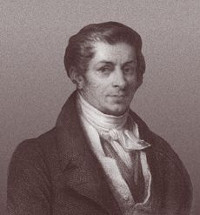
Jean-Baptiste Say (1767-1832),
The Concise Encyclopedia of Economics
Includes picture and list of selected works
French economist J. B. Say is most commonly identified with Say's Law, which states that supply creates its own demand. Over the years Say's Law has been embroiled in two kinds of controversy—the first over its authorship, the second over what it means and, given each meaning, whether it is true. ... Say was the best-known expositor of Adam Smith's views in Europe and America. His Traité d’économie politique was translated into English and used as a textbook in England and the United States. But Say did not agree with Adam Smith on everything. In particular, he took issue with Smith's labor theory of value.
Say, Jean-Baptiste (1767-1832), by
David M. Hart,
The Encyclopedia of Libertarianism, 15 Aug 2008
Biographical and bibliographical essay
Jean-Baptiste Say was the leading French political economist in the first third of the 19th century ... Say made his name with the publication of the Traité d'économie politique (1803), which went through many editions and revisions during his lifetime. The ideas that are most closely associated with his name include "Say's law" of markets—crudely formulated sometimes as "supply creates its own demand" or more broadly understood as the idea that nations and individuals benefit from each other's rising level of wealth as it provides increased opportunities for mutually beneficial trade.
Articles
The Accidental Inventor of Today's Capitalism: Jean-Baptiste Say, No Longer a Villain, Stands Guard Over Free Markets, by Louis Uchitelle,
The New York Times, 21 Feb 1998
Written in the aftermath of the 1997 Asian financial crisis, discusses Say's law, both as popularly heard and what he actually wrote, and Keynes' role in making Say's unwritten words famous as well as his preference for government intervention
[Jean-Baptiste Say] never actually wrote "supply creates its own demand." His best seller, the "Treatise on Political Economy," published in 1803 ... is full of the concept, but not the famous five words ... John Maynard Keynes attributed Say's law to Say, and made him famous. It was the Great Depression of the 1930's, and free market concepts were ripe for attack. Supply certainly was not creating its own demand. There was supply, but no buyers. And Keynes singled out Say, making him the foil for his own view of how markets work and the role government should play in keeping markets on track.
Editorial: Turgot and the Battle Against Physiocracy, by
Leonard Liggio,
Literature of Liberty, 1979
Editorial essay for volume II, number 1; discusses those who influenced Turgot and those influenced by him
Turgot’s economic influence is also evident on J. B. Say's law of markets. In the 'Observations on a Paper by Saint-Péravy' (1767), Turgot exposited what later became 'Say's Law of Markets.' Turgot's analysis of the basic issues inspired Say's effective statement of his theory of markets. As did Say, Turgot noted the economic effects of wars, especially in causing inflation: 'The deadly contrivance of borrowing derives from the mania of spending more than one owns...; the ambition of Louis XIV and other princes has no less been a cause of it [the borrowing] through their stubborn wars pushed to the point of exhaustion. ...'
Frederic Bastiat, Ingenious Champion for Liberty and Peace, by
Jim Powell,
The Freeman, Jun 1997
Biographical essay of Frédéric Bastiat, covering those who influenced him as well as those influenced by him, his writings (including correspondence with his friend Coudroy), his roles in the French Constituent and Legistative Assemblies and his legacy
[Jean Baptiste] Say descended from Protestants who had fled France during religious persecution. He worked for a while in Britain before joining a Paris insurance company. There his boss suggested that he read Adam Smith's Wealth of Nations. The book thrilled him, and he resolved to learn more about how an economy works ... He co-founded a republican periodical, La Décade philosophique, which published many of his articles about economic freedom ... The Traité d'économie politique, Say's major work, appeared in 1803. He reintroduced free-market views to France and Europe generally.
Related Topics:
Frédéric Bastiat,
Richard Cobden,
Foundation for Economic Education,
Benjamin Franklin,
Government,
Henry Hazlitt,
Law,
The Law,
Libertarianism,
Liberty,
Gustave de Molinari,
Rights,
Adam Smith,
Socialism,
The State,
Trade
Jean-Baptiste Say (1767 - 1832),
Religion & Liberty, Jun 2002
Highlights Say's contributions on entrepreneurship, his troubles and later vindication in France, and his influence on Jefferson and Madison
Jean-Baptiste Say was inspired to write his Treatise on Political Economy when, working at a life insurance office, he read a copy of Adam Smith's Wealth of Nations. His Treatise, often described as a popularization of Smith's ideas, departed from the typical economics methodology of his day. This departure was based on Say's conviction that the study of economics should start not with abstract mathematical and statistical analyses but with the real experience of the human person. ... Say's emphasis on the role of the entrepreneur in an economy ... was Say's primary contribution to the field of economics.
Jean-Baptiste Say: Neglected Champion of Laissez-Faire, by Larry J. Sechrest, 15 Jul 2000
Biographical and bibliographical essay, discussing Say's life, methodology and his writings on money, banking, the law of markets, entrepreneurship, capital, interest, value, utility, taxes and the state
[J.B. Say] was born in Lyons, France, to middle-class Huguenot parents, and spent most of his early years in Geneva and London. As a young man, he returned to France in the employ of a life insurance company, and soon became an influential member of a group of strongly pro-free-market intellectuals. Indeed, Say was the first editor of La Decade Philosophique, a journal published by the group ... His devotion to laissez-faire principles appears to have been maintained throughout his life ... J.B. Say deserves to be remembered ... as a pivotal figure in the history of economic thought.
Liberalism, Marxism, and the State [PDF], by
Ralph Raico,
Cato Journal, 1992
Examines the writings about the state by the French founders and contributors to the early 19th century journal
Le Censeur, compares them to Karl Marx (who they influenced), as well as some 1990 comments by Václav Havel
The greatest influence on the Industrialists [Comte and Dunoyer] was Jean-Baptiste Say. Say ... held that wealth is composed of what has value, and value is based on utility ... Say awards pride of place ... to the entrepreneur; Say was one of the first to realize the boundless possibilities of a free economy led by creative entrepreneurs ... But categories exist of persons who consume wealth rather than produce it ... Say was quite aware that anti-productive and anti-social activity was also possible, [even] common, when otherwise productive elements used state power to capture privileges ...
Libertarian Class Analysis, by
Sheldon Richman,
Freedom Daily, Jun 2006
Examines the class analysis of Charles Comte, Charles Dunoyer and Augustin Thierry and its basis on the work of J. B. Say, drawing on writings by Ralph Raico, Leonard Liggio, David M. Hart and Walter E. Grinder
Comte and Dunoyer were influenced by the important, but underappreciated, French liberal economist J.B. Say, whom Murray Rothbard lauded as brilliantly innovative, the superior of Adam Smith ... Indeed, the seeds of a radical liberal class theory were to be found in ... Say's Treatise on Political Economy ..., which reflected his response to Napoleon's military spending and economic manipulation ... Comte and Dunoyer were struck by Say's view that services provided in the marketplace are productive ... "immaterial goods" and that the entrepreneur, like the laborer, is a producer.
Life and Work of Richard Cantillon, by Henry Higgs, 1959
Concluding essay to the 1959 edition of the
Essai, edited and translated by Henry Higgs, pp. 363-389
So eminent an authority on the history of economic thought as Professor Gide claims for J. B. Say that he 'first employed the well-chosen term Entrepreneur to designate that most important economic function of the man who collects in his hands the productive forces of capital—labour and natural agents'. And again, J. B. Say 'gave economic science its present form and its definitions... (e.g. the term "Entrepreneur" which has been borrowed by most other languages)'. Say's Traité appeared in 1803. It is unnecessary to point out that Cantillon anticipated him completely 70 years earlier ...
Monetary Central Planning and the State, Part XVIII: Say's Law of Markets and Keynesian Economics, by
Richard M. Ebeling,
Freedom Daily, Jun 1998
Contrasts the views of John Maynard Keynes with "the commonsense foundations of economics" by explaining the basics of exchange and markets, and discussing Say's Law and John Stuart Mill's refinement
The cobbler makes shoes and sells them ... [He] then uses the money he has earned ... to buy the food he wants to eat. But he cannot buy that food unless he has first earned a certain sum of money by selling a particular quantity of shoes on the market. In the end, his supply of shoes has been the means for him to demand a certain amount of food. This, in essence, is the meaning of Say's Law, named after the 19th-century French economist Jean-Baptiste Say. Say called it "the law of markets." Unless we first produce, we cannot consume; unless we first supply, we cannot demand.
 Non-Marxist Theories of Imperialism
, by
Alan Fairgate,
Reason, Feb 1976
Examines writings of critics of imperialism that are not based on Marxist analysis
Those with a background in Austrian economics should be well acquainted with the classic statement of Say's Law of Markets and the logic behind the contention that a situation of absolute or general overproduction (or underconsumption) cannot emerge in the free market. The economist Benjamin M. Anderson offers the following concise summary of Say's Law:
Supply and demand in the aggregate are ... not merely equal, but they are identical, since every commodity may be looked upon either as supply of its own kind or as demand for other things. (Economics and the Public Welfare ...)
Related Topics:
Latin America,
Banking,
John Bright,
Richard Cobden,
John T. Flynn,
Foreign entanglements,
Garet Garrett,
Imperialism,
Leonard Liggio,
Militarism,
George Orwell,
Murray N. Rothbard,
Joseph Schumpeter,
Adam Smith,
Joseph R. Stromberg,
William Graham SumnerSay's Law and the Keynesian Revolution, by
Richard M. Ebeling,
Freedom Daily, Feb 1999
Review of
Say's Law and the Keynesian Revolution: How Macroeconomic Theory Lost Its Way (1998) by Steven Kates
In his recent book ... Steven Kates ... thoroughly demonstrates that Keynes misrepresented and then criticized the classical economists' theory of the "law of markets and their explanation of the causes of economic depressions. ... Beginning with Jean-Baptiste Say and then refined ... the law of markets was stated in the following way: Ultimately it is always goods that are traded for goods. ... Say's Law ... explains both what causes unemployment and how to solve it. But the ghost of Keynes continues to point economic policy in the direction of inflationary demand stimulus in an attempt to bring markets back into balance.
William Harold Hutt (1899-1988): A Biographical Essay from an Austrian Perspective, by John B. Egger
Biographical and bibliographical essay
Keynes considered the foundation of his own work his refutation of Say's Law, which (according to Hutt) he coined the phrase "supply creates its own demand" to express, and Keynesianism[— Retrospect and Prospect]'s central theme was to reassert the validity and relevance of Say's perceptiveness. Later he focused precisely on this, with his provocative short study A Rehabilitation of Say's Law. By then he was delighted to find works by Clower, Leijonhufvud, and Yeager courageously advocating the use of forms of Say's Law.
Writings
Letters to Mr. Malthus, on Several Subjects of Political Economy, and on the Cause of the Stagnation of Commerce, 1820
Original title: Lettres à M. Malthus, sur différens sujets d'économie politique, notamment sur les causes de la stagnation générale du commerce
Series of five letters from Say to Malthus, written in response to the latter's criticisms in
Principles of Political Economy (1820); the letters were translated from the French by John Richter
Every person who takes an interest in the new and interesting science of political economy, will certainly read the work with which you have lately enriched it. You are not one of those authors who claim the attention of the public, without having any information to communicate ...
I strip [my pretended paradoxes] completely naked, and submit them to the candour of Mr. Ricardo and yourself, and to the good sense of the public. I shall however hold myself at liberty to explain them if they are misunderstood, and to defend them with perseverance if they are unjustly attacked.
Related Topics:
Capital Goods,
Capitalism,
Economics,
Entrepreneurship,
Europe,
Farming,
Government,
Labor,
Prices,
Adam Smith,
Taxation,
Technology,
Trade,
United States
Reviews
Book Review: J.-B. Say: An Economist in Troubled Times, by
Richard M. Ebeling,
Freedom Daily, May 1998
Review of
J.-B. Say: An Economist in Troubled Times (1997), writings selected and translated by R. R. Palmer
One of the most original and influential of these early 19th-century classical liberals was the French economist Jean-Baptiste Say. Born in 1767, Say published the first edition of his famous Treatise on Political Economy in 1803 ... [M]ost of Say's political and economic writings have not been available in English. Noted historian R.R. Palmer has recently translated and edited selections from these works ... [T]he main focus of his writings was to emphasize the importance of sound economic principles for understanding why the market should be freed from government control.
Books
J. B. Say: An Economist in Troubled Times
by R. R. Palmer ((editor, translator)), 1997
Chapter list: The Mild Revolutionary, The Sober Utopian, The Frustrated Economist, The Innovative Economist, The Commentator on England, The Professor of Political Economy
Books Authored
Traité d’économie politique ou simple exposition de la manière dont se forment, se distribuent et se consomment les richesses, 1803
French Wikisource has six editions available, dating from 1803 to 1841, in DjVu format; the last one fully transcribed and published after Say's death but based on manuscripts he left with his brother Horace
A Treatise on Political Economy: or The Production, Distribution, and Consumption of Wealth, 1803
Contents: Of the Production of Wealth - Of the Distribution of Wealth - Of the Consumption of Wealth; electronic text available at The Library of Economics and Liberty is from the 1855 translation by C. R. Prinsep based on the 4th and 5th French editions