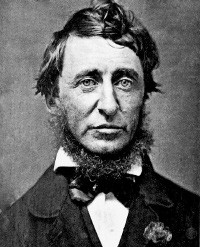
Henry David Thoreau (1817-1862) was a naturalist, essayist, poet and philosopher. A leading transcendentalist, he is best known for his book Walden, a reflection upon simple living in natural surroundings, and his essay "Civil Disobedience" (originally published as "Resistance to Civil Government"), an argument for citizen disobedience to an unjust state. Thoreau was a lifelong abolitionist, delivering lectures that attacked the fugitive slave law. Thoreau's philosophy of civil disobedience later influenced the political thoughts and actions of notable figures such as Leo Tolstoy, Mahatma Gandhi and Martin Luther King, Jr.
Reference
Henry David Thoreau, by Rick Anthony Furtak, Stanford Encyclopedia of Philosophy, 30 Jun 2005
Major sections: Life and Writings - Nature and Human Existence - The Ethics of Perception - Friendship and Politics - Locating Thoreau - Bibliography; last substantive revision 8 Aug 2014
Henry David Thoreau (1817–1862) was an American philosopher, poet, and environmental scientist whose major work, Walden, draws upon each of these identities in meditating on the concrete problems of living in the world as a human being. He sought to revive a conception of philosophy as a way of life, not only a mode of reflective thought and discourse. Thoreau's work was informed by an eclectic variety of sources.
Henry David Thoreau (1817-1862), by Robert Michael Ruehl, Internet Encyclopedia of Philosophy
Major sections: Biographical Information - Subjectivity, Philosophy, and Writing - Education and Uncommon Sense - Nature and Ontology - Religion and the Wild - An Ethic of Preservative Care - Disobedient Politics - Conclusion
The American author Henry David Thoreau is best known for his magnum opus Walden, or Life in the Woods (1854); second to this in popularity is his essay, 'Resistance to Civil Government' (1849), which was later republished posthumously as 'Civil Disobedience' (1866). ... Thoreau gravitated toward Stoic philosophy, Hindu and Buddhist insights, and European idealism and romanticism; he was an eclectic thinker weaving together various philosophies to formulate his own unique strain of American thought.
Henry David Thoreau was an American naturalist, a lecturer, and an abolitionist. Thoreau was the author of perhaps the most radical and influential essay in the history of American political philosophy, "Civil Disobedience." ... Thoreau's tax resistance, which led to his being jailed in Concord in 1846, was occasioned by his opposition to slavery. Thoreau was an abolitionist, as was his father, and there is some evidence that both the Thoreau family home in Concord and Henry's famous cottage on Walden Pond, a short distance outside the village, were stops on the Underground Railroad ...
Henry David Thoreau and "Civil Disobedience," Part 1, by Wendy McElroy, Freedom Daily, Mar 2005
After some background and biographical material, describes the event (Thoreau's imprisonment) that led to writing "Civil Disobedience" and Thoreau's reaction to those who paid the tax on his behalf, his jailers, his neighbors and Ralph Waldo Emerson
Henry David Thoreau (1817–1862) was an introspective man who wandered the woods surrounding the small village of Concord, Massachusetts ... How, then, did he profoundly influence such political giants as Mohandas Gandhi, Leo Tolstoy, and Martin Luther King Jr.? The answer lies in a brief essay that has been variously titled but which is often referred to simply as "Civil Disobedience" (1849). Americans know Thoreau primarily as the author of the book Walden, or Life in the Woods (1854) but it is "Civil Disobedience" that established his reputation in the wider political world.
Henry David Thoreau and "Civil Disobedience," Part 2, by Wendy McElroy, Freedom Daily, Apr 2005
Examines several of the initial themes in Thoreau's "Civil Disobedience", including government injustice, the individual as the source of power and authority, war and the military and the reasons why people obey the state
Whatever his position on government, one point is clear: Thoreau denies the right of any government to automatic and unthinking obedience ... This is the key to Thoreau's political philosophy. The individual is the final judge of right and wrong. More than this, since only individuals act, only individuals can act unjustly ... Before [his] imprisonment, when a confused taxman had wondered aloud about how to handle his refusal to pay, Thoreau had advised, "Resign." If a man chose to be an agent of injustice, then Thoreau insisted on confronting him with the fact that he was making a choice.
Henry David Thoreau and "Civil Disobedience," Part 3, by Wendy McElroy, Freedom Daily, May 2005
Further examination of themes in "Civil Disobedience", including unjust laws, politicians and reformers, voting, when to resist the state and the influence on Gandhi
Thoreau dissects the notion that "the law is the law and should be respected." ... [N]ot all laws are equal. Some laws exist for no other reason than to protect the government ... Lawyers and the courts are part of the state's defensive machinery ... Such courts offer no protection to Thoreau, who refuses to respect their authority. But he takes his refusal one step further. He not only rejects unjust laws but also the men who enact them. He withdraws his support from politicians who "rarely make any moral distinctions [and] are as likely to serve the Devil, without intending it, as God."
Henry David Thoreau was born David Henry Thoreau on July 12, 1817, in Concord, Massachusetts, a small country town about 20 miles northwest of Boston ... Nathaniel Hawthorne, who met him in 1842 at Emerson's house, wrote that ... Thoreau seemed highly intelligent and had a Harvard education in an era when few men had any more schooling than the local grammar school could provide them ... What Thoreau really wanted to do was walk around the countryside, observing nature and making entries in his notebooks, which he would later write up in more finished form in his journal.
Henry David Thoreau - Hero of the Day, The Daily Objectivist, 2000
Biographical profile published by The Daily Objectivist; excerpted from "Resistance to Civil Government"
I heartily accept the motto, 'That government is best which governs least'; and I should like to see it acted up to more rapidly and systematically. Carried out, it finally amounts to this, which also I believe--'That government is best which governs not at all'; and when men are prepared for it, that will be the kind of government which they will have.
"If 1,000 Men Were Not to Pay Their Tax Bills This Year…", by Carl Watner, Reason, Sep 1983
Discusses the 1846 incident that led Thoreau to spend a night in jail for refusing to pay a poll tax and the influence of his friends Bronson Alcott and Charles Lane as well as those Thoreau influenced later
One evening in late July 1846, Henry David Thoreau walked into the village of Concord ... to pick up a shoe he had left at the cobbler's. He was stopped on the street by the local constable, Sam Staples, and asked to pay his poll tax, which he had not paid for three or four years ... Thoreau responded that he had not paid his tax as a matter of principle and didn't intend to pay it ... That didn't go over too well, and since Thoreau did not promptly pay up, Staples hauled him off to jail ... Based on his experience ... [he] presented a lecture ... titled "The Relation of the Individual to the State."
Henry David Thoreau (1817-1862) ... was a deep believer in the demands of conscience over the demands of the state. His refusal in July 1846 to pay a tax led him to write the essay Civil Disobedience, which was to exercise a great influence on subsequent generations of thinkers. ... Obligations to pay taxes to the state or to submit to its authority normally fall into the second category of particular obligations. Thoreau insists that he did not consent to them, and that he therefore is not bound by them and instead follows the demands of his own conscience (notably his opposition to the enforcement of slavery and to the war with Mexico).
Henry David Thoreau is best known for Walden, which chronicles his experiment in simple, self-sufficient living. Less remembered, however, is that while living at Walden Pond, he was imprisoned for refusing to pay his poll tax as a statement of protest against slavery and what he saw as an unjust war with Mexico. After someone else paid his tax, he was released, but he gave an 1848 lecture on 'Resistance to Civil Government'--since published as 'Civil Disobedience'--to explain his action.
Thoreau And The Modern American Housewife, by Frances Brown, Reason, Aug 1962
A 1960's housewife tells of her "friendship" with Thoreau, from having to read Walden in college, through jobs, marriage, wanting a new house, children growing up and how Henry's advice coloured her decisions
Today I went to town and bought two copies of Walden, and I mailed one to each of the boys, enclosing this note:
I would like for you to become better acquainted with my dear friend, Henry David Thoreau. The reading of this book started a new era in my life; it helped me to consider my values before I acted. I hope it can bring to you some of the happiness it has brought to me.
Interviews
An Interview With David Theroux, by David J. Theroux, Strike-The-Root.com, 2 Sep 2003
Topics discussed include: the Independent Institute, Theroux's life before founding it, possible connection to Thoreau, the Vietnam War, his heroes and influencers, activism, September 11 and book recommendations
How did you get a cool name like David Theroux? Do people often ask you if it has anything to do with Henry David Thoreau? Although Thoreau has long been an inspiration for me, my full name is actually David Jon Theroux ... [D]uring my first year ..., my parents moved and we lived in Needham, Mass., a short distance from Walden Pond, where ... Thoreau retreated to write his famous book, Walden. It is unclear whether there is a family tie to Thoreau (who had no direct descendants), but French names were often misspelled or re-spelled in order to be more functional in the ... American republic.