Reference
Washington, George (1732-1799), by
Jonathan Rowe,
The Encyclopedia of Libertarianism, 15 Aug 2008
Biographical essay, including examination of some of his writings
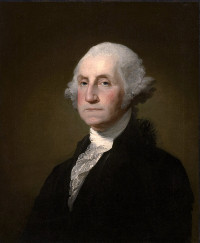
George Washington was the first president of the United States and the "father of his country." Washington fought for the Virginia colony early in the French and Indian War, and he later commanded the Continental Army in America's fight for independence. He presided over the Constitutional Convention and served for two terms as president under the new Constitution ... Washington was fervently committed to the cause of republicanism, which embraced the view that political liberty was an inalienable right. Indeed, he played leading roles in nearly every major event of America's founding.
Born
22 Feb
1732, in Popes Creek Plantation, Westmoreland County,
Virginia
Biography
Biography of George Washington: George Washington's Mount Vernon
Educational resource from the Mount Vernon Ladies' Association; includes birth and childhood, French & Indian War, marriage & family, entrepreneur, slavery, Revolutionary War, Constitutional Convention, Presidency and final years
Popular fables illustrating young George Washington's youthful honesty, piety, and physical strength have long taken the place of documented fact. Some of these fables are more plausible than others. The story that Washington threw a silver dollar across the Potomac River -- an impossible feat -- had its origins in the recollections of a cousin that George could throw a stone across the much narrower Rappahannock River. But others, including the familiar story of Washington and the cherry tree, seem to have been invented by one of Washington's first biographers, Mason Locke Weems.
Biography of George Washington - The Washington Papers, by Mark Mastromarino, Dec 1999
Written for Bicentennial of Washington's death; includes Surveying the Land: An Early Career for Young Washington, Building a Record in the Military, Love & Marriage, Politics & War, First President of a New Country, The Final Chapter
George Washington (1732-1799), the most celebrated person in American history, was born on 22 February 1732 on his father's plantation on Pope's Creek in Westmoreland county, Virginia. ... Washington's burning ambition for personal distinction did not permit him to remain long content as a tobacco planter but compelled him to seek out honor on the battlefield. ... Washington knew that his leadership was no longer indispensable to the survival of the nation, and he left as his political testament to the American people his Farewell Address, which was widely printed in newspapers and broadsides.
Websites
Anti-Tariff.org, by
Independent Institute,
Vernon Smith (signer),
Robert Higgs (signer),
Donald J. Boudreaux (signer),
Peter J. Boettke (signer),
Richard Ebeling (co-signer),
Williamson Evers (co-signer),
Mark Skousen (co-signer), 18 Apr 2025
Includes text of "Trade and Tariffs Declaration", identification of 24 principal signers, additional notable co-signers and link for other individuals to sign
[W]e reiterate a commitment to the foundational principles articulated by George Washington in his Farewell Address:
"Harmony, liberal intercourse with all nations, are recommended by policy, humanity, and interest. But even our commercial policy should hold an equal and impartial hand; neither seeking nor granting exclusive favors or preferences; consulting the natural course of things; diffusing and diversifying by gentle means the streams of commerce, but forcing nothing."
George Washington | National Portrait Gallery
Smithsonian Institution's National Portrait Gallery formerly traveling exhibition of Gilbert Stuart's portrait of George Washington. Site includes audio narration.
George Washington stands before you in a full-length portrait by Gilbert Stuart. The painting, done in 1796, is known as the Lansdowne portrait because it was a gift to the Marquis of Lansdowne ... This interactive portait allows you to to explore the portrait in detail, from three very different vantage points: the symbolic, the biographic, and the artistic. Each filter highlights an element in the portrait and provides unique information and a distinct interpretation. What does an element symbolize? How does it relate to Washington? And, what techniques did the artist use to render it?
George Washington Papers | Library of Congress
Includes timeline as well as various essays
The papers of army officer and first U.S. president George Washington (1732-1799) held in the Manuscript Division of the Library of Congress constitute the largest collection of original Washington papers in the world. ... This collection ... is organized into nine series ... Exercise Books, Diaries, and Surveys, ca. 1745-1799 ... Letterbooks, 1754-1799 ... Varick Transcripts, 1775-1785 ... General Correspondence, 1697-1799 ... Financial Papers, 1750-1796 ... Military Papers, 1755-1798 ... Applications for Office, 1789-1796 ... Miscellaneous Papers, ca. 1775-1799 ... Addenda, ca. 1732-1943
George Washington's Mount Vernon
Owned and maintained by the Mount Vernon Ladies' Association founded in 1853 (the oldest national historic preservation organization in the United States)
We envision an America where all know and value the singular story of the Father of Our Country. Ever mindful of our past, we seek innovative and compelling ways to tell the story of George Washington so that his timeless and relevant life lessons are accessible to the world. ... Open 365 days of the year, Mount Vernon is the most popular historic estate in America. Over 85 million people have visited Mount Vernon since 1860, when the estate officially opened to the public. Today, Mount Vernon welcomes an average of one million guests each year.
The Washington Papers | The Complete Corrrespondence
The Letterpress Edition is in five series: Colonial (1744-75), Revolutionary War (1775-83), Confederation (1784-88), Presidential (1788-97) and Retirement (1797-99). The Digital Edition is available in three versions.
The Papers of George Washington, a grant-funded project, was established in 1968 at the University of Virginia, under the joint auspices of the University and the Mount Vernon Ladies’ Association of the Union, to publish a comprehensive edition of Washington's correspondence. ... Today there are copies of over 135,000 Washington documents in the project's document room. This is one of the richest collections of American historical manuscripts extant. There is almost no facet of research on life and enterprise in the late colonial and early national periods that will not be enhanced by material from these documents.
Web Pages
The man who financed the American Revolution, by
Jim Powell,
LibertyStory.net
Lengthy biographical essay of Robert Morris, a signer of the Declaration of Independence (and other founding documents) and financier of the Revolutionary War
Desperate to hold his army together, Washington promised his soldiers that if they would remain with him for an additional six weeks, each soldier would get a $10 bonus, but he told Morris he didn’t know how he would pay it ... Washington subsequently led his soldiers to Trenton where they won an important victory against the British ... Washington wrote Morris, asking for still more money: "The service they are going upon is disagreeable to the northern regiments, but I make no doubt that a douceur of a little hard money [gold and silver] would put them in a proper temper."
Articles
The American Heritage of "Isolationism", by
Gregory Bresiger,
Freedom Daily, May 2006
Criticizes the use of the word "isolationist" by the media, "internationalists" and other foreign intervention promoters, looking at the heritage of noninterventionism as exemplified by Washington's Farewell Address
[I]solationism—noninterventionism—became the standard for American foreign policy ... Its formal beginning came ... with [George Washington's] Proclamation of Neutrality in 1793 ... [The] proclamation ... was controversial because the United States still had an alliance with France that was entered into during the American Revolution ... Nevertheless, Washington's goal was to put relations with both empires on an equal footing. He saw war with either side as inherently dangerous. He feared that if the United States joined the war, the country would be divided between partisans of both sides.
Related Topics:
John Adams,
Foreign entanglements,
Limited Government,
Thomas Jefferson,
Lyndon B. Johnson,
Militarism,
Richard Nixon,
Franklin D. Roosevelt,
Trade,
Vietnam War,
Woodrow Wilson
Benjamin Franklin: The Man Who Invented the American Dream, by
Jim Powell,
The Freeman, Apr 1997
Lengthy biographical essay, including a section on the posthumous publication and reaction to Franklin's
Autobiography
[Franklin] might not have accomplished much without evidence that the Americans could win. Washington provided that when he crossed the Delaware River on Christmas Day 1776 and won the Battle of Trenton, capturing over 900 fierce Hessian soldiers, mercenaries for the British ... In 1781, the British General Charles Cornwallis retreated from advancing forces led by George Washington and the French Marquis de Lafayette ... In late 1787, Franklin had a bad fall ... George Washington wrote: "As long as I retain my memory, you will be thought of with respect, veneration and affection."
Related Topics:
John Adams,
American Revolutionary War,
United States Constitution,
United States Declaration of Independence,
Entrepreneurship,
France,
Benjamin Franklin,
Thomas Jefferson,
Massachusetts,
Thomas Paine,
Pennsylvania,
Philadelphia,
No quartering of Soldiers,
Taxation
Bill Kauffman: American Anarchist, by Laurence M. Vance, 4 Dec 2006
Review of Kauffman's
Look Homeward, America: In Search of Reactionary Radicals and Front-Porch Anarchists (2006)
Not only does Kauffman disdain elites and our "great" presidents, Congress as a whole does not impress him either. After recounting the annual ritual in the U.S. Senate of the reading of Washington's Farewell Address (in which he quotes Washington's warning against "overgrown military establishments," "permanent alliances with any portion of the foreign world," and "excessive partiality for one foreign nation"), Kauffman remarks that "the Senate spends the next 364 days of the year repudiating the Father of Our Country."
Bureaucracy and the Civil Service in the United States, by
Murray N. Rothbard,
The Journal of Libertarian Studies, 1995
Historical examination of the evolution of the United States Civil Service and attempts to reform it, from its beginnings through the early 20th century
Starry-eyed historians have contended that George Washington staffed the administrative bureaucracy with a genuinely non-political and non-partisan array of the Best and the Brightest. Carl Prince has shown, however, that, guided by ... Alexander Hamilton, Washington deliberately developed a highly partisan, Federalist party-oriented federal civil service. In the first place, all Anti-Federalists were from the beginning deliberately excluded from office ... During the second Washington administration, [he] and Hamilton had made sure to exclude members of the new Republican Party from office ...
Related Topics:
John Adams,
Bureaucracy,
Founding Fathers,
Government,
Limited Government,
Andrew Jackson,
Thomas Jefferson,
Richard Nixon,
Pennsylvania,
Political Parties,
Spoils system,
Martin Van Buren,
Voting
Citizen Washington, by
Ryan McMaken,
LewRockwell.com, 23 Feb 2001
Contrasts the good and bad policies and events during Washington's presidency with his achievements prior to taking office and cautions against confusing "great men and great presidents"
This ... pulls into focus why we honor George Washington in the first place. Washington is important not as a president, but simply as a man. He was a man who risked his vast fortune and his life to fight for what many saw as a lost cause. Who can say that any president ever risked as much as Washington did during the revolution? ... [His] accomplishments as a soldier and private citizen are important to recognize because they illustrate that Washington should not be considered great because he became president. [He] was a great man who just happened to be president at one point in his life.
Emergencies: The Breeding Ground of Tyranny, by
William L. Anderson,
Freedom Daily, Nov 2006
Examines the long history of "emergency powers" claimed by U.S. Presidents, including recent examples such as sanctions stemming from the International Economic Powers Act and the so-called War on Terror
Issues of national emergencies and presidential emergency powers existed long before the devastating attacks of September 11, 2001. One can argue that George Washington grabbed what could only be called "emergency powers" when he led an army of federalized troops into Western Pennsylvania in order to enforce collection of taxes on "spirits." While no courts ever ruled on his actions, Washington certainly pushed the envelope with respect to the exercise of "emergency powers."
George Mason and the Bills of Rights, by
Gary Williams,
The Freeman, May 1992
Relates the life of George Mason, his primary role in writing the Virginia Declaration of Rights and his opposition to ratifying the U.S. Constitution
What first drew Mason into public life was involvement as an officer in the Ohio Company, a group of local land speculators that included his friend and neighbor, George Washington ... In July 1774, Mason and Patrick Henry spent the night at Mount Vernon ... When Washington was named commander-in-chief of the Continental Army in 1775, Mason was prevailed upon to take his friend's seat in the Virginia legislature ... One of the casualties [of the Constitutional ratification fight] was the friendship of Mason and Washington, as the latter bitterly referred to Mason as his "quondam friend."
George Washington - Hero of the Day, by
David Ramsay,
The Daily Objectivist, 2000
Biographical profile published by
The Daily Objectivist; excerpted from the 1807 biography
Life of Washington
Valley Forge, about twenty-five miles distant from Philadelphia, was fixed upon for the winter quarters of the Americans. ... The legislature of Pennsylvania ... on hearing that Washington was about to retire into winter quarters, presented a remonstrance to Congress on that subject ... A copy of this being sent to him, he addressed Congress in terms very different from his usual style. ... He assured the complainers, 'that it was much easier to draw up remonstrances in a comfortable room by a good fire-side, than to occupy a cold bleak hill, and sleep under frost and snow, without clothes or blankets.'
Happy Counterterrorism Day, by
Scott Horton,
Harper's Magazine, 5 Nov 2007
Recounts the history of Guy Fawkes and the Gunpowder Plot and proposes three lessons to be learned from it for the present age
The original George W. saw things quite differently. For him, America was involved in a struggle for its liberty, and the commemoration of Guy Fawkes stood for the opposite: government by fear, oppression of a minority, a celebration of arbitrary power. Guy Fawkes Day was the abnegation of the essential values of the Revolution. So [he] put it in an order: No more Guy Fawkes Day ... America, ... having abolished Guy Fawkes Day would mark that week with a new tradition: the exercise of the democratic franchise. It was to be the time in which the rulers are held accountable to the people.
Independence Day Propaganda, by
Anthony Gregory,
LewRockwell.com, 4 Jul 2011
Argues that the American Revolution, albeit of a libertarian flavor, had several unsavory shortcomings both before and after 4 July 1776
The first major battle in [the French and Indian] war, the Battle of Jumonville Glen, was an ambush of French Canadians spearheaded by George Washington ... A year before the Declaration ..., ... Washington began the process of structuring the military along authoritarian lines, instituting gratuitously unequal pay, dealing death to deserters, and even attempting (but failing) to raise the maximum corporal punishment to 500 lashes ... [As president, he] cracked down on the ... Whiskey Rebellion, created a national bank, and put ... Hamilton, a centralizing statist, in charge of the Treasury.
No More "Great Presidents", by
Robert Higgs,
The Free Market, Mar 1997
Discusses the results of a 1996 poll of 30 historians and two politicians asking them to rank U.S. presidents, focusing on those ranked Great, Near Great and Failure, and offers his own ranking
The three Great ones are Washington, Lincoln, and Franklin D. Roosevelt ... Of the top-ranking [nine,] three (Washington, Jackson, and Teddy Roosevelt) were best known prior to becoming president for their martial exploits ... Washington, I think, actually does deserve a high rating—not even the historians can be wrong all the time. He established the precedent of stepping down after two terms, which lasted until it clashed with FDR's insatiable ambition, and he prescribed the sensible foreign policy, later slandered as "isolationism," that served the nation well for more than a century.
The Post Office as a Violation of Constitutional Rights, by
Wendy McElroy,
The Freeman, May 2001
Prompted by the announcement of the U.S. Postal Service eBillPay service (now discontinued), surveys the history of mail service vis-à-vis civil rights, from colonial days to the present
[R]eliability of delivery would not be the only goal of the new postal service. In 1785, a resolution authorized the secretary of the Department of Foreign Affairs to open and inspect any mail that related to the safety and interests of the United States. The ensuing "inspections" caused prominent men, such as George Washington, to complain of mail tampering. According to Unmailable: Congress and the Post Office by Dorothy Ganfield Fowler, the Continental Congress was soon debating whether some communications should be deemed "unmailable" because their content was too dangerous.
The Spirit of Humility [PDF], by
Stanley Kober,
Cato Journal, 1997
Discusses the recognition of the limits on human knowledge, which the author claims leads to the title spirit as evidenced in "the American experiment" and its possible lessons for European unification
[Washington] considered himself "a Citizen of the great republic of humanity at large." As he explained in a letter to Lafayette:
I cannot avoid reflecting with pleasure on the probable influence that commerce may hereafter have on human manners and society in general. On these occasions I consider how mankind may be connected like one great family in fraternal ties. I indulge a fond, perhaps an enthusiastic idea ... that the period is not very remote, when the benefits of a liberal and free commerce will, pretty generally, succeed to the devastations and horrors of war.
Writings
 Farewell Address
,
Claypoole’s American Daily Advertiser, 19 Sep 1796
Full title: The Address of General Washington To The People of The United States on his declining of the Presidency of the United States
Letter by President Washington to the American public, published about two months before the 1796 election, declining to serve a third term and serving as his farewell
The period for a new election of a Citizen, to Administer the Executive government of the United States, being not far distant, ... it appears to me proper, especially as it may conduce to a more distinct expression of the public voice, that I should now apprise you of the resolution I have formed, to decline being considered ...
I anticipate with pleasing expectation ... the sweet enjoyment of partaking ... the benign influence of good Laws under a free Government—the ever favourite object of my heart, and the happy reward, as I trust, of our mutual cares, labours and dangers.
Book chapters
John Adams, by
John Fiske,
The Presidents of the United States, 1789-1914, 1914
Biographical essay; includes picture of Adams (painting by Gilbert Stuart), photograph of the Braintree houses where he was born; facsimile of a letter with his signature and a section on his wife Abigail
[Adams] proposed Washington for the chief command of [the continental] army, and thus, by putting Virginia in the foreground, succeeded in committing that great colony to a course of action [for] independence. This move not only put the army in charge of the only commander capable of winning independence ..., but its political importance was great and obvious. Afterward ..., Mr. Adams seems almost to have regretted his part in this selection of a commander. He understood little or nothing of military affairs, and was incapable of appreciating General Washington's transcendent ability.
Reviews
Founding Father: Rediscovering George Washington, by
Clarence B. Carson,
The Freeman, Sep 1996
Review of the 1996 book by Richard Brookhiser, concluding that it is "a worthy testament to the greatness of Washington"
This is ... a series of essays on the general subject of George Washington ... [He] was strong, courageous, brave, a good listener, a leader, had great dignity, was conscious of doing the honorable thing, and a patriot ... Washington was a man of ideas as well as of action ... Not only was he familiar with the well-traveled ideas of his time, he was given to asking those about him for their opinions and understanding, such as the need to restrain government lest it trample individual rights. He listened and learned much. There was a balance to his ideas that set him apart from most thinkers.
A Sacred Union of Citizens—George Washington's Farewell Address and the American Character, by
George C. Leef,
The Freeman, Nov 1997
Review of the title book (1996) by Matthew Spalding and Patrick Garrity, which examines Washington's Farewell Address
Of all the Founders, George Washington is the most famous, but arguably the least well known. [His] life is well chronicled, but when it comes to his thought, he is largely a mythic figure ... [H]e is known almost entirely for his deeds—defeating Cornwallis, presiding over the Constitutional Convention, serving as the first president ... Washington did not actually deliver the address; rather, he sent it to Philadelphia's American Daily Advertiser, where it was published on September 19, 1796 ... [I]n the Farewell Address, Washington extolled the virtues of just minding one's own business.