
Author of the Declaration of Independence, third president of the United States
See also: FreedomPedia
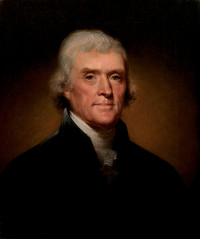
Thomas Jefferson (1743-1826) was an American Founding Father who served as the third president of the United States from 1801 to 1809. He was the principal author of the Declaration of Independence. Following the American Revolutionary War and before becoming president, Jefferson was the nation's first secretary of state under George Washington and then the second vice president under John Adams. Jefferson was a leading proponent of democracy, republicanism and natural rights, and he produced formative documents and decisions at the state, national, and international levels.
Related Works
United States Declaration of Independence, Author, signer and representative from Virginia
Reference
Jefferson, Thomas (1743-1826), by David Mayer, The Encyclopedia of Libertarianism, 15 Aug 2008
Biographical essay
Biographical essay
Thomas Jefferson was the author of the Declaration of Independence and other key documents of early American constitutionalism. He was almost certainly the founder most instrumental in developing the philosophy of limited government that dominated American political thought until the 20th century. Jefferson was a quintessential Renaissance man, with law and politics as perhaps the least favorite of his many interests, yet he was drawn into the political conflicts of his time because of his devotion to what he called "the holy cause of freedom."
Related Topics: United States Bill of Rights, United States Declaration of Independence
Biography
Life of Thomas Jefferson, by B. L. Rayner, 1834
Revised and edited (circa 1997) by Eyler Robert Coates, Sr.; presents the original text but with "a large number of corrections and additions", "a complete modernization of the punctuation" and "replacement of obsolete terms"
Revised and edited (circa 1997) by Eyler Robert Coates, Sr.; presents the original text but with "a large number of corrections and additions", "a complete modernization of the punctuation" and "replacement of obsolete terms"
Thomas Jefferson was born April 13, 1743 (April 2, old style), on the farm called Shadwell, adjoining what is now Monticello, in the county of Albermarle, Virginia. The date of his birth was unknown to the public until after his decease. Repeated attempts had been made to ascertain it ... but ... he always declined revealing it and enjoined the same privacy upon his family. The principles which determined him on this subject were the great indelicacy and impropriety of permitting himself to be made the recipient of a homage, so incompatible with the true dignity and independence of the republican character ...
Websites
Monticello.org
Owned and maintained by the Thomas Jefferson Foundation, Inc. (a non-profit corporation) since 1923 and opened to the public a year later
Owned and maintained by the Thomas Jefferson Foundation, Inc. (a non-profit corporation) since 1923 and opened to the public a year later
Monticello, Thomas Jefferson's plantation near Charlottesville, Va., was the center of his world. To understand Jefferson, one must understand Monticello; it can be seen as his autobiographical statement. ... The Foundation seeks to facilitate conversations and to use its extensive research and knowledge to stimulate interactions on a variety of topics that were of keen interest to Jefferson, the most powerful of which are liberty and self government. Through virtual, off-site and on-site engagement, the Foundation seeks to excite the world about Jefferson's relevance today and ignite a passion for history.
Thomas Jefferson Papers, 1606 to 1827
Digital collection at the Library of Congress; includes related essays as well as teaching and research resources
Digital collection at the Library of Congress; includes related essays as well as teaching and research resources
The papers of Thomas Jefferson (1743-1826), diplomat, architect, scientist, and third president of the United States ... consist of approximately 27,000 items ... The Thomas Jefferson Papers are divided into ten series as follows: ... General Correspondence, 1651-1827 ... Horatio Gates Letterbook, 1780-1781 ... District of Columbia Miscellany, 1790-1808 ... Account Books, 1767-1782 ... Commonplace Books, 1758-1772 ... Randolph Family Manuscripts, 1790-1889 ... Miscellaneous Bound Volumes, 1768-1829 ... Virginia Records, 1606-1737 ... Collected Manuscripts, 1783-1822 ... Addenda, 1781-1829
Web Pages
Brief Biography of Thomas Jefferson, Monticello.org
Sections: Who was Thomas Jefferson? - Jefferson's Early Life and Education - Monticello - Professional and Political Life - President of the United States (1801-1809) - Retirement - Death
Sections: Who was Thomas Jefferson? - Jefferson's Early Life and Education - Monticello - Professional and Political Life - President of the United States (1801-1809) - Retirement - Death
Other men would serve as U.S. president and hold the public offices he had filled, but only he was the primary draftsman of the Declaration of Independence and of the Virginia Statute for Religious Freedom, nor could others claim the position as the Father of the University of Virginia. More importantly, through these three accomplishments he had made an enormous contribution to the aspirations of a new America and to the dawning hopes of repressed people ... He had dedicated his life to meeting the challenges of his age: political freedom, religious freedom, and educational opportunity.
Home Study Course: Module 3: Thomas Paine's Common Sense and Thomas Jefferson and the Declaration of Independence
Third module of the Cato Home Study Course, includes link to listen or download audio program (two parts, 1:18:20 and 1:13:52), questions and suggested readings
Third module of the Cato Home Study Course, includes link to listen or download audio program (two parts, 1:18:20 and 1:13:52), questions and suggested readings
Thomas Jefferson (1743-1826), in drafting the Declaration of Independence, had, as he later said, "turned to neither book nor pamphlet in writing it"; he attempted simply "to place before mankind the common sense of the subject." This is strong evidence of the degree to which libertarian ideas, such as those articulated by John Locke in the previous century, had come to permeate popular American thinking on morality and politics. It is notable how many of phrases from Locke's Second Treatise of Government are echoed in the Declaration of Independence.
Thomas Jefferson - Libertarianism.org
Short profile and links to essays, videos and other resources about Jefferson
Short profile and links to essays, videos and other resources about Jefferson
One of the most well-known founding fathers, Thomas Jefferson was the principal author of the Declaration of Independence. The ideas of liberty he promoted continue to form the basis of the American cultural heritage today.
Thomas Jefferson - Online Library of Liberty
Includes portrait, short biography, links to timeline of his life and work, to various versions of Jefferson's works and to selected quotations
Includes portrait, short biography, links to timeline of his life and work, to various versions of Jefferson's works and to selected quotations
Thomas Jefferson (1743-1826), a Virginian, was the author of the American Declaration of Independence (1776), an active participant in the Revolution, Governor of Virginia (1779), member of Congress, Minister to France, Secretary of State under President Washington, and president of the United States (1800). He was a polymath who wrote on and was knowledgeable about science, architecture, music, agriculture, law, education, geography, and music.
Articles
273 Years Later, Here's How Thomas Jefferson Is Still Shaping Our Society, 13 Apr 2016
Brief discussion of the anniversary of Jefferson's birth date, together with a video where professor Aeon Skoble discusses what are rights
Brief discussion of the anniversary of Jefferson's birth date, together with a video where professor Aeon Skoble discusses what are rights
He was the author of the Declaration of Independence. He served as the third president of our country. He was an undisputedly important American intellectual and innovator. As we commemorate Thomas Jefferson's 273rd birthday (he was born on April 13th, 1743), we could certainly remember him for more than one accomplishment. ... This concept that rights are not granted by a king, a church, or a government was revolutionary ... It's also perhaps one of the main reasons that Thomas Jefferson's birthday will continue to be celebrated by those who care about liberty and individual rights for many years to come.
Related Topic: Inalienable Rights
Albert Jay Nock: A Gifted Pen for Radical Individualism, by Jim Powell, The Freeman, Mar 1997
Biographical and bibliographical essay, including Nock's early life, editorship of The Freeman (1920-1924), and notable books and essays
Biographical and bibliographical essay, including Nock's early life, editorship of The Freeman (1920-1924), and notable books and essays
Then Nock focused on book-length biographical essays. The first was Mr. Jefferson (1926), which skipped the most famous events of the Founder's life to focus on the development of his mind. Nock drew extensively on Charles Beard's The Economic Origins of Jeffersonian Democracy. Claude Bowers's Jefferson and Hamilton, published the same year, sold more copies at the time and did more to revive the reputation of Jefferson, who had been a forgotten man since the Civil War. But it is Nock's book that remains in print ... [H]istorian Samuel Eliot Morison hailed the "brilliancy" of Nock's Jefferson.
Algernon Sidney: A Father of the Declaration of Independence, by David B. Kopel, The Washington Post, 3 Jul 2016
After a short biography, discusses the main themes made by Sidney in Discourses Concerning Government, written in response to Robert Filmer's Patriarcha, which defended the divine right of kings
After a short biography, discusses the main themes made by Sidney in Discourses Concerning Government, written in response to Robert Filmer's Patriarcha, which defended the divine right of kings
A few days before Jefferson died on July 4, 1826, the 50th anniversary of the Declaration of Independence, he wrote his final letter, which echoed [Algernon] Sidney's words from a century and a half before:
All eyes are opened, or opening, to the rights of man. The general spread of the light of science has already laid open to every view the palpable truth, that the mass of mankind has not been born with saddles on their backs, nor a favored few booted and spurred, ready to ride them legitimately, by the grace of God.Letter to Roger Weightman, June 24, 1826.
America at Her Best, by Joseph S. Fulda, The Freeman, Nov 1981
Reflects on the United States after the 1980 elections, with voluntary migration away from authoritarian states and out of decaying inner cities, and the federalism that allows these adjustments to take place
Reflects on the United States after the 1980 elections, with voluntary migration away from authoritarian states and out of decaying inner cities, and the federalism that allows these adjustments to take place
I can think of no better defense ... than the words of Jefferson:
These principles form the bright constellation which has gone before us and guided our steps through an age of revolution and reformation. The wisdom of our sages and blood of our heroes have been devoted to their attainment. They should be the creed of our political faith, the text of civic instruction, the touchstone by which to try the services of those we trust; and should we wander from them in moments of error or of alarm, let us hasten ... to regain the road which alone leads to peace, liberty, and safety.
The American Heritage of "Isolationism", by Gregory Bresiger, Freedom Daily, May 2006
Criticizes the use of the word "isolationist" by the media, "internationalists" and other foreign intervention promoters, looking at the heritage of noninterventionism as exemplified by Washington's Farewell Address
Criticizes the use of the word "isolationist" by the media, "internationalists" and other foreign intervention promoters, looking at the heritage of noninterventionism as exemplified by Washington's Farewell Address
John Adams, despite many outrages committed by the French, would not be drawn into war ... And when Adams's great political opponent, Thomas Jefferson, took office in 1801, he, too, paid homage to Washington's foreign-policy advice. Jefferson, despite his differences with the Federalists, promised no "entangling alliances." Isolationism, or non-interventionism, was, for a short time, the established policy of the United States.
"And the Pursuit of Happiness": Nathaniel Branden, RIP, by Sheldon Richman, The Goal Is Freedom, 12 Dec 2014
Memorial essay, including some personal recollections, with emphasis on Branden's work on self-esteem and self-responsibility, and a preamble on the quoted phrase in the United States Declaration of Independence
Memorial essay, including some personal recollections, with emphasis on Branden's work on self-esteem and self-responsibility, and a preamble on the quoted phrase in the United States Declaration of Independence
Libertarians and others have wondered why Thomas Jefferson's Declaration of Independence concludes its explicitly incomplete list of unalienable rights with the pursuit of happiness ... Jefferson ... said, "I know only that I turned to neither book nor pamphlet while writing" the Declaration; he sought, he said, only to achieve "an expression of the American mind." In other words, the ideas were thick in the air of his time. That Jefferson never explained why he chose the pursuit of happiness over property may indicate that he thought the choice was too obvious to require explanation.
Related Topics: Nathaniel Branden, Pursuit of Happiness, Libertarianism, John Locke, Objectivism, Personal responsibility, Property, Ayn Rand, George H. Smith
Benjamin Franklin: The Man Who Invented the American Dream, by Jim Powell, The Freeman, Apr 1997
Lengthy biographical essay, including a section on the posthumous publication and reaction to Franklin's Autobiography
Lengthy biographical essay, including a section on the posthumous publication and reaction to Franklin's Autobiography
In March 1790, Thomas Jefferson visited [Franklin] and reported: "I found him in bed where he remains almost constantly. He had been clear of pain for some days and was cheerful & in good spirits. ... He is much emaciated. I pressed him to continue the narration of his life, & perhaps he will." Franklin entrusted Jefferson—the only one outside his family—with a copy of some chapters from his Autobiography. The last letter Franklin ever wrote, nine days before his death, was to Jefferson.
Bureaucracy and the Civil Service in the United States, by Murray N. Rothbard, The Journal of Libertarian Studies, 1995
Historical examination of the evolution of the United States Civil Service and attempts to reform it, from its beginnings through the early 20th century
Historical examination of the evolution of the United States Civil Service and attempts to reform it, from its beginnings through the early 20th century
A brilliant libertarian-republican theoretician before achieving power ..., Jefferson is a classic case of corruption of principle from being in power. [His first] Administration ... was certainly one of the finest libertarian moments in the history of the United States. Expenses were lowered, the army and navy were sharply reduced, the bureaucracy was cut, the public debt retired, and the federal excise tax, and the Alien and Sedition Acts, were repealed. In the second term, however, the course was reversed, as Jefferson began expanding government, and gearing up for ... conflict with England.
The Case for the Barbarous Relic, by Llewellyn H. Rockwell, Jr., 26 Jul 2006
Argues for a return to the gold stndard by reviewing U.S. political, economic and monetary history; from talk presented in New York City on 21 March 2006
Argues for a return to the gold stndard by reviewing U.S. political, economic and monetary history; from talk presented in New York City on 21 March 2006
The Hamiltonians and their agenda of mercantilism, paper money, and presidential exaltation had been humiliated in the election of 1800. Jeffersonianism had prevailed against them. And though Jefferson made some missteps during his presidency—not even Jefferson could be fully trusted with power—the policy bias was clear: frugality, free trade, hard money, and decentralized government ... In the commercial republic of Jefferson, money was gold and silver. Government had no power to print currency ... Even if Jefferson had wanted to be a tyrant, there was no means to do so.
The Challenge to the U.S. Postal Monopoly, 1839-1851 [PDF], by Kelly B. Olds, Cato Journal, 1995
Analysis of the operation of the U.S. Post Office in the 1840s, including estimates of subsidies to various groups, and discussion of the private competitors and the effects they had on the postal service
Analysis of the operation of the U.S. Post Office in the 1840s, including estimates of subsidies to various groups, and discussion of the private competitors and the effects they had on the postal service
Giving out the postage revenues to groups with political power became the Post Office's second function. Measured monetarily, it was the Post Office's primary function. Thomas Jefferson, suspicious of the Post Office, had written:
I view [the Post Office] as a source of boundless patronage to the executive, jobbing to members of Congress and their friends and a bottomless abyss of public money ...The government resisted subsidizing the Post Office until the 1850s, partly out of fear of that which Jefferson prophesied.
The Constitution or Liberty, by Sheldon Richman, The Goal Is Freedom, 7 Dec 2007
Contrasts Article II of the Articles of Confederation with the Tenth Amendment and Article I, Section 8 of the U.S. Constitution, and discusses the implied powers doctrine (a revised version was published in The Freeman, Jan/Feb 2008)
Contrasts Article II of the Articles of Confederation with the Tenth Amendment and Article I, Section 8 of the U.S. Constitution, and discusses the implied powers doctrine (a revised version was published in The Freeman, Jan/Feb 2008)
When advocates of the proposed Constitution advertised the document as containing express, enumerated powers, the Anti-federalists and fellow travelers such as Thomas Jefferson scoffed ...
Jefferson replied:
To say, as Mr. Wilson does that ... all is reserved in the case of the general government which is not given ... might do for the Audience to whom it was addressed, but is surely gratis dictim, opposed by strong inferences from the body of the instrument, as well as from the omission of the clause of our present confederation [Article II], which declared that in express terms.
Related Topics: United States Constitution, Eminent domain, Government, Libertarianism, James Madison, Enumerated Powers, Reserved Powers
Editorial: Turgot and the Battle Against Physiocracy, by Leonard Liggio, Literature of Liberty, 1979
Editorial essay for volume II, number 1; discusses those who influenced Turgot and those influenced by him
Editorial essay for volume II, number 1; discusses those who influenced Turgot and those influenced by him
So highly did Thomas Jefferson esteem the liberalism of Turgot that in the honored place of the entrance hall to Monticello he placed a Houdon portrait bust to this Enlightenment hero. Jefferson revered Turgot’s strong support of the American Revolution and his contributions to a major debate on constitutional principles. ... [John] Adams's friend, the Abbé Mably, a founder of modern socialism's denial of private property, published a work on the American constitutions which disturbed such republicans as Jefferson.
Related Topics: Eugen von Böhm-Bawerk, Richard Cantillon, Jean-Baptiste Say, Anne Robert Jacques Turgot
Empire on Their Minds, by Sheldon Richman, The Goal Is Freedom, 14 Mar 2014
Compares recent Russian and U.S. imperialistic behavior and then delves into the imperial tendencies of the Founding Fathers and early U.S. Presidents
Compares recent Russian and U.S. imperialistic behavior and then delves into the imperial tendencies of the Founding Fathers and early U.S. Presidents
Thomas Jefferson—"the most expansion-minded president in American history" (writes Gordon S. Wood)—set out a vision of an "Empire of Liberty," later revised as an "Empire for Liberty," and left the presidency believing that "no constitution was ever before as well calculated as ours for extensive empire and self-government." As Jefferson wrote James Monroe in 1801 ...
However our present interests may restrain us within our own limits, it is impossible not to look forward to distant times, when our rapid multiplication will expand itself beyond those limits ...
Related Topics: Americas, United States Constitution, Foreign entanglements, Founding Fathers, Imperialism
First Principles, by Charley Reese, 24 Mar 2007
Enumerates and discusses briefly some of the "essential principles" presented by Thomas Jefferson in his first inaugural speech
Enumerates and discusses briefly some of the "essential principles" presented by Thomas Jefferson in his first inaugural speech
Thomas Jefferson, in his first inaugural speech, listed what he called "the essential principles of our government and consequently those which ought to shape its administration." ... peace, commerce and honest friendship with all nations—entangling alliances with none. Misname it "isolationism" all you want, but it is the wisest policy advocated by the wisest of our Founding Fathers ... Jefferson said that should we wander from these principles in error or alarm, we should retrace our steps to regain the road that leads to peace, liberty and safety. He was a hell of a lot smarter than today's politicians.
Related Topic: Government
The Founding Fathers and the Economic Order, by Forrest McDonald, Online Library of Liberty, 19 Apr 2006
Speech given at the Economic Club of Indianapolis; contrasts the economic system the Founding Fathers intended to create with the one that was actually created
Speech given at the Economic Club of Indianapolis; contrasts the economic system the Founding Fathers intended to create with the one that was actually created
You have heard Jefferson's quotation–isn't it on the Jefferson Monument in Washington?–"those who labor in the earth are the chosen people of God if ever He had a chosen people." That attitude was widely shared in 18th century America, and so was Jefferson's comment that "the mobs of great cities add just so much to the support of pure government as sores do to the strength of the human body." ... [T]he agrarian mentality of Thomas Jefferson was well-nigh universal in America ... [H]ad the Jeffersonians prevailed, ... the United States would have remained an agrarian, colonial economy ...
Related Topics: John Adams, United States Constitution, England, Founding Fathers, Market economy, Money
Honoring Jefferson, by Joseph Sobran, 1 Jul 2004
Argues the 2004 cover of Time magazine, featuring Jefferson, as well as numerous articles in it, merely pay "lip service (to his genius) while missing the essence of it"
Argues the 2004 cover of Time magazine, featuring Jefferson, as well as numerous articles in it, merely pay "lip service (to his genius) while missing the essence of it"
Today it's fashionable to condescend to Jefferson by saying his philosophy is a bit old-fashioned ... Jefferson would reply that self-evident truths are never 'old': A proposition is either true or false. If his truths were true in 1776, they were always true, and will always remain true. ... Jefferson saw that those truths were fatal to slavery. And his personal conduct on slavery has been rightly criticized on his own principles. But that is all the more reason to take his principles seriously. A man of Jefferson’s intellect, merely creating a philosophy to justify himself, would have come up with a very different set of principles.
Related Topics: Abraham Lincoln, John Locke
The Ignorant Can't Be Free, by C. T. Rossi, LewRockwell.com, 28 Mar 2007
Considers the U.S. Constitution in terms of Aristotle's "four questions" (causes), particularly the purpose (final cause), then cites Edward Freeman's study of federalism and the U.S. transition from confederacy to a "supreme federal government"
Considers the U.S. Constitution in terms of Aristotle's "four questions" (causes), particularly the purpose (final cause), then cites Edward Freeman's study of federalism and the U.S. transition from confederacy to a "supreme federal government"
It is a misfortune that [our countrymen] do not sufficiently know the value of their constitutions, and how much happier they are rendered by them, than any other people on earth by the governments under which they live. – Thomas Jefferson to John Adams, 1787
What Jefferson praised above was not the unitary Constitution which exists today (and is giving rise to the unitary executive) but the many constitutions of the many states. He praised the idea ... maligned as mere "local interest" not only in a letter to Adams but in his Declaration of Independence.
What Jefferson praised above was not the unitary Constitution which exists today (and is giving rise to the unitary executive) but the many constitutions of the many states. He praised the idea ... maligned as mere "local interest" not only in a letter to Adams but in his Declaration of Independence.
Independence Day Propaganda, by Anthony Gregory, LewRockwell.com, 4 Jul 2011
Argues that the American Revolution, albeit of a libertarian flavor, had several unsavory shortcomings both before and after 4 July 1776
Argues that the American Revolution, albeit of a libertarian flavor, had several unsavory shortcomings both before and after 4 July 1776
Thomas Jefferson had originally also wanted to include ... language blaming the British for the importation of slavery ..., which was ... a bit gaudy in light of the simultaneous condemnation of Britain for fomenting "domestic insurrections" by the same slaves ... Jefferson deployed the Marines on an ultimately failed mission in the Barbary war, attempted to suspend habeas corpus and create a department of education, imposed a brutal embargo on English goods that decimated the economy and destroyed privacy rights, and conducted the Louisiana Purchase in bold defiance of the Constitution.
James Madison: Father of the Implied-Powers Doctrine, by Sheldon Richman, The Goal Is Freedom, 26 Jul 2013
Examines whether James Madison intended the U.S. federal government to have "expressly delegated" powers vs. "powers by implication"
Examines whether James Madison intended the U.S. federal government to have "expressly delegated" powers vs. "powers by implication"
Wilson sought to assure the people that the government's powers were expressly limited by enumeration ... But this assertion was met with incredulity by many who read the document. Jefferson responded:
To say, as Mr. Wilson does that ... all is reserved in the case of the general government which is not given ... might do for the Audience to whom it was addressed, but is surely gratis dictum, opposed by strong inferences from the body of the instrument, as well as from the omission of the clause of our present confederation [Article II], which declared that in express terms.
Related Topics: United States Constitution, James Madison, Enumerated Powers, Reserved Powers, Taxation
James Madison - Hero of the Day, by Timothy Sandefur, The Daily Objectivist, 2000
Biographical profile published by The Daily Objectivist
Biographical profile published by The Daily Objectivist
When Thomas Jefferson returned ... to become governor of Virginia, he and Madison began a lifelong friendship. Madison admired Jefferson's flashing brilliance, and Jefferson respected Madison's more realistic and disciplined thought. ... Elected to the new House of Representatives, Madison ... worked with Jefferson to oppose the Federalists' big-government programs. During the Adams administration, he helped Jefferson oppose the Sedition Act by writing the Virginia Resolutions. When Jefferson was elected, he became Secretary of State. ... He was glad to retire ... and to work on Jefferson's new University of Virginia.
Related Topic: James Madison
Thomas Jefferson - Hero of the Day, The Daily Objectivist, 1 Jan 2000
Biographical profile published by The Daily Objectivist
Biographical profile published by The Daily Objectivist
In the 1760s and early 1770s, ... most colonials continued to hope for a peaceful resolution ... Thomas Jefferson, too, hoped for reconciliation ... Within a few months he was leaning much more in favor of independence. '... by the God that made me, I will cease to exist before I yield to a connection on such terms as the British Parliament propose ...' Jefferson soon would be 'speaking the sentiments of America' very openly indeed: as the author of the founding document of the united (small 'u' in those days) States ... Jefferson almost missed getting the job: he was out of the loop on much of the discussion about independence.
Jefferson on American Liberty, by Gary Galles, Mises Daily, 4 Jul 2002
List of Thomas Jefferson quotations on the subjects of liberty, rights and government
List of Thomas Jefferson quotations on the subjects of liberty, rights and government
Because Thomas Jefferson penned the Declaration ... and because he died on this day in 1826 ... it is worth taking a moment to remember some of the central ideas of Jefferson, the most prolific of our Founding Fathers on the topics of our rights and the liberty which America was to preserve and protect ... Jefferson once asked a seminal question: "Sometimes it is said that man cannot be trusted with the government of himself. Can he, then, be trusted with the government of others?" Our founding documents were designed, in part by Jefferson's hand, to answer that question for America.
Jefferson's Philosophy, by Murray N. Rothbard, Faith and Freedom, Mar 1951
Contrasts the philosophy of Jefferson with the "practical man" approach of Alexander Hamilton
Contrasts the philosophy of Jefferson with the "practical man" approach of Alexander Hamilton
Jefferson's position on foreign policy stemmed from the same source. He did not believe that our government, or any government, is equipped to remake the world by force to our own liking. He was frankly a whole-hearted patriot, whose natural love of the soil and his country was reinforced by the fact that America constituted the Great Experiment in Liberty. His foreign policy was expressed in this classic phrase: 'Peace, commerce, and honest friendship with all nations—entangling alliances with none.' Particularly marked was his perceptive distrust of the wily imperialism of Great Britain.
The Latest Defamation of Jefferson, by Thomas DiLorenzo, LewRockwell.com, 31 Mar 2006
Criticizes a conference titled "Mr. Jefferson Goes to the Middle East", thus implying that George W. Bush is somehow Jeffersonian, by contrasting Jefferson and Lincoln's (and by extension Bush's) policies and actions
Criticizes a conference titled "Mr. Jefferson Goes to the Middle East", thus implying that George W. Bush is somehow Jeffersonian, by contrasting Jefferson and Lincoln's (and by extension Bush's) policies and actions
Jefferson was the apostle of states' rights, enunciated in his famous Kentucky Resolve of 1798 ... Jefferson authored America's Declaration of Secession from the British empire, known as the Declaration of Independence ... Jefferson was against protectionism, central banking, and internal improvement' subsidies ... [He] was a strict constructionist ... [He] was a southern agrarian ... Jefferson was opposed to a standing army, let alone one that would wage imperialistic wars of conquest, even under such "benevolent" sounding guises as spreading democracy.
Related Topics: Standing Army, George W. Bush, Foreign entanglements, Grove City College, Abraham Lincoln
Life and Works of Antoine Louis Claude, Comte Destutt de Tracy, by David M. Hart, 1 Jan 2002
Biographical essay on French philosopher Destutt de Tracy
Biographical essay on French philosopher Destutt de Tracy
The impact of Tracy's political and economic ideas was considerable. His Commentary and Review of Montesquieu's Spirit of Laws (1811) was much admired by Thomas Jefferson, who translated it and had it published in America at a time when a French edition was impossible due to Napoleon's censorship. ... Tracy's multi-volume work Elements of Ideology (1801-1815) is his magnum opus. Volume 4, which appeared in 1815 and which dealt with political economy, was also translated and published by Jefferson in 1817.
Martin Van Buren: The American Gladstone, by Jeffrey Rogers Hummel, Reassessing the Presidency, 2001
Revised version of the 1999 essay "Martin Van Buren: The Greatest American President", now a chapter in Reassessing the Presidency: The Rise of the Executive State and the Decline of Freedom (2001)
Revised version of the 1999 essay "Martin Van Buren: The Greatest American President", now a chapter in Reassessing the Presidency: The Rise of the Executive State and the Decline of Freedom (2001)
What was needed was a "system founded on private interest, enterprise, and competition ...," one that embodied the Jeffersonian maxim "that the less government interferes with private pursuits the better for the general prosperity." ... [T]his admirer of both Thomas Jefferson and Andrew Jackson presided himself over an administration marred by none of their inconsistencies. Nothing like the Sage of Monticello's despotic embargo, his unconstitutional Louisiana Purchase, or his vindictive witch-hunt against Aaron Burr disfigured [Van Buren]'s term.
No More "Great Presidents", by Robert Higgs, The Free Market, Mar 1997
Discusses the results of a 1996 poll of 30 historians and two politicians asking them to rank U.S. presidents, focusing on those ranked Great, Near Great and Failure, and offers his own ranking
Discusses the results of a 1996 poll of 30 historians and two politicians asking them to rank U.S. presidents, focusing on those ranked Great, Near Great and Failure, and offers his own ranking
One need not ponder the [presidential] rankings long ... to discover a remarkable correlation: all but one of the presidents ranked as Great or Near Great had an intimate association with war ... The one exception, Jefferson, confined his presidential bellicosity to authorizing, with Congressional consent, the naval engagements against the Barbary pirates. (Of course, he had been a revolutionary official during the War of Independence.) ... Other early presidents who were not entirely reprehensible in office include Jefferson and Jackson, though each committed grave derelictions.
The Physiocrats, by Wendy McElroy, Freedom Daily, Dec 2010
Discusses the 18th century French economists and their influences on Adam Smith, on American agriarianism and on Henry George
Discusses the 18th century French economists and their influences on Adam Smith, on American agriarianism and on Henry George
In a letter (1785) to John Jay, Jefferson wrote, "Cultivators of the earth are the most valuable citizens. They are the most vigorous, the most independent, the most virtuous, & they are tied to their country & wedded to its liberty & interests by the most lasting bonds." ... The Physiocratic influence upon Jefferson may have deepened when [Pierre Samuel du] Pont [de Nemours] emigrated to America (1799) and the two men become personal friends. Arguably, Jefferson's land policies that were key to 19th-century Western settlement derived their tone from the Physiocrats.
Related Topics: France, Benjamin Franklin, Henry George, François Quesnay, Adam Smith, Taxation, Anne Robert Jacques Turgot
Rebuilding the Democratic Party brand: Back to the future with a return to liberalism's Jeffersonian roots [PDF], by Terry Michael, The Washington Examiner, 9 Feb 2005
As the Democratic Party was set to elect a new chairman, former DNC staffer Michael looks back at its history and recommends a "rebranding" by a return to its Jeffersonian roots
As the Democratic Party was set to elect a new chairman, former DNC staffer Michael looks back at its history and recommends a "rebranding" by a return to its Jeffersonian roots
The new desktop-empowered generation ... could embrace Democrats if we return to our founder's philosophy—a back-to-the-future Jeffersonian liberalism. Jefferson, who said the government that governs least governs best, knew the era of big government was over before Bill Clinton proclaimed it. If we listen to the man from Monticello, who advocated "peace, commerce and honest friendship with all nations, but entangling alliances with none," we can rediscover our anti-war, anti-interventionist nerve ... Jefferson can be an inspiration to our candidates ...
The Revolution's Forgotten Hero, by David A. Merrick, Freedom Daily, Dec 2003
Highlights the work of George Mason as the person "most responsible for penning freedoms into written law" for his contributions to or influence on the Virginia Declaration of Rights, the U.S. Declaration of Independence and the U.S. Bill of Rights
Highlights the work of George Mason as the person "most responsible for penning freedoms into written law" for his contributions to or influence on the Virginia Declaration of Rights, the U.S. Declaration of Independence and the U.S. Bill of Rights
That all men are by nature equally free and independent and have certain inherent rights of which when they enter into a state of society they cannot by any compact, deprive or divest their posterity; namely, the enjoyment of life and liberty with the means of acquiring and possessing property and pursuing and obtaining happiness and safety.... One might guess [these words] were written by Thomas Jefferson ... But [he] was anticipated and undoubtedly influenced by a man whom he described as a statesman "of the first order of wisdom among those who acted on the theater of revolution."
The Rocky Road of American Taxation, by Charles Adams, Mises.org, 15 Apr 2006
Adapted from the author's For Good and Evil: The Impact of Taxes on the Course of Civilization; examines tax resistance in colonial America up to the Jefferson presidency
Adapted from the author's For Good and Evil: The Impact of Taxes on the Course of Civilization; examines tax resistance in colonial America up to the Jefferson presidency
When Jefferson ran for president in 1800, his anti-federalist tax platform endeared him to the hearts of the people and assured his victory ... We can now put in historical context [his] comment that it was good medicine for government to have a rebellion every twenty years or so ... He even felt governments should not discourage rebellions or be too punitive against unsuccessful rebels ... Jefferson justified tolerance for civic disorder and rebellion by referring to a Latin maxim ...: Mao periculosam libertatem quam quietam servitutem ("Rather a dangerous liberty than a peaceful servitude").
Thomas Jefferson's Sophisticated, Radical Vision of Liberty, by Jim Powell, The Freeman, Jul 1995
Biographical essay, highlighting Jefferson's "felicity of expression" that led him to write the famous words in the Declaration of Independence
Biographical essay, highlighting Jefferson's "felicity of expression" that led him to write the famous words in the Declaration of Independence
Jefferson expressed a sophisticated, radical vision of liberty with awesome grace and eloquence. He affirmed that all people are entitled to liberty, regardless what laws might say. If laws don't protect liberty, he declared, then the laws are illegitimate, and people may rebel. While Jefferson didn't originate this idea, he put it in a way that set afire the imagination of people around the world. Moreover, he developed a doctrine for strictly limiting the power of government, the most dangerous threat to liberty everywhere. [He] was among the most learned men of his time. He understood historic struggles for liberty.
Related Topics: John Adams, United States Declaration of Independence, Founding Fathers, Property Rights
Thomas Paine—Passionate Pamphleteer for Liberty, by Jim Powell, The Freeman, Jan 1996
Biographical essay, highlighting Paine's writings in Common Sense, American Crisis, Rights of Man and Age of Reason
Biographical essay, highlighting Paine's writings in Common Sense, American Crisis, Rights of Man and Age of Reason
The Second Continental Congress asked Thomas Jefferson to serve on a five-person committee that would draft the declaration Paine had suggested in Common Sense ... Paine encouraged President Jefferson to propose purchasing the Louisiana territory ... Although Federalist critics savaged President ... Jefferson for defending Paine, he courageously invited his friend to the White House. When Jefferson's daughters Mary and Martha made clear they would rather not associate with Paine, [he] replied that Paine "is too well entitled to the hospitality of every American, not to cheerfully receive mine."
The Trouble With Thomas Jefferson: The eloquent Founder's original sin, by Damon Root, Reason, Jan 2009
Review of the book The Hemingses of Monticello: An American Family, by Annette Gordon-Reed
Review of the book The Hemingses of Monticello: An American Family, by Annette Gordon-Reed
Think about what Calhoun is saying here. The idea that 'all men are created equal' has slowly developed in the American consciousness, producing the 'poisonous fruits' of the anti-slavery movement. Jefferson may or may not have intended such an outcome; he certainly did little actively to bring it about, though he did denounce slavery and its brutalizing impact on white society. But the libertarian ideas that inspired Jefferson, the ones coursing through the Declaration of Independence and later through the Constitution, nonetheless did bring it about. Douglass welcomed that result; Calhoun despised it.
Related Topic: Frederick Douglass
The War of 1812 Was the Health of the State, Part 1, by Sheldon Richman, The Goal Is Freedom, 27 Feb 2015
Examines the sentiments of the United States founding fathers and other leading figures as well as some of the events that led to the War of 1812, and argues that "dangerous precedents were set" that led to imperialism and further wars
Examines the sentiments of the United States founding fathers and other leading figures as well as some of the events that led to the War of 1812, and argues that "dangerous precedents were set" that led to imperialism and further wars
As president ..., Thomas Jefferson had pushed Congress to impose a general trade embargo—a ban on all American exports—during the Napoleonic wars, when American merchant ships (and a warship) were interfered with, American neutrality violated, and merchant seamen impressed into the Royal Navy. Jefferson called this response, which was highly divisive because it disrupted so many Americans' means of earning a living, "peaceful coercion" and an alternative to war. [Gordon S.] Wood adds, "The actual fighting of 1812 was only the inevitable consequence of the failure of 'peaceful coercion.'"
Was the Constitution Really Meant to Constrain the Government?, by Sheldon Richman, The Goal Is Freedom, 8 Aug 2008
Explains how attempting to revert to the "original meaning" of the Constitution or appealing to the writings of the framers is not a shortcut leading to a free society
Explains how attempting to revert to the "original meaning" of the Constitution or appealing to the writings of the framers is not a shortcut leading to a free society
Hamilton and ... Jefferson, whose political philosophies could hardly have been more different, could both look on the Constitution with favor. As historian Merrill Jensen wrote:
Once it was adopted Thomas Jefferson and Alexander Hamilton, with two opposed ideas of what the United States should be, laid down two classic and contradictory opinions of the nature of the Constitution ... Jefferson held that the central government was sharply limited by the letter of the Constitution; that in effect the states retained their sovereign powers except where they were specifically delegated ...
Where Is the Constitution?, by Sheldon Richman, The Goal Is Freedom, 28 Jul 2006
Discusses the varying legal interpretations of the U.S. Constitution, what is meant by "obeying rules" and suggests that to effect change in a pro-liberty direction, the "hearts and minds" of people must change
Discusses the varying legal interpretations of the U.S. Constitution, what is meant by "obeying rules" and suggests that to effect change in a pro-liberty direction, the "hearts and minds" of people must change
Jensen goes on:
Once it was adopted Thomas Jefferson and Alexander Hamilton, with two opposed ideas of what the United States should be, laid down two classic and contradictory opinions of the nature of the Constitution. [Emphasis added.] The two ... may be simply stated. Jefferson held that the central government was sharply limited by the letter of the Constitution; that in effect the states retained their sovereign powers except where they were specifically delegated. Hamilton argued in effect that the central government was a national government which could not be restrained ...
Related Topics: United States Constitution, Founding Fathers, Government, Jeffrey Rogers Hummel, Roderick T. Long
Would-Be Rulers without Clothes, by Sheldon Richman, Freedom Daily, May 2008
Examines Hillary Clinton's assertion, in a debate with Barack Obama, about "wanting" a universal health care plan and dismissing the option of voluntary medical insurance
Examines Hillary Clinton's assertion, in a debate with Barack Obama, about "wanting" a universal health care plan and dismissing the option of voluntary medical insurance
It's what Thomas Jefferson meant when he wrote, "All men are created equal" in the Declaration of Independence. He certainly did not mean that people are equal in intelligence, talent, energy, ambition, physical strength, and so on. And he couldn't have meant that they should merely be equal before the law, because that would be a low bar indeed; we can imagine a society in which the law treats everyone rather poorly but ... equally. Even equality of freedom doesn't capture what Jefferson meant because societies have existed in which virtually everyone had an equally small measure of freedom.
Writings
Autobiography, 29 Jul 1821
Covering the period from 1743 (his childhood, with background on his parents) to 1790 (shortly after his return from Paris and before assuming his office as U.S. Secretary of State); written during 6 Jan-29 July 1821
Covering the period from 1743 (his childhood, with background on his parents) to 1790 (shortly after his return from Paris and before assuming his office as U.S. Secretary of State); written during 6 Jan-29 July 1821
At the age of 77, I begin to make some memoranda and state some recollections of dates & facts concerning myself, for my own more ready reference & for the information of my family. The tradition in my father's family was that their ancestor came to this country from Wales, and from near the mountain of Snowdon ... my eldest daughter had been happily married ... I left Monticello on the 1st of March 1790. for New York. At Philadelphia I called on the venerable and beloved Franklin. He was then on the bed of sickness from which he never rose. ...I arrived at New York on the 21st. of Mar. where Congress was in session.
Notes on the State of Virginia, 1782
Written in 1781, corrected and enlarged in 1782 and published 27 Feb 1787; presented as a series of 23 questions and answers covering geographic, demographic, economic, legal, historic and other details of the state
Written in 1781, corrected and enlarged in 1782 and published 27 Feb 1787; presented as a series of 23 questions and answers covering geographic, demographic, economic, legal, historic and other details of the state
Virginia is bounded on the East by the Atlantic ... An inspection of a map of Virginia, will give a better idea of the geography of its rivers ... The following table shews the number of persons imported for the establishment of our colony in its infant state, and the census of inhabitants at different periods ... Queen Elizabeth by her letters-patent, bearing date March 25, 1584, licensed Sir Walter Raleigh to search for remote heathen lands, not inhabited by Christian people, and granted to him, in fee simple, all the soil within 200 leagues of the places where his people should, within 6 years, make their dwellings or abidings ...
Related Topic: Virginia
A Summary View of the Rights of British America, The Avalon Project, 1774
Details, as a resolution to be adopted by a congress of deputies of the various states, complaints against the current and previous British kings and parliament, including laws or decrees limiting commerce, suspending state legislatures and many more
Details, as a resolution to be adopted by a congress of deputies of the various states, complaints against the current and previous British kings and parliament, including laws or decrees limiting commerce, suspending state legislatures and many more
Resolved, that it be an instruction to the said deputies, when assembled in general congress with the deputies from the other states of British America, to propose to the said congress that an humble and dutiful address be presented to his majesty, ... the united complaints of his majesty's subjects in America ...
This, sire, is our last, our determined resolution; ... to quiet the minds of your subjects in British America, against any apprehensions of future encroachment, ... and that these may continue to the latest ages of time, is the fervent prayer of all British America!
This, sire, is our last, our determined resolution; ... to quiet the minds of your subjects in British America, against any apprehensions of future encroachment, ... and that these may continue to the latest ages of time, is the fervent prayer of all British America!
Book chapters
Agenda for Liberty, by Jim Powell, The Triumph of Liberty, 2000
Second chapter of section I "Natural Rights"; lengthy biographical essay of the Leveller John Lilburne
Second chapter of section I "Natural Rights"; lengthy biographical essay of the Leveller John Lilburne
"I am sure there was no man born marked of God above another," [Richard Rumbold] declared, "for none comes into the world with a saddle upon his back, neither any booted and spurred to ride him." Thomas Jefferson adapted Rumbold's phrasing in one of his last letters ...: "All eyes are opened, or opening, to the rights of man. The general spread of the light of science has already laid open to every view the palpable truth, that the mass of mankind has not been born with saddles on their backs, nor a favored few booted and spurred ready to ride them legitimately, by the grace of God."
Related Topics: Edward Coke, Ireland, Rule of Law, John Lilburne, John Milton, Liberty of the Press, Self-incrimination
John Adams, by John Fiske, The Presidents of the United States, 1789-1914, 1914
Biographical essay; includes picture of Adams (painting by Gilbert Stuart), photograph of the Braintree houses where he was born; facsimile of a letter with his signature and a section on his wife Abigail
Biographical essay; includes picture of Adams (painting by Gilbert Stuart), photograph of the Braintree houses where he was born; facsimile of a letter with his signature and a section on his wife Abigail
[Washington's] measures were for the most part opposed by the persons who were rapidly becoming organized under Jefferson's leadership ... [Adams'] friendship with Jefferson, which had been broken off by their political differences, was resumed in his old age, and an interesting correspondence was kept up between the two ... [Adams] died on the fiftieth anniversary of the declaration of independence and in the ninety-first year of his age. His last words were, "Thomas Jefferson still survives." But, by a remarkable coincidence, Jefferson had died a few hours earlier the same day.
Books
Give Me Liberty [PDF], by Rose Wilder Lane, 1936
Originally published as an article titled "Credo" in the Saturday Evening Post; describes her experiences in and history of Soviet Russia and Europe, contrasting them with the history of the United States, emphasizing the individualist themes
Originally published as an article titled "Credo" in the Saturday Evening Post; describes her experiences in and history of Soviet Russia and Europe, contrasting them with the history of the United States, emphasizing the individualist themes
Jefferson saw that the whole West—that is to say, the eastern half of the Mississippi valley—would be lost unless the United States could get a port on the Gulf. All that he wanted was a port, just one little bay. Two American commissioners in Paris, with no authority whatever to do so, bought the whole of Louisiana from Napoleon. It belonged to Spain, but Napoleon sold it, his armies could settle the matter with Spain. And two Americans bought it, paid fifteen million dollars for it. Jefferson was aghast when he heard the news. He came within an inch of repudiating the purchase.
Related Topics: American Revolutionary War, United States Bill of Rights, Bureaucracy, California, Capitalism, Democratic Party, Economic Resources, Economics, Farming, France, Germany, Government, Hungary, Italy, Kentucky, Liberty, Individual Liberty, Militarism, Nonviolent resistance, Personal responsibility, Political Parties, Republican Party, Socialism, United States
Mr. Jefferson [PDF], by Albert Jay Nock, 1926
Table of contents: Youth - Beginnings - 1784-1789 - 1784-1789 (continued) - Washington, Hamilton, Adams - Eight Years of "Splendid Misery" - Recommencements - Advesperascit
Table of contents: Youth - Beginnings - 1784-1789 - 1784-1789 (continued) - Washington, Hamilton, Adams - Eight Years of "Splendid Misery" - Recommencements - Advesperascit
- ISBN 0873190246: Paperback, Hallberg Publishing, 1983
Videos
New Rule: The King's Speech, by Bill Maher, 20 Feb 2026
Suggests doing away with the in-person State of the Union address, indicating Article I of the U.S. Constitution states that "All legislative powers" are vested in Congress, something that has been eroded by Presidents particularly in recent decades
[N]owhere does [the Constitution] say the president has to get up before Congress every year and bloviate on and on ... It only says that, "He shall from time to time give to the Congress information on the State of the Union." ... Our third president, Thomas Jefferson, stopped doing it in person altogether, as did all the presidents for the next 112 years. They just wrote a brief report ... Jefferson didn't want a speech to Congress because he thought it was too much like the King of England's speech from the throne and that it sent the wrong message. It did. It still does.
 Thomas Jefferson, by Ken Burns, 1997
Documentary on the life of Thomas Jefferson, broadcast over PBS stations, directed and produced by Ken Burns, narrated by Ossie Davis and with Sam Waterston as the voice of Jefferson
The introductory paragraph uses material from the Wikipedia article "Thomas Jefferson" as of 4 Feb 2025, which is released under the Creative Commons Attribution-Share-Alike License 3.0.