
Thirty-second president of the United States
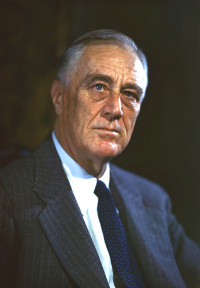
Franklin Delano Roosevelt Sr. (1882-1945), often referred to by his initials FDR, was an American statesman and political leader who served as the 32nd President of the United States from 1933 until his death in 1945. A Democrat, he won a record four presidential elections and became a central figure in world events during the mid-20th century. Roosevelt directed the federal government during most of the Great Depression, implementing his New Deal domestic agenda in response to the worst economic crisis in U.S. history. As a dominant leader of his party, he built the New Deal Coalition, which realigned American politics into the Fifth Party System and defined American liberalism throughout the middle third of the 20th century. His third and fourth terms were dominated by World War II. He is often rated by scholars as one of the three greatest U.S. Presidents, along with George Washington and Abraham Lincoln.
Born
Articles
Albert Jay Nock: A Gifted Pen for Radical Individualism, by Jim Powell, The Freeman, Mar 1997
Biographical and bibliographical essay, including Nock's early life, editorship of The Freeman (1920-1924), and notable books and essays
Biographical and bibliographical essay, including Nock's early life, editorship of The Freeman (1920-1924), and notable books and essays
Nock became an implacable foe of Franklin D. Roosevelt's New Deal. In May 1934, he wrote: "Probably not many realize how the rapid centralization of government in America has fostered a kind of organized pauperism ... In fostering pauperism it also by necessary consequence fosters corruption ... " ... Nock was considered a conservative for opposing [FDR], who touted big government and schemed to get America into another European war ... He affirmed his authentic radicalism in many of the 48 articles he wrote between 1932 and 1939 for American Mercury, hotbed of opposition to FDR.
America as Utopia, by Robert Nisbet, Reason, Mar 1987
Historical survey of the "American Religion" (America as "the city upon a hill") from the Pilgrims to the present and questions whether it will progress further in the near future
Historical survey of the "American Religion" (America as "the city upon a hill") from the Pilgrims to the present and questions whether it will progress further in the near future
In Roosevelt's view—a view helped a great deal by his man Harry Hopkins, ever vigilant to Soviet interest and welfare—Stalin was precisely the kind of world leader Roosevelt could work with after the war against Nazi Germany was won. After all, the Soviets had (yet) no record of imperialism, and despite such misfortunes as the liquidation of the peasantry, the purges, and the 1939 pact with Hitler, they were clearly on the way to becoming a nation like the United States. So FDR thought to the very end of his life, and by so thinking brought the Cold War upon America ...
The American Heritage of "Isolationism", by Gregory Bresiger, Freedom Daily, May 2006
Criticizes the use of the word "isolationist" by the media, "internationalists" and other foreign intervention promoters, looking at the heritage of noninterventionism as exemplified by Washington's Farewell Address
Criticizes the use of the word "isolationist" by the media, "internationalists" and other foreign intervention promoters, looking at the heritage of noninterventionism as exemplified by Washington's Farewell Address
[Americans] have often voted for presidential candidates they thought would keep the nation at peace but instead led the nation into wars and more wars ... Franklin Roosevelt, at the outbreak of World War II in September 1939, said the United States must be neutral. One year later, campaigning for a third term, he pledged that American boys wouldn't be sent to Europe to fight in World War II. This came while he was secretly scheming to help the British stay in the war.
'Beginning of the end of America', by Keith Olbermann, Countdown with Keith Olbermann, 18 Oct 2006
Transcript of the Countdown with Keith Olbermann show segment criticizing Bush's signing of the Military Commissions Act
Transcript of the Countdown with Keith Olbermann show segment criticizing Bush's signing of the Military Commissions Act
[W]e have been here when President Franklin D. Roosevelt insisted that Executive Order 9066 was necessary to save American lives, only to watch him use [it] to imprison and pauperize 110,000 Americans while ... General DeWitt, told Congress: "It makes no difference whether he is an American citizen—he is still a Japanese." American citizens, in ... camps, for something they neither wrote nor said nor did, but for the choices they or their ancestors had made about coming to America ... Roosevelt's internment ... would necessitate a formal apology ... to the citizens ... whose lives it ruined.
The Courts and the New Deal, Part 1, by William L. Anderson, Freedom Daily, Jun 2005
First part of a four-part series examining how Franklin D. Roosevelt and his New Deal affected federal courts and other legal practices; contrasts the thoughts of Blackstone and Bentham
First part of a four-part series examining how Franklin D. Roosevelt and his New Deal affected federal courts and other legal practices; contrasts the thoughts of Blackstone and Bentham
[T]he centralization of government ... reached warp speed during the ... New Deal. The legislative agenda that President Franklin D. Roosevelt sought to impose was collectivist in nature and clearly went against the emphasis on individual rights that reflected the core philosophy of those who wrote the Constitution. Although the U.S. Supreme Court resisted [it] during Roosevelt's first term, ultimately [he] was able to push his agenda by remaking the High Court, which became little more than a rubber stamp for policies that made a mockery of rule of law and of the rights of individuals.
Related Topics: Jeremy Bentham, United States Bill of Rights, Commerce Clause, United States Constitution, Law, Due process of Law
Democracy Versus Liberty, by James Bovard, The Freeman, Aug 2006
Discusses the dangers of equating liberty with "self-government" as majority rule, with representative actions or quotes by several U.S. presidents from Lincoln to George W. Bush
Discusses the dangers of equating liberty with "self-government" as majority rule, with representative actions or quotes by several U.S. presidents from Lincoln to George W. Bush
Franklin Roosevelt's presidency was the clearest turning point in the American understanding of freedom ... Roosevelt perennially invoked freedom as a pretext to increase government power. His promises of freedom for the entire world distracted attention from how his administration was subjugating Americans. Partly because Americans in the 1930s and early 1940s were less politically astute than those of the Founding era, FDR's bait and switch worked like a charm—and was canonized into American folklore by Norman Rockwell and others.
Related Topics: United States Bill of Rights, George W. Bush, Bill Clinton, Democracy, Government, Liberty, Abraham Lincoln, Richard Nixon, Ronald Reagan, Woodrow Wilson
Don't Blame the Thermometer for the Fever, by Sheldon Richman, Freedom Daily, Jan 1999
Discusses President Clinton's calls for worldwide regulations limiting capital movements and a global regime similar to the New Deal, comparing his views on private property with those of Hitler
Discusses President Clinton's calls for worldwide regulations limiting capital movements and a global regime similar to the New Deal, comparing his views on private property with those of Hitler
[T]he original New Deal did not rescue America from depression. Five years after Franklin Roosevelt became president, the economy was nearly as bad off as it was under ... Hoover ... [T]he economy did not recover until after World War II. The New Deal ... was America's first formal experiment with the third way. Roosevelt's Brain Trust had watched Mussolini's Italy closely. And Il Duce admired Roosevelt's handiwork. To take one example, the National Recovery Administration compelled each industry to band together to establish formal codes to govern its activities, including labor relations.
Related Topics: Capitalism, Central Banking, Bill Clinton, Economic Freedom, Fascism, Government, Private Property
Emergencies: The Breeding Ground of Tyranny, by William L. Anderson, Freedom Daily, Nov 2006
Examines the long history of "emergency powers" claimed by U.S. Presidents, including recent examples such as sanctions stemming from the International Economic Powers Act and the so-called War on Terror
Examines the long history of "emergency powers" claimed by U.S. Presidents, including recent examples such as sanctions stemming from the International Economic Powers Act and the so-called War on Terror
After Franklin Roosevelt took office in 1933, he invoked the "emergency powers" that had been written into the Trading with the Enemy Act in 1917 to seize privately held gold in order to inflate the dollar. Presumably he thought that inflation would stimulate consumer spending and "revitalize" the moribund U.S. economy. Like his other New Deal policies, this one provided little relief but instead further undermined private enterprise. Thanks to Progressive rhetoric, however, the myth lives on to this day that Roosevelt's economic policies somehow "ended" the Great Depression.
Related Topics: American War Between the States, Jimmy Carter, Government, Law, Abraham Lincoln, Terrorism, George Washington, Woodrow Wilson
Fascism, by Sheldon Richman, The Concise Encyclopedia of Economics, 2008
Defines fascism, contrasting it with other ideologies (such as socialism, capitalism, Marxism), identifying Mussolini's Italy and Nazi Germany as its two main exponents and discussing its influence on the New Deal
Defines fascism, contrasting it with other ideologies (such as socialism, capitalism, Marxism), identifying Mussolini's Italy and Nazi Germany as its two main exponents and discussing its influence on the New Deal
It is a matter of controversy whether President Franklin Roosevelt's New Deal was directly influenced by fascist economic policies. Mussolini praised the New Deal as "boldly ... interventionist in the field of economics," and Roosevelt complimented Mussolini for his "honest purpose of restoring Italy" and acknowledged that he kept "in fairly close touch with that admirable Italian gentleman." Also, Hugh Johnson, head of the National Recovery Administration, was known to carry a copy of Raffaello Viglione's pro-Mussolini book, The Corporate State, with him ...
The Federal War on Gold, Part 3, by Jacob G. Hornberger, Freedom Daily, Oct 2006
Describes Franklin Roosevelt's 1933 executive order confiscating gold held by U.S. citizens and the congressional act nullifying gold clauses in contracts, its constitutional ramifications and subsequent related history
Describes Franklin Roosevelt's 1933 executive order confiscating gold held by U.S. citizens and the congressional act nullifying gold clauses in contracts, its constitutional ramifications and subsequent related history
On April 5, 1933, ... President Roosevelt issued Executive Order 6102, which prohibited the "hoarding" of gold by U.S. citizens ... What was Roosevelt’s justification for the gold seizure? He said that it was necessary to battle the Great Depression ... How in the world could the seizure of people's gold relieve the consequences of the Great Depression? ... [T]he real reason for Roosevelt's gold seizure was twofold: ... to enrich the coffers of the federal government ... to prevent the American people from protecting themselves from the onslaught of ever-depreciating paper money ...
Felix Morley – Washington Post & his Career, by Leonard Liggio
Review of Morley's autobiographical For the Record (1979)
Review of Morley's autobiographical For the Record (1979)
Morley criticizes FDR for his refusal to consult with President Hoover during the long transition from 1932 November election to the inauguration on March 4, 1933 ... FDR's massive popular vote in November, 1936 led him to propose to pack the US Supreme Court on February 5, 1937. FDR proposed that he appoint an additional judge for every federal judge over the age of 70 years, and up to six additional US Supreme Court judges for those over 70 years ... By the summer of 1937, Roosevelt had lost his fight to pack the US Supreme Court as well as support for his domestic program as the US again entered into a depression.
The Final Secret of Pearl Harbor, by John T. Flynn, Oct 1945
Written shortly after the release of the U.S. Army and Navy reports on the Pearl Harbor attack, Flynn claims it was the result of "three incredible blunders" and that President Roosevelt "personally managed the whole crisis"
Written shortly after the release of the U.S. Army and Navy reports on the Pearl Harbor attack, Flynn claims it was the result of "three incredible blunders" and that President Roosevelt "personally managed the whole crisis"
It was Roosevelt who bottled the fleet in Pearl Harbor. It was Roosevelt who stripped the base of its defenses. ... By January 1, 1941, Roosevelt had decided to go to war with Japan. But he had solemnly pledged the people he would not take their sons to foreign wars unless attacked. Hence he dared not attack and so decided to provoke the Japanese to do so. ... When the attack came he was appalled and frightened. He dared not give the facts to the country. To save himself he maneuvered to lay the blame upon Kimmel and Short. To prevent them from proving their innocence he refused them a trial.
Related Topics: Japan, World War II
Garet Garrett (1878-1954) On Empire, by Joseph R. Stromberg, The Old Cause, 5 Aug 2000
Biographical and bibliographical essay, focusing on the essays in The People's Pottage
Biographical and bibliographical essay, focusing on the essays in The People's Pottage
As the New Deal administration of Franklin Roosevelt seemed more and more to threaten those values fundamentally, Garrett became an important spokesman of the emerging Old Right opposition movement ... [He] details how the New Deal accomplished its ends: Roosevelt's illegal "banking holiday," repudiation of what was left of the gold standard, and the abortive fascistic National Recovery Administration ... As in the Roman case, the new imperial rulers were careful to keep up the appearances of republican legitimacy. FDR, like Augustus, was merely the "first man" among equals.
Gold Policy in the 1930s, by Richard H. Timberlake, The Freeman, May 1999
Discusses U.S. government monetary policies during the 1930s, in particular, the Gold Reserve Act (1934) which allowed FDR to devalue the dollar, the Banking Act (1935) which reformed the FRS and the misguided policies of Treasury Secretary Morgenthau
Discusses U.S. government monetary policies during the 1930s, in particular, the Gold Reserve Act (1934) which allowed FDR to devalue the dollar, the Banking Act (1935) which reformed the FRS and the misguided policies of Treasury Secretary Morgenthau
[The Gold Reserve Act of 1934] authorized the president, Franklin Roosevelt, to raise the price of gold by 60 percent. [He], however, did not use all the power given him—only 98% of it. In early 1934, he increased the official mint price ... which had been $20.67 per ounce for 100 years, to $35 per ounce ... Roosevelt rationalized [the] usurpation of private property rights in gold in one of his notorious fireside chats. "Since there was not enough gold to pay all holders of gold obligations," he claimed, "the Government should in the interest of justice allow none to be paid in gold."
Related Topics: Banking, Central Banking, United States Constitution, Federal Reserve System, Gold Standard, Money
The Grinch Who Moved Thanksgiving, by Bill Kauffman, 26 Nov 2003
Recounts the history of the Thanksgiving holiday, from Washington's proclamation in 1789 to Lincoln's in 1863 (at the behest of Sarah Josepha Hale) and FDR's changes between 1939 and 1942
Recounts the history of the Thanksgiving holiday, from Washington's proclamation in 1789 to Lincoln's in 1863 (at the behest of Sarah Josepha Hale) and FDR's changes between 1939 and 1942
The presidents of .. unsentimental vendors petitioned President Roosevelt to move Thanksgiving [1939] to ... November 23, thus creating an additional week of Christmas shopping ... the president did so ... Roosevelt returned Thanksgiving 1942 to the last Thursday in November ... Just as Roosevelt's megalomaniacal refusal to observe the two-term tradition set by George Washington necessitated the 22nd Amendment, so did his flouting of Thanksgiving precedent require corrective legislation. In a compromise of sorts, FDR signed into law a bill fixing Thanksgiving as the fourth Thursday – not the last Thursday – in November.
Related Topic: Thanksgiving
Hard Cases Make Bad Law, by Jacob G. Hornberger, FFF.org, 23 Mar 2005
Discusses the attempt by members of the U.S. Congress to have U.S. federal courts intervene in the Terri Schiavo case, already decided by a Florida district court
Discusses the attempt by members of the U.S. Congress to have U.S. federal courts intervene in the Terri Schiavo case, already decided by a Florida district court
[Congress] enacted a law that has got to be the biggest attack on the Constitution and our system of constitutional government since President Franklin Roosevelt's infamous "court-packing scheme" ... [F]aced with a Supreme Court that was declaring much of his New Deal ... unconstitutional, Roosevelt devised a scheme whereby Congress would permit him to pack the Court with additional justices who would do his bidding ... Despite Roosevelt's enormous popularity, the American people ... rose up in arms against FDR's disdainful attempt ... and forced FDR to ... withdraw his plan.
Related Topics: United States Bill of Rights, United States Constitution, Florida, Government, Law, Rule of Law, Life
Hitler's Mutual Admiration Society, by Jacob G. Hornberger, 29 Oct 2003
Describes the mutual admiration society that existed in the 1930s between Franklin Roosevelt, Adolf Hitler and Benito Mussolini
Describes the mutual admiration society that existed in the 1930s between Franklin Roosevelt, Adolf Hitler and Benito Mussolini
One of the best examples was Franklin Roosevelt's New Deal, which in large part mirrored the economic policies that Hitler was implementing to get Germany out of the Depression ... FDR and Hitler shared much of the same economic philosophy and were implementing many of the same economic policies ... Hitler was not Roosevelt's only admirer. Benito Mussolini, who had led Italy into fascism, an economic philosophy that called for government control over economic activity, including government-business partnerships, said that he admired FDR because he, like Mussolini, was a "social fascist."
Related Topics: Germany, Great Britain
H. L. Mencken, America's Wittiest Defender of Liberty, by Jim Powell, The Freeman, Sep 1995
Biographical essay, highlighting Mencken's tenure at the Baltimore Sun, the books he authored, the founding and his work at the American Mercury monthly and his brief relationship with Sara Haardt
Biographical essay, highlighting Mencken's tenure at the Baltimore Sun, the books he authored, the founding and his work at the American Mercury monthly and his brief relationship with Sara Haardt
Mencken denounced Franklin Delano Roosevelt for amassing dangerous political power and for maneuvering to enter World War II, and he again lost his newspaper job. Moreover, the President ridiculed him by name ... Mencken expressed outrage at violence against blacks and as Hitler menaced Europe, Mencken attacked President Roosevelt for refusing to admit Jewish refugees ...: "There is only one way to help the fugitives, and that is to find places for them in a country in which they can really live. Why shouldn't the United States take in a couple hundred thousand of them, or even all of them?"
Related Topics: The American Mercury, Capitalism, Government, Henry Hazlitt, Humor, Liberty, H. L. Mencken, Albert Jay Nock, Ayn Rand, Woodrow Wilson
How Franklin Roosevelt Lied America Into War, by William Henry Chamberlin, Perpetual War for Perpetual Peace, 1953
Excerpted from chapter 8, "The Bankruptcy of a Policy", of the anthology edited by Harry Elmer Barnes; describes several actions by Roosevelt and his administration which contradicted his campaign pledges "to keep our country out of war"
Excerpted from chapter 8, "The Bankruptcy of a Policy", of the anthology edited by Harry Elmer Barnes; describes several actions by Roosevelt and his administration which contradicted his campaign pledges "to keep our country out of war"
One of the [Roosevelt]'s first actions after the beginning of hostilities was to call Congress into special session and ask for the repeal of the embargo on the sales of arms to belligerent powers, which was part of the existing neutrality legislation. He based his appeal on the argument that this move would help to keep the United States at peace ... This statement was made after the President had opened up a secret correspondence with Winston Churchill ... What has been revealed ..., inspires considerable doubt as to whether its main purpose was keeping America out of the war.
How Much Do You Know About Liberty? (a quiz), The Freeman, Jun 1996
A 20-question quiz (with answers) on various topics related to liberty in the history of the United States
A 20-question quiz (with answers) on various topics related to liberty in the history of the United States
14. What effect did the New Deal have on the Great Depression? ... The New Deal certainly did not get America out of the Great Depression. In 1932, when Roosevelt was elected, 11,586,000 people were unemployed. In 1939, almost as many people were still unemployed—11,369,000. In 1932, 16,620,000 people were on welfare. Eight years later, even more people were on welfare—16,908,000.
The Ideological Odyssey of John T. Flynn, by John E. Moser
Short biographical essay by the author of Right Turn: John T. Flynn and the Transformation of American Liberalism
Short biographical essay by the author of Right Turn: John T. Flynn and the Transformation of American Liberalism
Flynn welcomed the election of Franklin D. Roosevelt in 1932, and referred to his New Deal as a 'promising experiment,' but quickly found fault with the new president. ... while he praised certain Roosevelt projects, such as Social Security, the Securities and Exchange Committee, and the Tennessee Valley Authority, he claimed that the president had done nothing to solve the fundamental problems that underlay the American economy--the wide gap between rich and poor and gross corporate mismanagement ... Even more disturbing for Flynn was that the president seemed to be moving the country toward involvement in another war.
Related Topic: John T. Flynn
Isabel Paterson's Place in History, by Douglas French, 20 Jun 2011
Review of Stephen D. Cox's The Woman and the Dynamo: Isabel Paterson and the Idea of America
Review of Stephen D. Cox's The Woman and the Dynamo: Isabel Paterson and the Idea of America
She railed against FDR's gold seizure from a woman's point of view: 'Never shall we forget the line of women we saw turning in their savings, under threat of ten years in jail and ten thousand dollars fine, while the multimillionaire Senator Couzens stood up bravely on the floor of the Senate and promised to "hunt them down" if they tried to hold out a few dollars' Paterson was not just adventurous with her words — calling Eleanor Roosevelt 'a pathetic fool' for instance ...
The Lawless State, by Joseph Sobran, The Reactionary Utopian, 11 Jul 2006
Explains how the United States changed from being a decentralized republic to a centralized democracy and how most of the power has moved from the legislative branch to the "imperial presidency"
Explains how the United States changed from being a decentralized republic to a centralized democracy and how most of the power has moved from the legislative branch to the "imperial presidency"
Thus Congress declared war after Pearl Harbor and Franklin D. Roosevelt then (and only then) assumed the powers of commander in chief of the armed forces. But a few years later, Harry Truman took the country to war in Korea without Congress's authorization ... Neither Woodrow Wilson nor Roosevelt, both of whom had greatly expanded the executive branch, had dared go that far ... During Roosevelt's four terms, conservatives had realized the same dangers of what they called "Caesarism," and to them we owe the Twenty-Second Amendment, limiting a president to two terms.
Libertarianism Is the Key to Our Future, by Jacob G. Hornberger, Freedom Daily, Jul 2006
Examines three reasons—freedom, morality and pragmatism—that suggest that Americans will eventually return to their libertarian heritage
Examines three reasons—freedom, morality and pragmatism—that suggest that Americans will eventually return to their libertarian heritage
This deception regarding the nature of freedom was undoubtedly one of the greatest achievements of the Franklin Roosevelt administration in the 1930s ... [He] revolutionized American life by making the concept of the welfare state and regulated society a permanent fixture ... But rather than convincing the ... people of the virtues of socialism, paternalism, and government control ..., Roosevelt convinced Americans that their new system was, in fact, designed to save freedom and free enterprise. Americans bought the argument and ever since have lived under an oppressive economic system ...
Related Topics: War on Drugs, Economic Freedom, Ethics, Government, Libertarianism, Liberty, Moral Liberty, Socialism, Taxation
The New Deal and Roosevelt's Seizure of Gold: A Legacy of Theft and Inflation, Part 1, by William L. Anderson, Freedom Daily, Aug 2006
Discusses the economy of the United States in 1933 and the measures taken by the Roosevelt administration in an effort to reduce unemployment and preventing deflation, namely restricting production and destroying crops, as lead-up to inflating the dollar
Discusses the economy of the United States in 1933 and the measures taken by the Roosevelt administration in an effort to reduce unemployment and preventing deflation, namely restricting production and destroying crops, as lead-up to inflating the dollar
[Due to] Executive Order 6102 in 1933 [with] Roosevelt's signature, gold as legal money disappeared in the United States ... Historians generally pass by EO 6102, but without it Roosevelt's economic programs never would have gained traction. Most articles, books, and papers that cover the New Deal concentrate on the myriad of programs and policies of the Roosevelt administration, such as the National Industrial Recovery Act, the Agricultural Adjustment Act, and the Wagner Act, and the battles between Roosevelt and the U.S. Supreme Court, which had struck down some key elements of the New Deal in 1935.
The New Deal and Roosevelt's Seizure of Gold: A Legacy of Theft and Inflation, Part 2, by William L. Anderson, Freedom Daily, Sep 2006
Describes Roosevelt's Executive Order 6102, its threats for non-compliance and its immediate effects, as well as its legacy: Btretton Woods, Nixon's closing of the gold window and current inflation
Describes Roosevelt's Executive Order 6102, its threats for non-compliance and its immediate effects, as well as its legacy: Btretton Woods, Nixon's closing of the gold window and current inflation
Roosevelt based his order on the 1917 Trading with the Enemy Act, which gave the president the power to prevent people from 'hoarding gold' during a time of war. Of course, the United States was not at war in 1933, but Roosevelt claimed that it was a 'national emergency' and Congress and the courts meekly bowed to the executive. ... Unfortunately, much of the Roosevelt legacy stands. Many historians and economists continue to insist that his economic programs 'saved capitalism' when, in fact, they were based on confiscation of property and on the false notion that inflation is the source of prosperity.
The New Deal Made Them 'Right', by Damon Root, Cato Policy Report, Sep 2009
Discusses how various "prominent liberals" (Mencken, John T. Flynn, Al Smith, Burton K. Wheeler and Nock) found themselves categorized on the political right as a consequence of their opposition to Roosevelt's New Deal
Discusses how various "prominent liberals" (Mencken, John T. Flynn, Al Smith, Burton K. Wheeler and Nock) found themselves categorized on the political right as a consequence of their opposition to Roosevelt's New Deal
Addressing a national radio audience less than two weeks after FDR introduced the plan in Congress, Wheeler moved in for the kill: "Every despot has usurped the power of the legislative and judicial branches in the name of the necessity for haste to promote the general welfare of the masses — and then proceeded to reduce them to servitude. I do not believe that President Roosevelt has any such thing in mind, but such has been the course of events throughout the world." Against Wheeler's incendiary rhetoric and crafty legislative maneuverings, the court-packing bill failed to garner the necessary votes and died in the Senate ...
Related Topics: Corporatism, Democratic Party, John T. Flynn, H. L. Mencken, Albert Jay Nock, Prohibition
No More "Great Presidents", by Robert Higgs, The Free Market, Mar 1997
Discusses the results of a 1996 poll of 30 historians and two politicians asking them to rank U.S. presidents, focusing on those ranked Great, Near Great and Failure, and offers his own ranking
Discusses the results of a 1996 poll of 30 historians and two politicians asking them to rank U.S. presidents, focusing on those ranked Great, Near Great and Failure, and offers his own ranking
[Washington] established the precedent of stepping down after two terms, which lasted until it clashed with FDR's insatiable ambition ... Unfortunately, under FDR the Constitution suffered damage that none of his successors has repaired and most have made worse. Certainly since 1932--and, one might well argue, since 1896—no president has been true to his oath of office. Realizing the ambitions harbored by Teddy Roosevelt and Wilson, Franklin Roosevelt created the "imperial presidency," and we have been the worse for it ever since.
Not Just Japanese Americans: The Untold Story of U.S. Repression During 'The Good War', by Jeffrey Rogers Hummel, The Journal of Historical Review, 1986
Detailed and well-annotated survey of United States government's repression of civil liberties during World War II, both before and after the attack on Pearl Harbor
Detailed and well-annotated survey of United States government's repression of civil liberties during World War II, both before and after the attack on Pearl Harbor
Roosevelt subjected [the America First Committee] to the meticulous scrutiny of first the FBI and later the Internal Revenue Service. In an ironic twist of fate, F.D.R. even ordered ex-President Hoover put under FBI observation ... An American trial would have disclosed ... clandestine personal correspondence between President Roosevelt and Winston Churchill, carried on prior to [him] becoming British Prime Minister ... Such a patent exposure of F.D.R.'s unneutral designs would probably have outraged the American people and damaged [his] bid for a third term in the 1940 Presidential race.
Parity: Bureaucratic Tyranny by Moral Fraud, by James Bovard, Freedom Daily, Sep 1999
Discusses the consequences of establishing "parity" for agricultural prices, in the name of "fairness", as was done by the Agricultural Adjustment Act of 1933 (and subsequent legislation)
Discusses the consequences of establishing "parity" for agricultural prices, in the name of "fairness", as was done by the Agricultural Adjustment Act of 1933 (and subsequent legislation)
The doctrine of parity illustrates how bogus moral doctrines can be used to restrict freedom. Parity proved that politicians and bureaucrats must commandeer the agricultural economy. The failure of farm prices to supposedly achieve parity in the early 1930s helped justify the Roosevelt administration's proclamation of a "national emergency" ... The New York Times reported on March 12, 1933, shortly after Roosevelt's inauguration, that Agriculture Secretary Henry Wallace and farm leaders were appealing to Roosevelt for the appointment of a "farm dictator" to solve the farm crisis.
Patriotism along the Southern Border, Part 3, by Jacob G. Hornberger, Freedom Daily, Feb 1999
Continues discussing patriotism along the Mexico-United States border starting with the Mexican Revolution (1910-20), through the creation of the INS, the repatriation policy of Franklin Roosevelt and present day immigration policies
Continues discussing patriotism along the Mexico-United States border starting with the Mexican Revolution (1910-20), through the creation of the INS, the repatriation policy of Franklin Roosevelt and present day immigration policies
[A]n estimated 500,000 to 1,000,000 Mexicans returned to Mexico during the Great Depression. Of course, they were "assisted" by President Franklin Roosevelt, commonly known as a great humanitarian and a lover of the poor, needy, and disadvantaged, who implemented a policy of repatriation of Mexican citizens in the 1930s ... The message Franklin Roosevelt and the INS sent out to Mexican citizens, whom previous Americans had welcomed for decades, was loud and clear: "You're not welcome here any longer. Get out of our country or face involuntary repatriation to Mexico."
A scholar's scholar retires, by Donald J. Boudreaux, TribLIVE.com, 21 Jul 2015
Discusses Higgs' retirement, highlighting his books Competition and Coercion and Crisis and Leviathan as well as his identification of "regime uncertainty"
Discusses Higgs' retirement, highlighting his books Competition and Coercion and Crisis and Leviathan as well as his identification of "regime uncertainty"
Bob first used regime uncertainty to explain the length of the Great Depression. In the early 1930s, President Herbert Hoover ... launched the government into unprecedented heights of activity. FDR followed with even more interventions. These interventions frightened entrepreneurs and investors ... The insecurity that these developments injected into the U.S. economy kept it greatly depressed for more than a decade. Not until the less radical Truman replaced the increasingly radical Roosevelt ... did the economic climate once again encourage enough entrepreneurial activity to promote growth.
The Secret of Pearl Harbor: FDR's Role Exposed – in 1944, by Justin Raimondo, 25 May 2001
Introduction to a republishing of Flynn's 1945 pamphlet "The Final Secret of Pearl Harbor", coincident with the release of the film Pearl Harbor
Introduction to a republishing of Flynn's 1945 pamphlet "The Final Secret of Pearl Harbor", coincident with the release of the film Pearl Harbor
Originally a supporter of the President, Flynn became one of FDR's bitterest, most relentless critics: his book, Country Squire in the White House, so enraged its subject that FDR wrote to one editor, at the Yale Review, demanding that Flynn be 'forever barred' from the pages of the 'respectable' media. ... If the President was appalled, it was at his own handiwork, but there is no record of his fear. Harry Hopkins, his top aide ... reported that the night before, when told that the Japanese had rejected his ultimatum, the President had said simply and quite matter-of-factly, 'This means war.'
Related Topics: John T. Flynn, World War II
The Secret State, by Carl Oglesby, KenRahn.com, 19 Dec 1991
Speech to the Massachusetts Libertarian Party; details various events from the 1945 dismantling of the Office of Strategic Services to the 1991 death of Danny Casolaro, which Oglesby said were reason to be worried about "a secret and invisible state"
Speech to the Massachusetts Libertarian Party; details various events from the 1945 dismantling of the Office of Strategic Services to the 1991 death of Danny Casolaro, which Oglesby said were reason to be worried about "a secret and invisible state"
Wild Bill Donovan of the wartime Office of Strategic Services, the OSS, proposed to President Roosevelt before the war was over that the United States should setup a permanent civilian intelligence agency, but military foes of Donovan leaked his plan to a conservative journalist, Walter Trohan, who exposed the idea in the Chicago Tribune and denounced it as an "American Gestapo." But only a few weeks after this, after Roosevelt's death and the inauguration of Harry Truman, in the utmost secrecy, the Army was taking its own much more dangerous steps toward a quite literal American Gestapo.
Related Topics: Brazil, Chile, Cuba, Dominican Republic, War on Drugs, Germany, Guatemala, Iran, Richard Nixon, Nonviolent resistance, Panama, Ronald Reagan, Unreasonable Searches and seizures, United States, Vietnam War
Seventy Years Since FDR: A Time To Remember John T. Flynn, by Lawrence Reed, 10 Mar 2003
Review of John T. Flynn's The Roosevelt Myth on the 70th anniversary of the inauguration of FDR, highlighting the defying attitudes of Henry Ford and Sewell Avery, the president of Montgomery Ward
Review of John T. Flynn's The Roosevelt Myth on the 70th anniversary of the inauguration of FDR, highlighting the defying attitudes of Henry Ford and Sewell Avery, the president of Montgomery Ward
Was FDR a man of principles, a man guided in his thinking by a fixed set of lofty and noncontradictory ideas? Far from it, Flynn proves, in what is an important theme of the book. FDR's thinking and behavior show him to be a real-life exemplar of an old Groucho Marx wisecrack: "Those are my principles. If you don't like them, I have others!" ... After being elected, ... FDR promptly championed reckless and extravagant spending and tried to centralize just about everything in Washington. He did so ... simply because he was an opportunist capitalizing on the public's demand for "action."
Related Topics: John T. Flynn, World War II
Three New Deals: Why the Nazis and Fascists Loved FDR, by David Gordon, Mises Daily, 22 Sep 2006
Review of Three New Deals: Reflections on Roosevelt's America, Mussolini's Italy, and Hitler's Germany, 1933-1939 (2006) by Wolfgang Schivelbusch
Review of Three New Deals: Reflections on Roosevelt's America, Mussolini's Italy, and Hitler's Germany, 1933-1939 (2006) by Wolfgang Schivelbusch
When Roosevelt took office in March 1933, he received from Congress an extraordinary delegation of powers to cope with the Depression. ... Roosevelt never had much use for Hitler, but Mussolini was another matter. '"I don't mind telling you in confidence," FDR remarked to a White House correspondent, 'that I am keeping in fairly close touch with that admirable Italian gentleman"' ... Why did these contemporaries see an affinity between Roosevelt and the two leading European dictators, while most people today view them as polar opposites? People read history backwards ...
Related Topics: Fascism, John T. Flynn
A Tribute to John T. Flynn, by John T. Flynn, Adam Young, 31 Jan 2003
Biographical overview followed by quotes from Flynn's writings on Franklin Roosevelt, Roosevelt's monument, the New Deal, the Second World War and the Roosevelt myth
Biographical overview followed by quotes from Flynn's writings on Franklin Roosevelt, Roosevelt's monument, the New Deal, the Second World War and the Roosevelt myth
Flynn was a critic of Roosevelt's New Deal, and of Roosevelt's motives and personality traits ... viewing the entire program as a copy of Mussolini's Fascist State corporatism. Key to Flynn's critique of New Dealism was the similarity between the Code Authorities of Roosevelt's National Recovery Administration, and Mussolini's state-supervised industrial cartels ... In response to Flynn's unremitting criticisms of him, Roosevelt personally wrote a letter to a magazine editor suggesting that Flynn "should be barred hereafter from the columns of any presentable daily paper, monthly magazine, or national quarterly."
Warring as Lying Throughout American History, by James Bovard, Freedom Daily, Feb 2008
Recounts how U.S. Presidents and their administrations since James Polk have been deceitful about wars and military engagements
Recounts how U.S. Presidents and their administrations since James Polk have been deceitful about wars and military engagements
In 1940, in one of his final speeches of the presidential campaign, Franklin Roosevelt assured voters, "Your president says this country is not going to war." At the time, he was violating the Neutrality Act by providing massive military assistance to Britain and was searching high and low for a way to take the United States into war against Hitler ... In early 1945, Roosevelt told Congress that the Yalta Agreement "spells the end of the system of unilateral action and exclusive alliance and spheres of influence." In reality, he signed off on Soviet domination of Eastern Europe ...
Related Topics: Bill Clinton, Gulf War, Abraham Lincoln, Nicaragua, Ronald Reagan, Terrorism, Vietnam War, War, Woodrow Wilson, World War II
Who Is Garet Garrett?, by Jeffrey Tucker, Mises Daily, 25 Oct 2007
Biographical and bibliographical essay, including both his novels and non-fiction writing
Biographical and bibliographical essay, including both his novels and non-fiction writing
"The Revolution Was" first appeared in 1938, the burden of which was to show that the New Deal transformed American society to such an extent that it was foolhardy to listen to American politicians ... [Garrett] chronicles what historians have forgotten, namely, that FDR campaigned for limiting government against the big-spending policies of Herbert Hoover. He shows how the New Deal regimented production to the point of making genuine production impossible. He blasts FDR's monetary policy as nothing short of robbery, and exposes the New Deal as a violation of everything a free country should be.
Related Topics: Entrepreneurship, Federal Reserve System, Garet Garrett, Prices, Ayn Rand, Socialism, Technology
Book chapters
Killing in the Name of Democracy, by James Bovard, Attention Deficit Democracy, 27 Jan 2006
Excerpt from the chapter 4 "Messianic Democracy", details various U.S. presidents' policies and actions from McKinley to Eisenhower
Excerpt from the chapter 4 "Messianic Democracy", details various U.S. presidents' policies and actions from McKinley to Eisenhower
Franklin Roosevelt painted World War II as a crusade for democracy–hailing Stalin as a partner ... FDR praised Stalin as "truly representative of the heart and soul of Russia"–as if the lack of bona fide elections in Russia was a mere technicality, since Stalin was the nation's favorite. Roosevelt praised Soviet Russia as one of the "freedom-loving Nations" and stressed that Stalin is "thoroughly conversant with the provisions of our Constitution." ... The fact that the Soviet regime had been the most oppressive government in the world in the 1930s was irrelevant, as far as FDR was concerned.
Related Topics: George W. Bush, Democracy, Dwight D. Eisenhower, Guatemala, William McKinley, Mexico, Philippines, Woodrow Wilson, World War I
Reviews
Capitalism Saves Us All, by Bernard Chapin, LewRockwell.com, 14 Jun 2004
Review of Thomas J. DiLorenzo's How Capitalism Saved America: The Untold History of Our Country, from the Pilgrims to the Present (2004)
Review of Thomas J. DiLorenzo's How Capitalism Saved America: The Untold History of Our Country, from the Pilgrims to the Present (2004)
[T]he chapter, "How the New Deal Crippled Capitalism" issues a proper indictment of the conventional wisdom that Roosevelt's terms in office saved the country and capitalism itself ... Unemployment never fell below 14.6 percent between 1932 and 1940 and between "1930 to 1940 net private investment was minus $3.1 billion." What The New Deal really represented was masterful electioneering and showcased, once again, that while FDR was a brilliant politician, he knew little about how to improve the economic health of our citizenry.
The Federal Ripoff, by George C. Leef, Freedom Daily, Nov 2006
Review of The Big Ripoff: How Big Business and Big Government Steal Your Money (2006) by Timothy P. Carney
Review of The Big Ripoff: How Big Business and Big Government Steal Your Money (2006) by Timothy P. Carney
Franklin Roosevelt is famous for his attacks on businessmen as "economic royalists," but many big business leaders were quite content to be thrown into his briar patch of governmental controls because they saw them as beneficial. Beneficial, that is, ... in the short run ... One of Roosevelt's lasting pro-business, anti-market innovations is the Export-Import Bank. Initially created by executive order as a way to circumvent congressional restrictions on trade with the Soviet Union, the bank was given greater status and authority when Congress passed the Export-Import Bank Act in 1945.
Forgotten Lessons, by Richard M. Ebeling, Freedom Daily, Mar 1996
Review of Forgotten Lessons: Selected Essays of John T. Flynn (1995), edited by Gregory P. Pavlik
Review of Forgotten Lessons: Selected Essays of John T. Flynn (1995), edited by Gregory P. Pavlik
[I]n 1937, Flynn wrote an article ... entitled "Mr. Hopkins and Mr. Roosevelt" in which he argued that FDR's appointing of his confidant, Harry Hopkins, to the post of secretary of commerce was part of the policy of cementing a network of government-business relationships and partnerships; as a result, Roosevelt tried to have Flynn blacklisted ... But even with massive deficit spending, by the late 1930s, unemployment in the U.S. economy was still in the double-digit range. So Roosevelt turned to that other great ... device to which governments have resorted to "create jobs": defense spending.
The Nightmare of the New Deal, Part 1, by George C. Leef, Freedom Daily, Dec 2007
Review of The Forgotten Man: A New History of the Great Depression (2007) by Amity Shlaes; introduction and focus on the "bad guys"
Review of The Forgotten Man: A New History of the Great Depression (2007) by Amity Shlaes; introduction and focus on the "bad guys"
Shlaes isn't the first writer to try to set the historical record straight and undermine the fawning adulation usually given to Roosevelt ... Except for die-hard statists, this book will at least cause readers to smirk next time they read that Franklin Roosevelt was one of our "great" presidents ... The main bad-guy role goes to Roosevelt himself, of course ... Shlaes reinforces the image of Roosevelt as merely a clever, conniving politician with one big asset, namely his great radio persona. Once he had sweet-talked his way into the White House ... his approach to policy was utterly clueless.
The Nightmare of the New Deal, Part 2, by George C. Leef, Freedom Daily, Jan 2008
Review of The Forgotten Man (2007) by Amity Shlaes; discusses the Schechter Supreme Court case which caused the National Recovery Administration (NRA) to be declared unconstitutional, the 1940 election and offers some concluding remarks
Review of The Forgotten Man (2007) by Amity Shlaes; discusses the Schechter Supreme Court case which caused the National Recovery Administration (NRA) to be declared unconstitutional, the 1940 election and offers some concluding remarks
What soured [Willkie] on Roosevelt was the way he and his minions went after private enterprise and especially the utilities. Roosevelt never came right out and said so, but it became clear that his socialistic underlings envisioned an America with nothing but governmentally owned electric companies. ... Shlaes recounts a radio debate Willkie had with one of Roosevelt's lawyers, Robert Jackson ... Willkie had come to see that, as Shlaes writes, "while Roosevelt might call himself a liberal, the inexorable New Deal emphasis on the group over the individual was not liberal in the classic sense."
 Wartime Attacks on Civil Liberties, by George C. Leef, Freedom Daily, Dec 2005
Review of Perilous Times: Free Speech in Wartime: From the Sedition Act of 1798 to the War on Terrorism (2004) by University of Chicago Law School professor Geoffrey R. Stone
Franklin D. Roosevelt, alas, was little interested in protecting the civil liberties of American citizens. In 1936, he secretly authorized FBI chief J. Edgar Hoover to investigate suspected fascists and communists, a task that Hoover undertook with relish. In 1940, Roosevelt signed into law the Smith Act ... Once the war began, Roosevelt pressured his civil-liberties-minded attorney general, Francis Biddle, to go after elements of the dissident press that were attacking him, asking, "When are you going to indict the seditionists?" Shortly thereafter, arrests of the "seditionists" began.
Related Topics: John Adams, American War Between the States, Liberty of Expression, Abraham Lincoln, War, Woodrow Wilson, World War I, World War II
Interviews
Interview with Karl Hess, by Karl Hess, A. Lin Neumann (interviewer), Reason, May 1982
Topics discussed include the Republican Party, National Review, AEI, Goldwater, Rothbard, anarchism, the Vietnam War, Carter and Reagan, fascism, urban enterprise zones, the environment, and authoritarianism vs. freedom
Topics discussed include the Republican Party, National Review, AEI, Goldwater, Rothbard, anarchism, the Vietnam War, Carter and Reagan, fascism, urban enterprise zones, the environment, and authoritarianism vs. freedom
REASON: Karl, how did it all begin for you? ...
HESS: I remember when Roosevelt was elected and my mother, who was a switchboard operator, had the good sense to realize he was a social fascist despite all the good things he said he wanted to do, specifically for people like my mother ... I really didn't like Roosevelt, that whole gang, my sense even as a kid was that he was an emperor of sorts, very elitist. I went to work when I was 15, and by that time I was an absolutely thoroughgoing Republican because the Republicans opposed Roosevelt. I knew that other people opposed him too ...
HESS: I remember when Roosevelt was elected and my mother, who was a switchboard operator, had the good sense to realize he was a social fascist despite all the good things he said he wanted to do, specifically for people like my mother ... I really didn't like Roosevelt, that whole gang, my sense even as a kid was that he was an emperor of sorts, very elitist. I went to work when I was 15, and by that time I was an absolutely thoroughgoing Republican because the Republicans opposed Roosevelt. I knew that other people opposed him too ...
Mises's Bibliographer: An Interview with Bettina Bien Greaves, by Bettina Bien Greaves, Austrian Economics Newsletter, 1998
Topics discussed include: Ludwig von Mises, the Mises bibliography project, language knowledge, Leonard Read, Henry Hazlitt, Human Action, the business cycle and her husband's Pearl Harbor book
Topics discussed include: Ludwig von Mises, the Mises bibliography project, language knowledge, Leonard Read, Henry Hazlitt, Human Action, the business cycle and her husband's Pearl Harbor book
GREAVES: ... We have documentation that Roosevelt was not willing to wait for United States territory to be attacked. He intended on December 8 to have the United States enter the war to defend "our national interests" in Southeast Asia when British and Thai territories were attacked in that region ... Thus the attack on Pearl Harbor became the excuse, but it was not the reason for our entering the war ... Most historians agree that Roosevelt wanted the United States to get into the war, but it is not well-known that he had that intention even before the December 7 attack on Pearl Harbor.
Related Topics: Federal Reserve System, Government, Percy L. Greaves Jr., Henry Hazlitt, Human Action, Ludwig von Mises, Leonard Read
The Roots of the Great Depression, by Richard Timberlake, Navigator, Jan 2001
Interview topics include the Federal Reserve policy during 1920-1939, the British attempt to return the pound to its World War I value and U.S. interventions during the Hoover and Roosevelt administrations
Interview topics include the Federal Reserve policy during 1920-1939, the British attempt to return the pound to its World War I value and U.S. interventions during the Hoover and Roosevelt administrations
Timberlake: ... The President appoints all seven members of the [Federal Reserve] Board. An appointment ... is for a term of fourteen years. So Franklin Roosevelt, by being president for thirteen years, was able to appoint at least six members, including the chairman. In practice, members also retire or die before their terms expire, so usually a president appoints more than one member every other year. Additionally, when Congress passed the act of 1935, it changed the name of the Board (insignificantly) and therefore President Roosevelt had the opportunity to appoint the whole "new" board.
Related Topics: Banking, Federal Reserve System, Gold Standard, Government, Great Britain, Money, Murray N. Rothbard, Wages
Books
The Roosevelt Myth: A Critical Account of the New Deal and Its Creator, by John T. Flynn, 1948
Partial contents: Book One: Trial-and Error: The Banking Crisis - The New New Deal - Book Two: Confusion: War on the Courts - The Forgotten Depression - Book Three: Betrayal: The Atlantic Charter - The Thought Police - Politics, Disease and History
Partial contents: Book One: Trial-and Error: The Banking Crisis - The New New Deal - Book Two: Confusion: War on the Courts - The Forgotten Depression - Book Three: Betrayal: The Atlantic Charter - The Thought Police - Politics, Disease and History
- ISBN 0930073282: Hardcover, Fox & Wilkes, Reprint edition, 1998
- ISBN 0815967225: Paperback, Dodd Mead, 1990
- ISBN 0930073274: Paperback, Fox & Wilkes, 50th anniversary edition, 1998
Videos
Leonard Liggio on the Rise of the Modern American Libertarian Movement, by Jacob G. Hornberger, Leonard Liggio, 9 Mar 1995
Talk given at Vienna Coffee Club (Future of Freedom Foundation). Liggio starts off with the New Deal and covers many events and individuals both at the core and the periphery of the modern libertarian movement
The introductory paragraph uses material from the Wikipedia article "Franklin D. Roosevelt" as of 30 May 2018, which is released under the Creative Commons Attribution-Share-Alike License 3.0.